4,068 posters, 219 videos, 101 topics, 69 sessions, 14,365 authors, 6,128 institutions
ePostersLive by SciGen Technologies S.A. All rights reserved.
Alzheimer's Association International Conference 2026
July 12-15, 2026 | London, United Kingdom, and Online

8715
a-Klotho Levels In FTLD Are Unaffected By KL-VS Genotype
Part of Topic
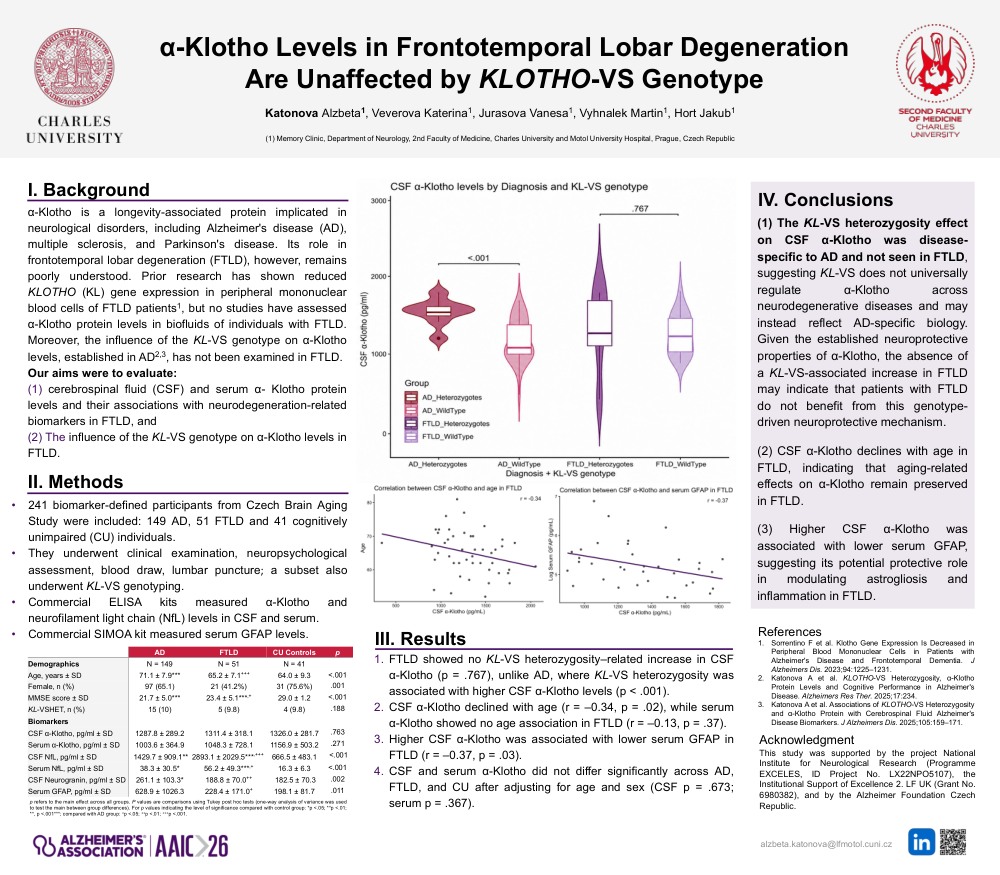
α-Klotho Levels in Frontotemporal Lobar Degeneration Are Unaffected by KLOTHO-VS Genotype
Background
α-Klotho is a longevity-associated protein implicated in neurological disorders, including Alzheimer's disease (AD), multiple sclerosis, and Parkinson's disease. Its role in frontotemporal lobar degeneration (FTLD), however, remains poorly understood. Prior research has shown reduced KLOTHO (KL) gene expression in peripheral mononuclear blood cells of FTLD patients1, but no studies have assessed α-Klotho protein levels in biofluids of individuals with FTLD. Moreover, the influence of the KL-VS genotype on α-Klotho levels, established in AD2,3, has not been examined in FTLD.
Our aims were to evaluate:
(1) cerebrospinal fluid (CSF) and serum α- Klotho protein levels and their associations with neurodegeneration-related biomarkers in FTLD, and
(2) The influence of the KL-VS genotype on α-Klotho levels in FTLD.
Methods
Results
Conclusions
(1) The KL-VS heterozygosity effect on CSF α-Klotho was disease-specific to AD and not seen in FTLD, suggesting KL-VS does not universally regulate α-Klotho across neurodegenerative diseases and may instead reflect AD-specific biology. Given the established neuroprotective properties of α-Klotho, the absence of a KL-VS-associated increase in FTLD may indicate that patients with FTLD do not benefit from this genotype-driven neuroprotective mechanism.
(2) CSF α-Klotho declines with age in FTLD, indicating that aging-related effects on α-Klotho remain preserved in FTLD.
(3) Higher CSF α-Klotho was associated with lower serum GFAP, suggesting its potential protective role in modulating astrogliosis and inflammation in FTLD.
References
Acknowledgment
This study was supported by the project National Institute for Neurological Research (Programme EXCELES, ID Project No. LX22NPO5107), the Institutional Support of Excellence 2. LF UK (Grant No. 6980382), and by the Alzheimer Foundation Czech Republic.
Comments
Email is required but is not shown publicly.
Loading comments...