4,068 posters, 219 videos, 101 topics, 69 sessions, 14,365 authors, 6,128 institutions
ePostersLive by SciGen Technologies S.A. All rights reserved.
Alzheimer's Association International Conference 2026
July 12-15, 2026 | London, United Kingdom, and Online

5178
Remote Speech-Based Digital Cognitive Markers Capture Longitudinal Change Beyond Standard Clinical Measures
Poster Presenter
Authors
Zampeta-Sofia ALEXOPOULOU, Louisa Schwed, Johannes Tröger, Nicklas Linz, Qingyue Li, Stefanie Köhler, Josef Priller, Annika Spottke, Bjoern Falkenburger, Gabor C. Petzold, Jens Wiltfang, Inga Zerr, Frank Jessen, Anja Schneider, Emrah Düzel, Michael Wagner, Christoph Laske, Stefan J. Teipel, Valeria Manera, Alexandra König
Affiliations
German Center for Neurodegenerative Diseases (DZNE), Rostock, Germany, CoBTek (Cognition-Behaviour-Technology) lab, Université Côte d'Azur, Nice, France, ki:elements GmbH, Saarbrücken, Germany, Department of Psychosomatic Medicine, Rostock University Medical Center, Rostock, Germany, German Center for Neurodegenerative Diseases (DZNE), Berlin, Germany/Department of Psychiatry and Psychotherapy, Charité, Berlin, Germany, German Center for Neurodegenerative Diseases (DZNE), Bonn, Germany/Clinic for Parkinson's, Sleep and Movement Disorders, Centre for Neurology, University of Bonn, Bonn, Germany, German Center for Neurodegenerative Diseases (DZNE), Bonn, Germany/Clinic for Vascular Neurology, Centre for Neurology, University Hospital Bonn, Bonn, Germany, German Center for Neurodegenerative Diseases (DZNE), Bonn, Germany/Department for Cognitive Disorders and Old Age Psychiatry, University Hospital Bonn, Bonn, Germany, Department of Psychosomatic Medicine, Rostock University Medical Center, Rostock, Germany/German Center for Neurodegenerative Diseases (DZNE), Rostock, Germany, CoBTek (Cognition-Behaviour-Technology) lab, Université Côte d'Azur, Nice, France/CreApolis JLNoisiez Fondation, Biot-Sophia Antipolis, France, ki:elements GmbH, Saarbrücken, Germany/Centre Hospitalier et Universitaire, Clinique Gériatrique du Cerveau et du Mouvement, Centre Mémoire de Ressources et de Recherche, Nice, France, German Center for Neurodegenerative Diseases (DZNE), Dresden, Germany/Department of Neurology, University Hospital Carl Gustav Carus, Technische Universität Dresden, Dresden, Germany, German Center for Neurodegenerative Diseases (DZNE), Goettingen, Germany/Department of Psychiatry and Psychotherapy, University Medical Center Goettingen, University of Goettingen, Goettingen, Germany, German Center for Neurodegenerative Diseases (DZNE), Goettingen, Germany/Department of Neurology, University Medical Center, Georg August University, Goettingen, Germany, German Center for Neurodegenerative Diseases (DZNE), Bonn, Germany/Department of Psychiatry and Psychotherapy, Medical Faculty, University of Cologne, Cologne, Germany, German Center for Neurodegenerative Diseases (DZNE), Magdeburg, Germany/Institute of Cognitive Neurology and Dementia Research, Otto-von- Guericke University, Magdeburg, Germany, German Center for Neurodegenerative Diseases (DZNE), Tübingen, Germany/Section for Dementia Research, Department of Psychiatry and Psychotherapy, University of Tübingen, Hertie Institute for Clinical Brain Research, Tübingen, Germany
Part of Topic
Introduction
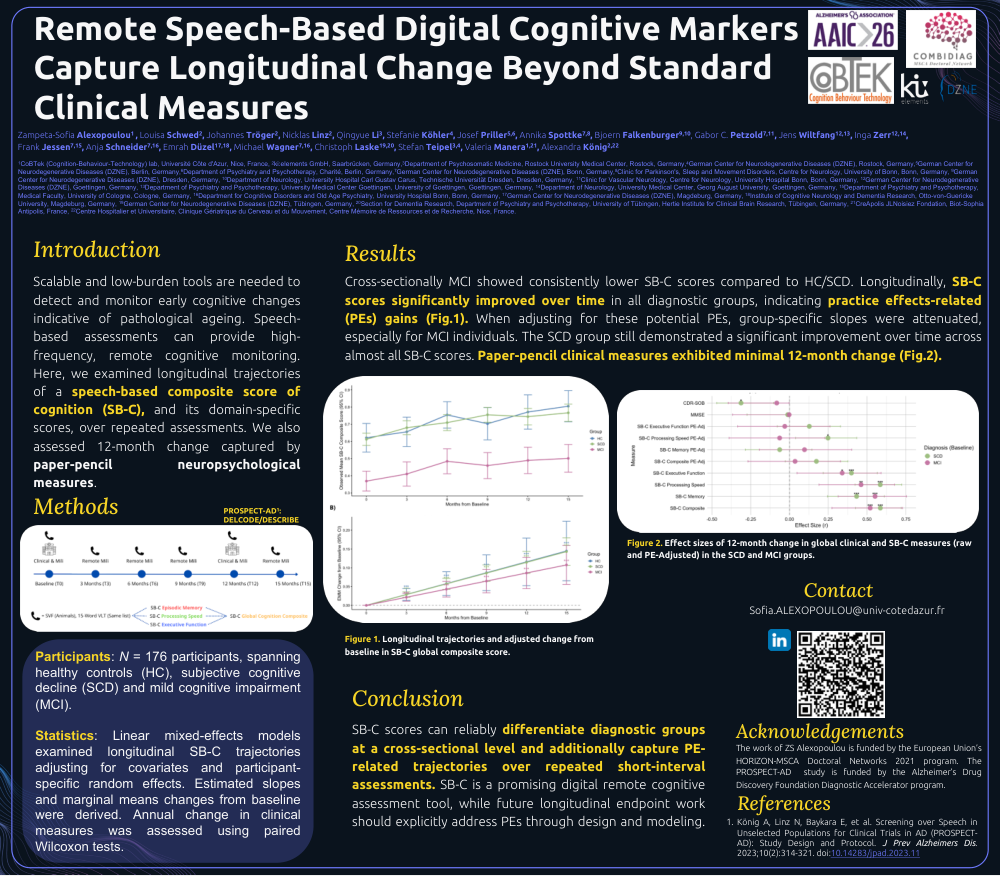
Scalable and low-burden tools are needed to detect and monitor early cognitive changes indicative of pathological ageing. Speech- based assessments can provide high-frequency, remote cognitive monitoring. Here, we examined longitudinal trajectories of a speech-based composite score of cognition (SB-C), and its domain-specific scores, over repeated assessments. We also assessed 12-month change captured by paper-pencil neuropsychological measures.
Methods
Participants: N = 176 participants, spanning healthy controls (HC), subjective cognitive decline (SCD) and mild cognitive impairment (MCI).
Statistics: Linear mixed-effects models examined longitudinal SB-C trajectories adjusting for covariates and participant- specific random effects. Estimated slopes and marginal means changes from baseline were derived. Annual change in clinical measures was assessed using paired Wilcoxon tests.
Results
Cross-sectionally MCI showed consistently lower SB-C scores compared to HC/SCD. Longitudinally, SB-C scores significantly improved over time in all diagnostic groups, indicating practice effects-related (PEs) gains (Fig.1). When adjusting for these potential PEs, group-specific slopes were attenuated, especially for MCI individuals. The SCD group still demonstrated a significant improvement over time across almost all SB-C scores. Paper-pencil clinical measures exhibited minimal 12-month change (Fig.2).
Conclusions
SB-C scores can reliably differentiate diagnostic groups at a cross-sectional level and additionally capture PE- related trajectories over repeated short-interval assessments. SB-C is a promising digital remote cognitive assessment tool, while future longitudinal endpoint work should explicitly address PEs through design and modeling.
Contact
Sofia.ALEXOPOULOU@univ-cotedazur.fr
Acknowledgements
The work of ZS Alexopoulou is funded by the European Union’s HORIZON-MSCA Doctoral Networks 2021 program. The PROSPECT-AD study is funded by the Alzheimer’s Drug Discovery Foundation Diagnostic Accelerator program.
References
1. König A, Linz N, Baykara E, et al. Screening over Speech in Unselected Populations for Clinical Trials in AD (PROSPECT- AD): Study Design and Protocol. J Prev Alzheimers Dis. 2023;10(2):314-321. doi:10.14283/jpad.2023.11
Comments
Email is required but is not shown publicly.
Loading comments...