4,068 posters, 219 videos, 101 topics, 69 sessions, 14,365 authors, 6,128 institutions
ePostersLive by SciGen Technologies S.A. All rights reserved.
Alzheimer's Association International Conference 2026
July 12-15, 2026 | London, United Kingdom, and Online

3825
Utilizing Machine Learning And Wearable Devices For Stress Detection In Remote Community-based Alzheimer’s Disease Dyads
Poster Presenter
Authors
Md Saif Hassan Onim, Nancy Wolff, Brian Carter, Elizabeth Rhodus, Himanshu Thapliyal
Affiliations
University of Kentucky, Lexington, KY, USA, University of Tennessee, Knoxville, TN, USA, Behavioral Science, University of Kentucky, Lexington, KY, USA, Southern Methodist University, Dallas, TX, USA
Part of Topic
Background:
Stress significantly affects older adults’ health, behavior, and quality of life. In Alzheimer’sdisease, stress can contribute to and trigger behavioral and psychological symptoms of dementia (BPSD),which often increase caregiver burden and lead to unplanned clinical escalation. However, self-reportedstress is vulnerable to bias and cognitive impairment, making accurate classification difficult. Caregiver-informed annotations can strengthen labeling and add context around BPSD-related events, whilewearable, sensor-based monitoring offers a non-obtrusive way to support remote care. This study uses machine learning with Empatica E4 wearable data to detect stress in community-dwelling adults withAlzheimer’s disease and their primary caregivers (dyads).
Methods:
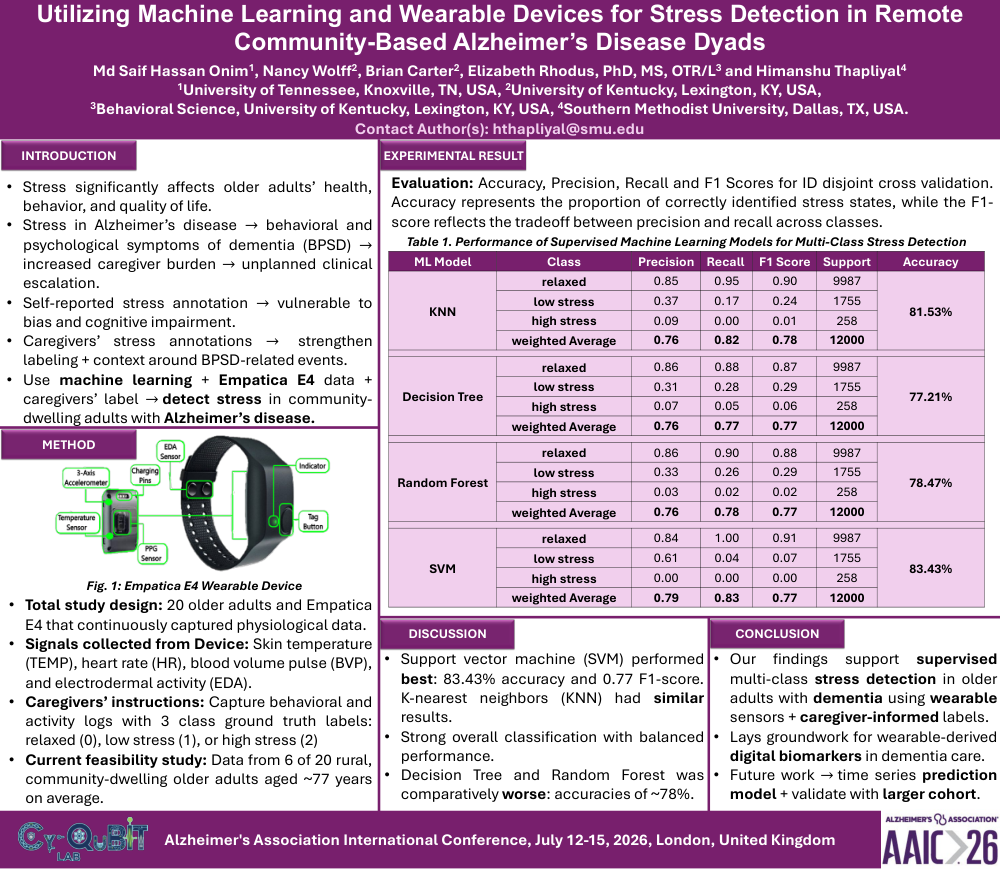
This preliminary feasibility analysis used data from six rural, community-dwelling older adultswith clinically confirmed dementia (mean age ≈ 77), each with complete caregiver annotations. Participantswore an Empatica E4 to collect skin temperature (TEMP), heart rate (HR), blood volume pulse (BVP), andelectrodermal activity (EDA), while caregivers provided time-aligned labels as relaxed (0), low stress (1), orhigh stress (2), serving as ground truth. Twelve time and frequency-domain features were extracted permodality, and support vector machines (SVM), decision trees (DT), random forests (RF), and k-nearest neighbors (KNN) models were evaluated using accuracy, precision, recall, and F1-score.
Results:
Among the models evaluated, the support vector machine (SVM) performed best, achieving83.43% accuracy and an F1-score of 0.77, suggesting strong overall classification with balancedperformance across caregiver-labeled stress levels. Accuracy represents the proportion of correctlyidentified stress states, while the F1-score reflects the tradeoff between precision and recall across classes.K-nearest neighbors (KNN) showed similar results (81.53% accuracy, F1 = 0.78). Decision trees and randomforests achieved accuracies of 77.21% and 78.47%, respectively, with F1-scores of 0.77. Table 1 summarizes performance across all models.
Conclusion:
These findings support supervised multi-class stress detection in older adults with dementiausing wearable sensors and caregiver-informed labels, with relevance to understanding and anticipatingBPSD-related events. This work also lays the groundwork for wearable-derived digital biomarkers in remote, community-based dementia care.
Comments
Email is required but is not shown publicly.
Loading comments...