4,068 posters, 219 videos, 101 topics, 69 sessions, 14,365 authors, 6,128 institutions
ePostersLive by SciGen Technologies S.A. All rights reserved.
Alzheimer's Association International Conference 2026
July 12-15, 2026 | London, United Kingdom, and Online

9145
Mitochondrial Function In Cognitively Unimpaired Older Adults: Associations With Sex, Depression, Cytokines, And Aί
Poster Presenter
Authors
Chelsea Reichert Plaska, Brandi Quintanilla, Sang Han Lee, Ashutosh Tripathi, Bruno Imbimbo, Henrik Zetterberg, Anilkumar Pillai, Nunzio Pomara
Affiliations
Chiesi Farmaceutici, Nathan Kline Institute. NYU Grossman School of Medicine, The University of Texas Health Science Center at Houston (UTHealth), Nathan Kline Institute, UCL Institute of Neurology. UK Dementia Research Institute at UCL. Hong Kong Center for Neurodegenerative Diseases. Wisconsin Alzheimer’s Disease Research Center, University of Wisconsin School of Medicine and Public Health, University of Wisconsin-Madison, Madison, The University of Texas Health Science Center at Houston (UTHealth). Charlie Norwood VA Medical Center
Part of Topic
Title: Mitochondrial Function in Cognitively Unimpaired Older Adults: Associations with Sex, Depression, Cytokines, and Aβ
Authors: Chelsea Reichert Plaska, Brandi Quintanilla, Sang Han Lee, Ashutosh Tripathi, Bruno P. Imbimbo, Henrik Zetterberg, Anilkumar Pillai, Nunzio Pomara
Keywords: Mitochondria, Amyloid-β, Plasma Biomarkers, Depression, Alzheimer’s disease
Introduction
- Late-life major depressive disorder (MDD) is a leading cause of disability, contributes to accelerated cognitive decline in older adults and is a risk factor for Alzheimer’s disease (AD).
- Mitochondrial dysfunction is increasingly recognized as key contributor to the pathophysiology of late-life depression and AD.
- Mitochondria regulate energy production, stress responses, and apoptosis in neurons and glia, while their dysfunction can trigger pro-inflammatory signaling, cellular senescence, and interfere with amyloid-beta -beta (Aβ) clearance.
- Circulating mitochondrial DNA (mtDNA), as cell-free fragments (ccf-mtDNA) or encapsulated within extracellular vesicles (EV-mtDNA), has emerged as a non-invasive biomarker of mitochondrial stress.
- However, the relationship between plasma mtDNA, depression status, biomarkers of cerebral amyloidosis, APOE genotype and sex remain largely unexplored.
- We investigated whether depression, sex and APOE genotype influence plasma mtDNA levels and their longitudinal associations with the plasma Aβ42/Aβ40 ratio, a marker of cerebral amyloidosis.
Methods
- This study included a longitudinal cohort of cognitively unimpaired older adults with and without MDD (N = 112; see demographics table below).
- All participants underwent annual clinical evaluation for three years (N=80 completed all visits).
- Baseline ccf-mtDNA and EV-mtDNA levels were determined using quantitative polymerase chain reaction.
- Plasma AD biomarkers and cytokines were determined as previously described.
- A multi-factor ANOVA examined whether age, sex, APOE status, and mtDNA level (baseline relative quantity [RQ]) were associated with plasma Aβ42/40 at year 3, and whether the mtDNA biomarker–outcome association differed by sex.
- Pearson’s correlations with cytokines were run.
Results
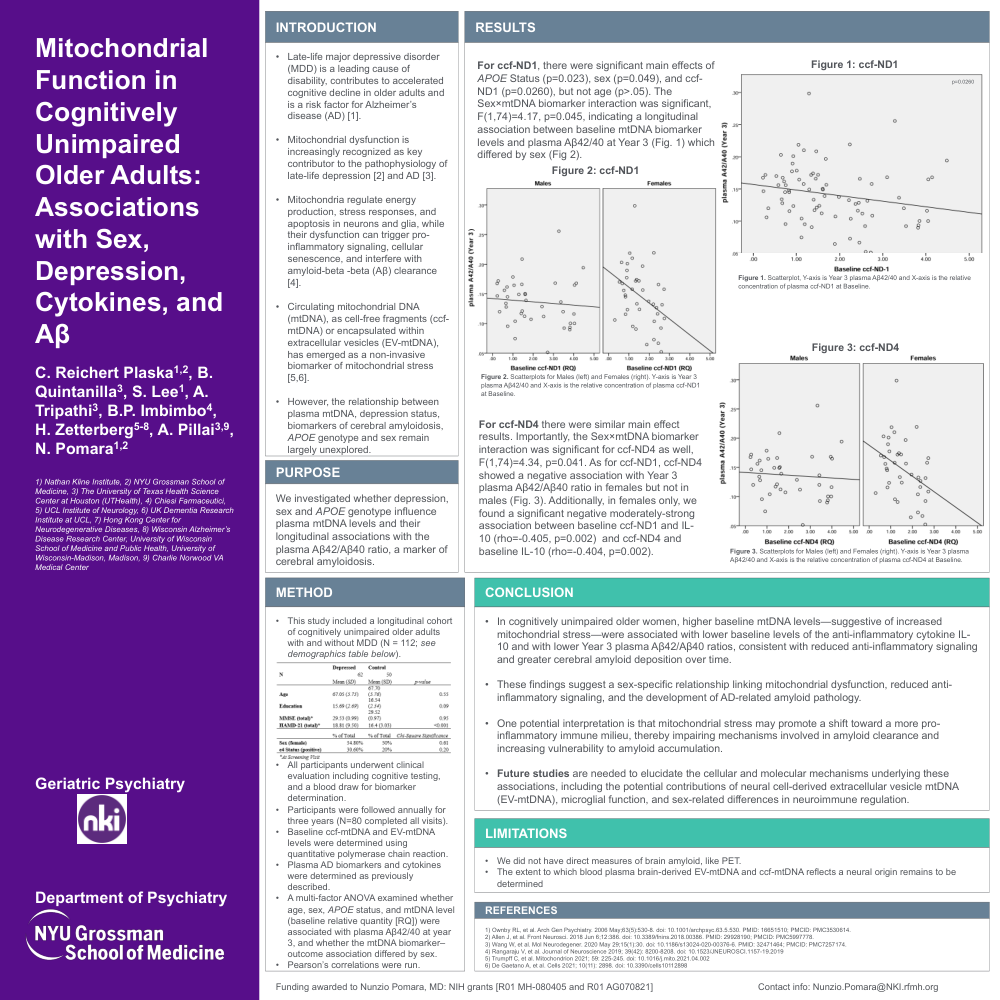
For ccf-ND1, there were significant main effects of APOE Status (p=0.023), sex (p=0.049), and ccf-ND1 (p=0.0260), but not age (p>.05). The Sex×mtDNA biomarker interaction was significant, F(1,74)=4.17, p=0.045, indicating a longitudinal association between baseline mtDNA biomarker levels and plasma Aβ42/40 at Year 3 (Fig. 1) which differed by sex (Fig 2). For ccf-ND4 there were similar main effect results. Importantly, the Sex×mtDNA biomarker interaction was significant for ccf-ND4 as well, F(1,74)=4.34, p=0.041. As for ccf-ND1, ccf-ND4 showed a negative association with Year 3 plasma Aβ42/Aβ40 ratio in females but not in males (Fig. 3). Additionally, in females only, we found a significant negative moderately-strong association between baseline ccf-ND1 and IL-10 (rho=-0.405, p=0.002) and ccf-ND4 and baseline IL-10 (rho=-0.404, p=0.002).
Conclusions
- In cognitively unimpaired older women, higher baseline mtDNA levels—suggestive of increased mitochondrial stress—were associated with lower baseline levels of the anti-inflammatory cytokine IL-10 and with lower Year 3 plasma Aβ42/Aβ40 ratios, consistent with reduced anti-inflammatory signaling and greater cerebral amyloid deposition over time.
- These findings suggest a sex-specific relationship linking mitochondrial dysfunction, reduced anti-inflammatory signaling, and the development of AD-related amyloid pathology.
- One potential interpretation is that mitochondrial stress may promote a shift toward a more pro-inflammatory immune milieu, thereby impairing mechanisms involved in amyloid clearance and increasing vulnerability to amyloid accumulation.
- Future studies are needed to elucidate the cellular and molecular mechanisms underlying these associations, including the potential contributions of neural cell-derived extracellular vesicle mtDNA (EV-mtDNA), microglial function, and sex-related differences in neuroimmune regulation.
Limitations
- We did not have direct measures of brain amyloid, like PET.
- The extent to which blood plasma brain-derived EV-mtDNA and ccf-mtDNA reflects a neural origin remains to be determined
1) Ownby RL, et al. Arch Gen Psychiatry. 2006 May;63(5):530-8. doi: 10.1001/archpsyc.63.5.530. PMID: 16651510; PMCID: PMC3530614.
2) Allen J, et al. Front Neurosci. 2018 Jun 6;12:386. doi: 10.3389/fnins.2018.00386. PMID: 29928190; PMCID: PMC5997778.
3) Wang W, et al. Mol Neurodegener. 2020 May 29;15(1):30. doi: 10.1186/s13024-020-00376-6. PMID: 32471464; PMCID: PMC7257174.
4) Rangaraju V, et al. Journal of Neuroscience 2019; 39(42): 8200-8208. doi: 10.1523/JNEUROSCI.1157-19.2019
5) Trumpff C, et al. Mitochondrion 2021; 59: 225-245. doi: 10.1016/j.mito.2021.04.002
6) De Gaetano A, et al. Cells 2021; 10(11): 2898. doi: 10.3390/cells10112898
Comments
Email is required but is not shown publicly.
Loading comments...