4,068 posters, 219 videos, 101 topics, 69 sessions, 14,365 authors, 6,128 institutions
ePostersLive by SciGen Technologies S.A. All rights reserved.
Alzheimer's Association International Conference 2026
July 12-15, 2026 | London, United Kingdom, and Online

3185
Advances In The Development Of Scalable Platforms For Returning Alzheimer's Test Results: Design And Rationale Of ESMARTER
Poster Presenter
Authors
Jessica Langbaum, Claire Erickson, Carolyn Langlois, Elisabeth Wood, Brian Egleston, Kristin Harkins, Emily Largent, Eric Reiman, Marisa Denkinger, Nicholas Ashton, J. Scott Roberts, Jason Karlawish, Angela Bradbury
Affiliations
University of Michigan, University of Pennsylvania, Banner Alzheimer's Institute, Banner Sun Health Research Institute, Fox Chase Cancer Center
Part of Topic
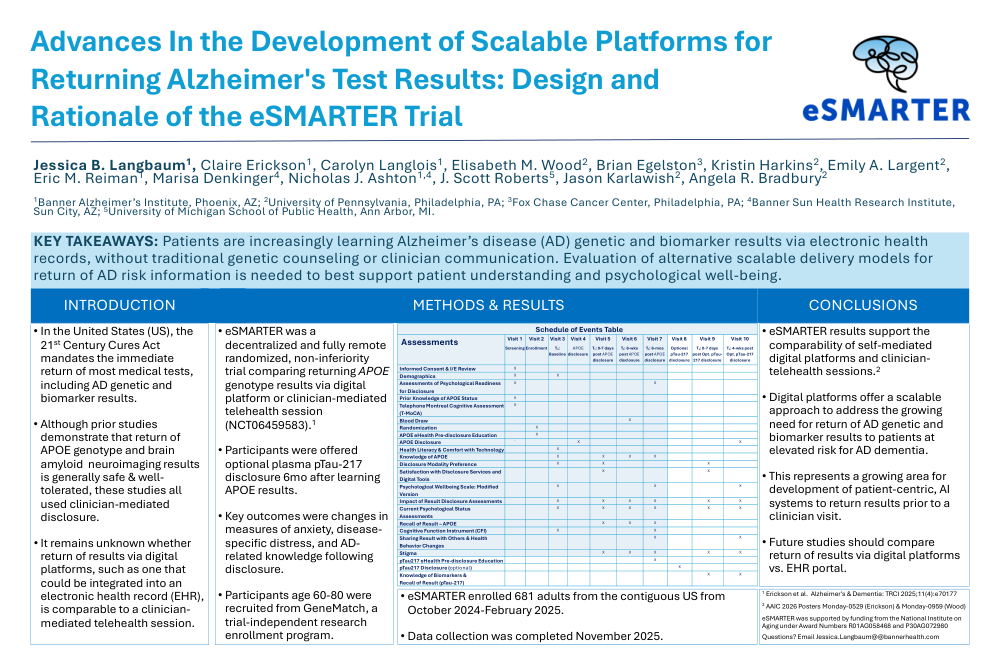
Key Takeaways: Patients are increasingly learning Alzheimer’s disease (AD) genetic and biomarker results via electronic health records, without traditional genetic counseling or clinician communication. Evaluation of alternative scalable delivery models for return of AD risk information is needed to best support patient understanding and psychological well-being.
Introduction:
- In the United States (US), the 21st Century Cures Act mandates the immediate return of most medical tests, including AD genetic and biomarker results.
- Although prior studies demonstrate that return of APOE genotype and brain amyloid neuroimaging results is generally safe & well-tolerated, these studies all used clinician-mediated disclosure.
- It remains unknown whether return of results via digital platforms, such as one that could be integrated into an electronic health record (EHR), is comparable to a clinician-mediated telehealth session.
Methods:
- eSMARTER was a decentralized and fully remote randomized, non-inferiority trial comparing returning APOE genotype results via digital platform or clinician-mediated telehealth session (NCT06459583).
- Participants were offered optional plasma pTau-217 disclosure 6mo after learning APOE results.
- Key outcomes were changes in measures of anxiety, disease-specific distress, and AD-related knowledge following disclosure.
- Participants age 60-80 were recruited from GeneMatch, a trial-independent research enrollment program.
Conclusions:
- eSMARTER results support the comparability of self-mediated digital platforms and clinician- telehealth sessions.
- Digital platforms offer a scalable approach to address the growing need for return of AD genetic and biomarker results to patients at elevated risk for AD dementia.
- This represents a growing area for development of patient-centric, AI systems to return results prior to a clinician visit.
- Future studies should compare return of results via digital platforms vs. EHR portal.
Comments
Email is required but is not shown publicly.
Loading comments...