4,068 posters, 219 videos, 101 topics, 69 sessions, 14,365 authors, 6,128 institutions
ePostersLive by SciGen Technologies S.A. All rights reserved.
Alzheimer's Association International Conference 2026
July 12-15, 2026 | London, United Kingdom, and Online

4866
Clinical Utility Of Plasma P-tau217 As An Early Diagnostic Tool In A Cohort Of Patients With Cognitive Complaints In Primary Care
Poster Presenter
Authors
Miquel Massons, Andrés Girona, Axel Rigol, Sira Casablancas, Neus Falgàs, Sergi Borrego-Ecija, Nuria Guillén, Diana Esteller-Gauxax, Isabel Martín, Paula Canasto-Jiménez, Laura Molina-Porcel, Santiago Fernández, Celia Painous, José María Cabrera-Maqueda, Teresa Alba, Victor Guerra, Inés Bartolomé, Adrià Tort Merino, Agnès Pérez-Millan, Guadalupe Fernàndez-Villullas, Anna Antonell, Roger Puey, Josep M Augè Fradera, Laia Cayuelas, Mireia Martinez, Nerea Candamil Llopis, Mariam de la Poza Abad, Mireia Simonet, Roger Vinyeta, Patricia Montenegro, Mercedes Núñez, Ángel Trueba-Sáiz, Raquel Sánchez-Valle, Mircea Balasa, Albert Lladó Plarrumaní
Affiliations
Alzheimer’s Disease and Other Cognitive Disorders Unit, Department of Neurology, Hospital Clínic de Barcelona, Fundació Clínic per a la Recerca Biomèdica (FCRB), Institut d’Investigacions Biomèdiques August Pi i Sunyer (IDIBAPS), Barcelona, Spain; University of Barcelona, Barcelona, Spain; Centro de Investigación Biomédica en Red en Enfermedades Neurodegenerativas (CIBERNED), Madrid, Spain., Alzheimer’s Disease and Other Cognitive Disorders Unit, Department of Neurology, Hospital Clínic de Barcelona, Fundació Clínic per a la Recerca Biomèdica (FCRB), Institut d’Investigacions Biomèdiques August Pi i Sunyer (IDIBAPS), Barcelona, Spain; University of Barcelona, Barcelona, Spain., Primary Health Care Center Casanova, Consorci d’Atenció Primària de Salut Barcelona Esquerra (CAPSBE), Barcelona, Spain., Alzheimer’s Disease and Other Cognitive Disorders Unit, Department of Neurology, Hospital Clínic de Barcelona, Fundació Clínic per a la Recerca Biomèdica (FCRB), Institut d’Investigacions Biomèdiques August Pi i Sunyer (IDIBAPS), Barcelona, Spain., Department of Neurology, Hospital Clínic de Barcelona, Barcelona, Spain., Parkinson's Disease and Other Movement Disorders Unit, Department of Neurology, Hospital Clínic de Barcelona, Fundació Clínic per a la Recerca Biomèdica (FCRB), Institut de Neurociències, IDIBAPS, CIBERNED, ERN-RND, Barcelona, Spain., Center of Neuroimmunology, Department of Neurology, Laboratory of Advanced Imaging in Neuroimmunological Diseases, Hospital Clínic de Barcelona, Institut d'Investigacions Biomèdiques August Pi i Sunyer (IDIBAPS), University of Barcelona, Barcelona, Spain., Functional Unit of Cerebrovascular Disease, Comprehensive Stroke Center, Department of Neurology, Hospital Clínic de Barcelona, Barcelona, Spain., Alzheimer's Disease and Other Cognitive Disorders Unit, Department of Neurology, Hospital Clínic de Barcelona, Fundació Clínic per a la Recerca Biomèdica (FCRB), Institut d'Investigacions Biomèdiques August Pi i Sunyer (IDIBAPS), Barcelona, Spain; University of Barcelona, Barcelona, Spain; Centro de Investigación Biomédica en Red en Enfermedades Neurodegenerativas (CIBERNED), Madrid, Spain., Alzheimer's Disease and Other Cognitive Disorders Unit, Department of Neurology, Hospital Clínic de Barcelona, Fundació Clínic per a la Recerca Biomèdica (FCRB), Institut d'Investigacions Biomèdiques August Pi i Sunyer (IDIBAPS), Barcelona, Spain; University of Barcelona, Barcelona, Spain; Centro de Investigación Biomédica en Red en Enfermedades Neurodegenerativas (CIBERNED), Madrid, Spain; eHealth Center, Faculty of Computer Science, Multimedia and Telecommunications, Universitat Oberta de Catalunya, Barcelona, Spain., Alzheimer's Disease and Other Cognitive Disorders Unit, Department of Neurology, Hospital Clínic de Barcelona, Fundació Clínic per a la Recerca Biomèdica (FCRB), Institut d'Investigacions Biomèdiques August Pi i Sunyer (IDIBAPS), Barcelona, Spain; University of Barcelona, Barcelona, Spain., Alzheimer's Disease and Other Cognitive Disorders Unit, Department of Neurology, Hospital Clínic de Barcelona, Fundació Clínic per a la Recerca Biomèdica (FCRB), Institut d'Investigacions Biomèdiques August Pi i Sunyer (IDIBAPS), Barcelona, Spain., Primary Health Care Center Casanova, Consorci d'Atenció Primària de Salut Barcelona Esquerra (CAPSBE), Barcelona, Spain., Primary Health Care Center Adrià, Barcelona, Spain; Department of Emergency Medicine, CHU de Québec – Université Laval, Québec City, QC, Canada., Primary Health Care Center Adrià, Barcelona, Spain., Primary Health Care Center Doctor Carles Ribas, Barcelona, Spain., Primary Health Care Center Sarrià, EAP Sarrià SLP – Vallplasa, Barcelona, Spain., Department of Medical Affairs, Eli Lilly and Company, Madrid, Spain., Alzheimer's Disease and Other Cognitive Disorders Unit, Department of Neurology, Hospital Clínic de Barcelona, Fundació Clínic per a la Recerca Biomèdica (FCRB), Institut d'Investigacions Biomèdiques August Pi i Sunyer (IDIBAPS), Barcelona, Spain; University of Barcelona, Barcelona, Spain; Centro de Investigación Biomédica en Red en Enfermedades Neurodegenerativas (CIBERNED), Madrid, Spain
Part of Topic
Clinical utility of plasma p-Tau217 as an early diagnostic tool in a cohort of patients with cognitive complaints in primary care
Miquel Massons, Andrés Girona, Axel Rigol, Sira Casablancas, Neus Falgàs, Sergi Borrego-Ecija, Nuria Guillén, Diana Esteller-Gauxax, Isabel Martín, Paula Canasto-Jiménez, Laura Molina-Porcel, Santiago Fernández, Celia Painous, José María Cabrera-Maqueda, Teresa Alba, Victor Guerra, Inés Bartolomé, Adrià Tort Merino, Agnès Pérez-Millan, Guadalupe Fernàndez-Villullas, Anna Antonell, Roger Puey, Josep M Augè Fradera, Laia Cayuelas, Mireia Martinez, Nerea Candamil Llopis, Mariam de la Poza Abad, Mireia Simonet, Roger Vinyeta, Patricia Montenegro, Mercedes Núñez, Ángel Trueba-Sáiz, Raquel Sánchez-Valle Diaz, Mircea Balasa, Albert Lladó Plarrumaní.
BACKGROUND
Alzheimer's disease (AD) is the leading cause of dementia. Early and accurate diagnosis has become increasingly relevant with the advent of disease-modifying therapies. Plasma biomarkers, particularly phosphorylated tau 217 (p-Tau217), show high diagnostic accuracy for AD [1] and may support early triage, referral decisions and diagnostic orientation in primary care (PC) settings [2]. A blood-based test that can be implemented close to the patient could help prioritise specialist referrals and reduce reliance on lumbar puncture and amyloid-PET imaging. However, evidence on how plasma p-Tau217 affects the diagnostic performance and confidence of clinicians in real-world primary care remains limited.
METHODS
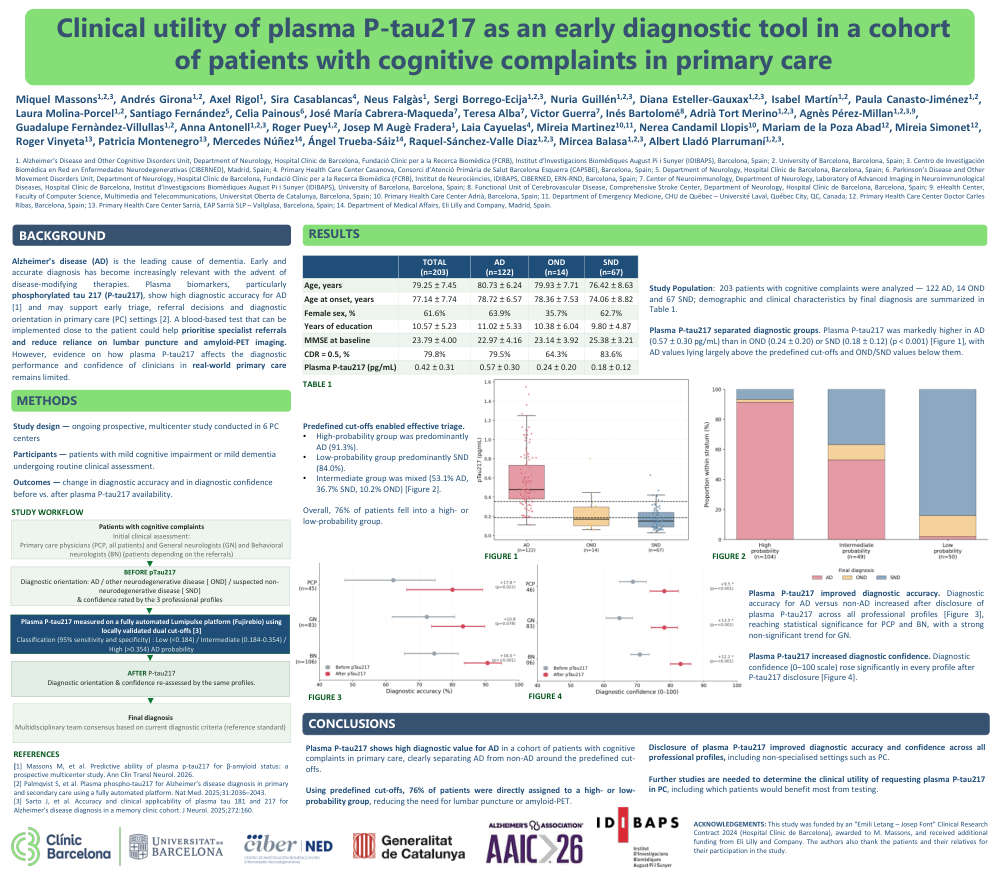
Study design — ongoing prospective, multicenter study conducted in 6 PC centers. Participants — patients with mild cognitive impairment or mild dementia undergoing routine clinical assessment. Outcomes — change in diagnostic accuracy and in diagnostic confidence before vs. after plasma p-Tau217 availability.
Study workflow: Patients with cognitive complaints underwent an initial clinical assessment by primary care physicians (PCP, all patients) and general neurologists (GN) and behavioral neurologists (BN), depending on the referrals. BEFORE p-Tau217, each profile gave a diagnostic orientation (AD / other neurodegenerative disease [OND] / suspected non-neurodegenerative disease [SND]) and rated their diagnostic confidence. Plasma p-Tau217 was measured on a fully automated Lumipulse platform (Fujirebio) using locally validated dual cut-offs [3], classifying patients (95% sensitivity and specificity) into Low (<0.184), Intermediate (0.184–0.354) or High (>0.354) AD probability. AFTER p-Tau217, diagnostic orientation and confidence were re-assessed by the same profiles. The final diagnosis was established by multidisciplinary team consensus based on current diagnostic criteria (reference standard).
RESULTS
Study population: 203 patients with cognitive complaints were analyzed — 122 AD, 14 OND and 67 SND; demographic and clinical characteristics by final diagnosis are summarized in Table 1.
Plasma p-Tau217 separated diagnostic groups. Plasma p-Tau217 was markedly higher in AD (0.57 ± 0.30 pg/mL) than in OND (0.24 ± 0.20) or SND (0.18 ± 0.12) (p < 0.001) [Figure 1], with AD values lying largely above the predefined cut-offs and OND/SND values below them.
Predefined cut-offs enabled effective triage. The high-probability group was predominantly AD (91.3%), the low-probability group predominantly SND (84.0%), and the intermediate group was mixed (53.1% AD, 36.7% SND, 10.2% OND) [Figure 2]. Overall, 76% of patients fell into a high- or low-probability group.
Plasma p-Tau217 improved diagnostic accuracy. Diagnostic accuracy for AD versus non-AD increased after disclosure of plasma p-Tau217 across all professional profiles [Figure 3], reaching statistical significance for PCP and BN, with a strong non-significant trend for GN.
Plasma p-Tau217 increased diagnostic confidence. Diagnostic confidence (0–100 scale) rose significantly in every profile after p-Tau217 disclosure [Figure 4].
CONCLUSIONS
Plasma p-Tau217 shows high diagnostic value for AD in a cohort of patients with cognitive complaints in primary care, clearly separating AD from non-AD around the predefined cut-offs. Using predefined cut-offs, 76% of patients were directly assigned to a high- or low-probability group, reducing the need for lumbar puncture or amyloid-PET. Disclosure of plasma p-Tau217 improved diagnostic accuracy and confidence across all professional profiles — including non-specialised settings such as PC. Further studies are needed to determine the clinical utility of requesting plasma p-Tau217 in PC, including which patients would benefit most from testing.
ACKNOWLEDGEMENTS
This study was funded by an "Emili Letang – Josep Font" Clinical Research Contract 2024 (Hospital Clínic de Barcelona), awarded to M. Massons, and received additional funding from Eli Lilly and Company. The authors also thank the patients and their relatives for their participation in the study.
REFERENCES
[1] Massons M, et al. Predictive ability of plasma p-tau217 for β-amyloid status: a prospective multicenter study. Ann Clin Transl Neurol. 2026.
[2] Palmqvist S, et al. Plasma phospho-tau217 for Alzheimer's disease diagnosis in primary and secondary care using a fully automated platform. Nat Med. 2025;31:2036–2043.
[3] Sarto J, et al. Accuracy and clinical applicability of plasma tau 181 and 217 for Alzheimer's disease diagnosis in a memory clinic cohort. J Neurol. 2025;272:160.
Comments
Email is required but is not shown publicly.
Loading comments...