4,068 posters, 219 videos, 101 topics, 69 sessions, 14,365 authors, 6,128 institutions
ePostersLive by SciGen Technologies S.A. All rights reserved.
Alzheimer's Association International Conference 2026
July 12-15, 2026 | London, United Kingdom, and Online

7186
Exploring Qualitative Feedback From Older Participants Who Completed At-home Blood Draws For Alzheimer’S Disease Plasma Biomarkers
Poster Presenter
Authors
Miriam Ashford, Alejandra Morlett-Paredes, Erika Erika Cavallone, Yodit Goshu, Chengshi Jin, Anna Aaronson, Juliet Fockler, Kristen George, R. Scott Mackin, Elizabeth Rose Mayeda, Rachel Nosheny
Affiliations
University of California, Los Angeles, University of California, Davis, University of California, San Francisco, Boston University, University of California, San Diego
Part of Topic
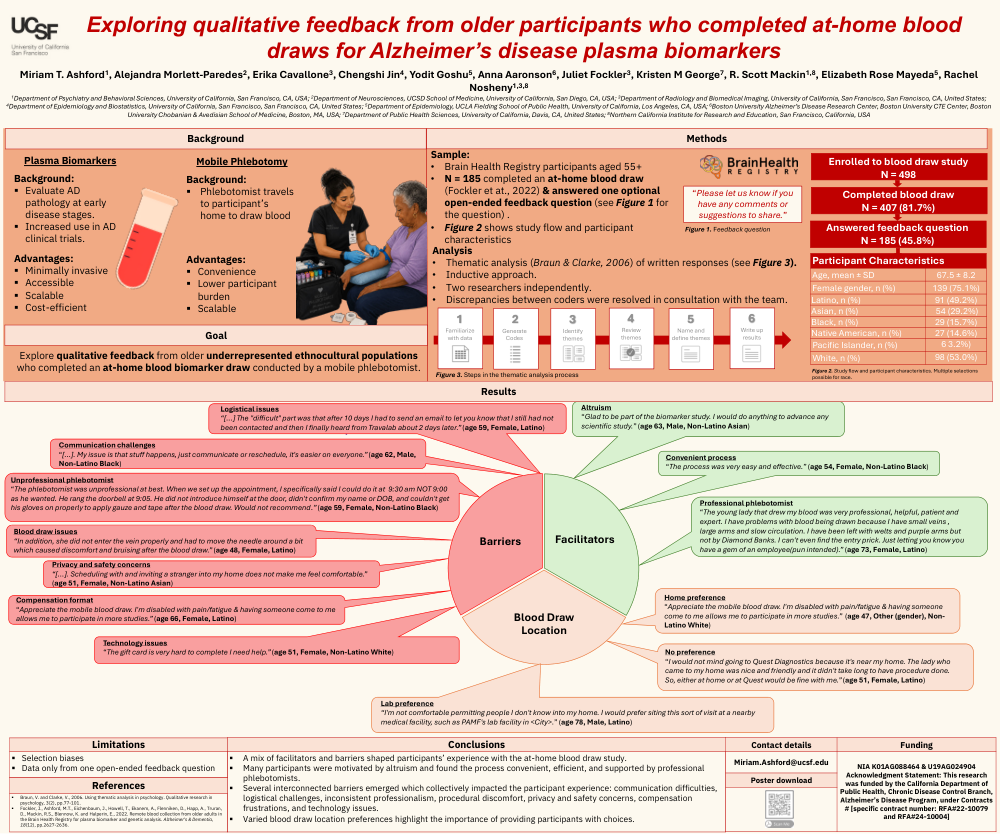
Background: Plasma biomarkers show great promise for identifying those with or at risk for Alzheimer’s disease. A persistent challenge is optimizing accessibility to plasma biomarker testing, especially in underrepresented ethnoracial populations (URP). The aim of this study was to explore qualitative feedback from older URPs who completed an at-home blood biomarker draw conducted by a mobile phlebotomist.
Methods: Enrolled Brain Health Registry participants aged 55+ and URP backgrounds were invited to a sub-study involving an at-home blood draw. Participants who completed the at-home blood draw were given the option to respond to an open-ended feedback question: “Please let us know if you have any comments or suggestions to share.” Written responses were analyzed using thematic analysis. An inductive approach was employed, whereby two researchers independently reviewed all responses to generate meaningful codes and apply them to the data. Discrepancies between coders were reviewed and resolved in consultation with the research team. Codes addressing similar concepts were subsequently organized into overarching themes.
Result: Among 407 participants who completed the at-home blood draw, N=186 (45.8%) provided responses to the optional open-ended question. Participants who provided feedback were on average 67.5 ± 8.2 years old and reported a mean of 15.7 ± 2.49 years of education. Seventy-five percent identified as female. Participants self-identified as Latino (49.2%), Asian (29.2%), Black (15.7%), Native American (14.6%), and Pacific Islander (3.2%).
Four overarching themes emerged: barriers, facilitators, blood draw location, and research interest. Table 1 presents themes and associated sub-themes. In terms of facilitators, many reported being motivated by altruism and characterized the process as convenient and efficient. Interconnected barriers noted by participants included communication challenges, logistical difficulties, inconsistent professionalism, procedural discomfort, privacy concerns, compensation frustrations, and technology-related issues. Preferences regarding location varied, with some valuing the convenience of home-based collection, while others preferred laboratory-based collection due to safety or comfort considerations. Finally, participants expressed sustained interest in research participation, a desire for study updates, and curiosity about their individual results.
Conclusion: These findings highlight both opportunities and challenges associated with at-home blood collection among older URPs, underscoring key considerations for optimizing participant-centered biomarker research protocols.
Comments
Email is required but is not shown publicly.
Loading comments...