4,068 posters, 219 videos, 101 topics, 69 sessions, 14,365 authors, 6,128 institutions
ePostersLive by SciGen Technologies S.A. All rights reserved.
Alzheimer's Association International Conference 2026
July 12-15, 2026 | London, United Kingdom, and Online

5244
Interrelationships Among Plasma Ptau217, Gfap, And Neurofilament Light Chain In African American Older Adults
Poster Presenter
Part of Topic
BACKGROUND
•Plasma biomarkers, such as phosphorylated tau 217 (pTau217), glial fibrillary acidic protein (GFAP), and neurofilament light chain (NfL), are increasingly used to characterize Alzheimer’s disease (AD) pathology and neurodegeneration.
•The biological and systemic factors driving variability in these biomarkers remain incompletely understood in African American older adults.
•This population is disproportionately affected by AD and by comorbid vascular and metabolic conditions.
•We examined demographic, inflammatory, renal, and lipid factors as candidate predictors of each plasma biomarker.
METHODS
•149 African American older adults were evaluated.
•Peripheral blood was collected by standard venipuncture; plasma was separated by centrifugation and stored at −80 °C until analysis.
•Plasma pTau217, GFAP, and NfL were quantified using ultrasensitive Single molecule array (Simoa) immunoassays.
•Biomarker concentrations were log₁₀-transformed to satisfy assumptions for parametric analyses.
•Candidate predictors examined included demographic variables (age and sex), inflammatory markers (ASC, caspase-1, and IL-18), renal indices (eGFR, BUN, and creatinine), and lipid profiles (total cholesterol, triglycerides, HDL, and LDL).
•Stepwise multiple regression analyses identified the independent predictors of each plasma biomarker.
RESULTS
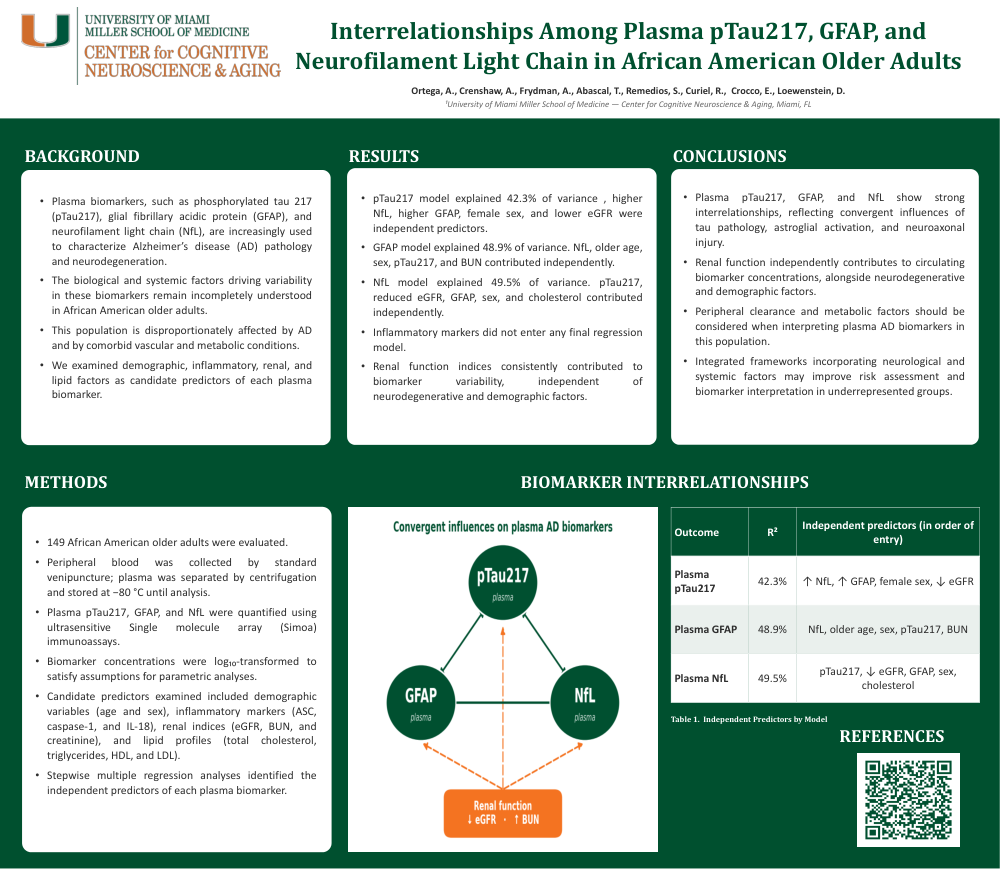
•pTau217 model explained 42.3% of variance , higher NfL, higher GFAP, female sex, and lower eGFR were independent predictors.
•GFAP model explained 48.9% of variance. NfL, older age, sex, pTau217, and BUN contributed independently.
•NfL model explained 49.5% of variance. pTau217, reduced eGFR, GFAP, sex, and cholesterol contributed independently.
•Inflammatory markers did not enter any final regression model.
•Renal function indices consistently contributed to biomarker variability, independent of neurodegenerative and demographic factors.
CONCLUSIONS
•Plasma pTau217, GFAP, and NfL show strong interrelationships, reflecting convergent influences of tau pathology, astroglial activation, and neuroaxonal injury.
•Renal function independently contributes to circulating biomarker concentrations, alongside neurodegenerative and demographic factors.
•Peripheral clearance and metabolic factors should be considered when interpreting plasma AD biomarkers in this population.
Integrated frameworks incorporating neurological and systemic factors may improve risk assessment and biomarker interpretation in underrepresented groupsComments
Email is required but is not shown publicly.
Loading comments...