4,068 posters, 219 videos, 101 topics, 69 sessions, 14,365 authors, 6,128 institutions
ePostersLive by SciGen Technologies S.A. All rights reserved.
Alzheimer's Association International Conference 2026
July 12-15, 2026 | London, United Kingdom, and Online

10276
Sex And Age Influence Inflammation In Vascular Risk Management: Secondary Analysis To Risk Reduction To Alzheimer’S Disease Clinical Trial
Poster Presenter
Authors
Affiliations
Part of Topic
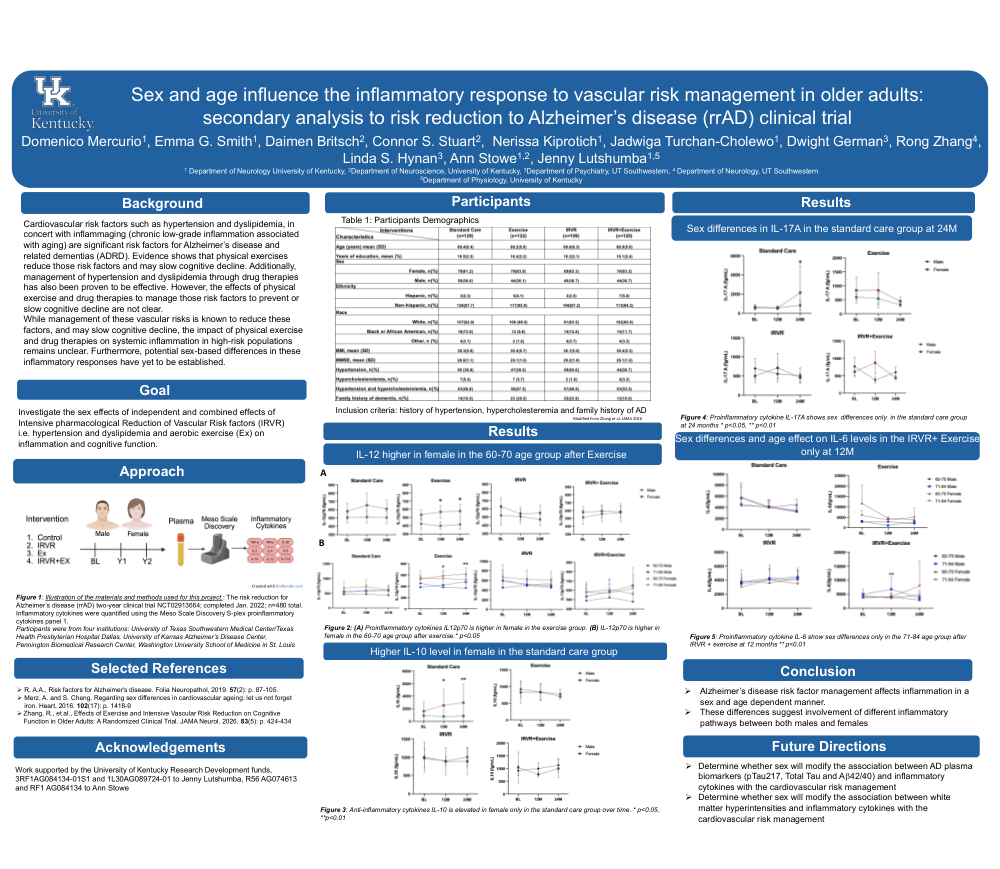
Background: Hypertension and dyslipidemia, in concert with inflammaging (chronic low-grade inflammation associated with aging) are significant risk factors for Alzheimer’s disease and related dementias. While management of these vascular risks is known to reduce these factors and may slow cognitive decline, the impact of physical exercise and drug therapies on systemic inflammation in high-risk populations remains unclear. Furthermore, potential sex-based differences in these inflammatory responses have yet to be established.
Methods: We analyzed plasma from participants of the ‘risk reduction for Alzheimer’s disease’ (rrAD) two-year multisite clinical trial (NCT 02913664; completed Jan. 2022; n=513 total participants). rrAD participants had a family history of dementia or subjective memory complaints, hypertension, and dyslipidemia. Participants were randomized to: Standard Care (SC), Aerobic Exercise (EX), Intensive reduction of vascular risk factors (IRVR), and a combination of EX and IRVR. Major Inflammatory cytokines (IFN-γ, IL-1β, IL-2, IL-4, IL-6, IL-10, IL-12, IL-17A, TNF-α) were quantified via Meso Scale Discovery (MSD) S-plex. Linear mixed model with R evaluated the sex differences at baseline (BL), 12 months (M) and 24M of intervention(s) or SC.
Results: In the EX group, IL-12 was elevated in females compared to males at 12M (p=0.0101) and 24M (p= 0.014), which was particularly pronounced in the 60-70 age group. Within the SC group, anti-inflammatory cytokine IL-10 showed a sex difference at 12M (p=0.015) and 24M (p=0.005); specifically, IL-10 increased over time in females while remaining unchanged in males. The SC also demonstrated sex differences in IL-17A at 24M (p=0.0059). In the combined (IRVR+EX) group, a sex difference in IL-6 was observed only in the 71-84 age group at 12M (p=0.0019). In these groups, males exhibited higher expression of both IL-17A and IL-6. Surprisingly, IRVR alone did not affect inflammatory cytokines over time.
Conclusion: ADRD risk factor management affects inflammation in a sex and age-dependent manner. These results highlight the importance of sex-based monitoring and tailored interventions to optimize neuroprotective strategies in aging populations.
Comments
Email is required but is not shown publicly.
Loading comments...