4,068 posters, 219 videos, 101 topics, 69 sessions, 14,365 authors, 6,128 institutions
ePostersLive by SciGen Technologies S.A. All rights reserved.
Alzheimer's Association International Conference 2026
July 12-15, 2026 | London, United Kingdom, and Online

7194
Benchmarking The Diagnostic Accuracies Of Plasma P-tau205 And P-tau212 Against P-tau217 In Alzheimer’S Disease
Poster Presenter
Authors
Part of Topic
Benchmarking the diagnostic accuracies of plasma p-tau205 and p-tau212 against p-tau217 in Alzheimer’s disease
Anuradha Sehrawat, Xuemei Zeng, Anum Saeed, Ann D. Cohen, Oscar L. Lopez, Steven E. Reis, Thomas K. Karikari
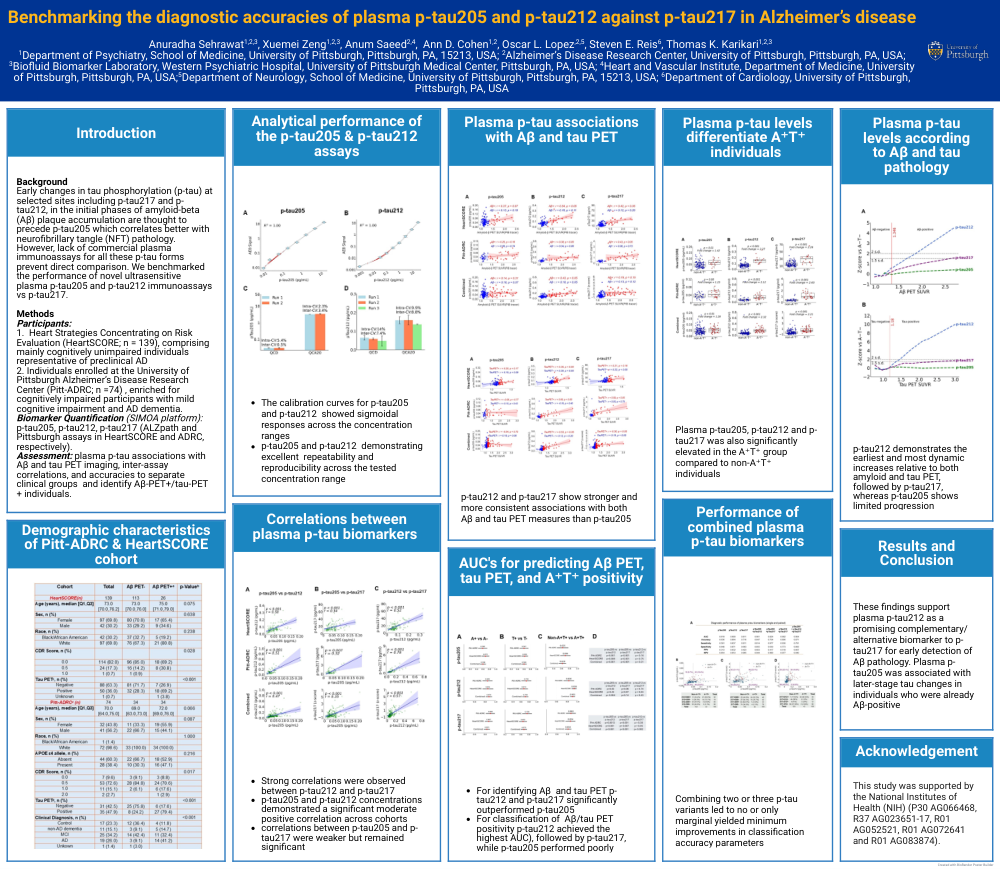
Objectives: Plasma phosphorylated tau (p-tau) assays are promising non-invasive biomarkers for Alzheimer’s disease (AD). A proposed phosphorylation cascade suggests early changes at sites including p-tau217, p-tau212, and p-tau181 in the initial phases of brain amyloid accumulation, while p-tau205 changes coincide with elevated tau neurofibrillary tangle pathology. While immunoassays for plasma p-tau181 and p-tau217 have been well characterized, evidence on plasma p-tau205 and p-tau212 remains limited. In this study, we evaluated the analytical and clinical performance of novel Quanterix Simoa assays for plasma p-tau205 and p-tau212, benchmarking against p-tau217.
Methods: In two independent cohorts - the University of Pittsburgh ADRC (n=74) and HeartSCORE (n=139) - plasma p-tau205 and p-tau212 were measured using prototype assays, and p-tau217 with the ALZpath (HeartSCORE) and Pittsburgh (ADRC) assays. We examined associations with Aβ and tau PET imaging, the ability to identify Aβ-PET+/tau-PET+ pathology, clinical group separation, and inter-assay correlations.
Results: Plasma p-tau212 and p-tau217 showed stronger correlations with Aβ and tau-PET burden and accuracies to identify Aβ-PET+/tau-PET+ individuals (r=0.38-0.60 and 0.19-0.58, P < 0.001; AUCs=0.901 and 0.810, respectively) than p-tau205 (r = 0.12 and 0.09, P > 0.05; AUC = 0.618; AUCs=0.618). P-tau212 and p-tau217 demonstrated stepwise increases across PET SUVR quartiles and exhibited high diagnostic performance for Aβ positivity (p-tau212 AUCs: 0.845 [ADRC], 0.851 [HeartSCORE]; p-tau217 AUCs: 0.898 [ADRC], 0.867 [HeartSCORE]). p-tau212 also showed strong concordance with p-tau217 (r = 0.78 [ADRC]; r = 0.52 [HeartSCORE]) and detectable signal in PET-negative individuals, suggesting sensitivity to early pathological changes. By contrast, plasma p-tau205 displayed weak associations with PET imaging metrics, failed to differentiate clinical groups, and demonstrated lower overall diagnostic accuracy.
Conclusions: These findings support plasma p-tau212 as a promising complementary/alternative biomarker to p-tau217 for early detection of Aβ pathology. In contrast, p-tau205 exhibited limited utility in plasma, likely due to its association with later-stage tau changes or reduced peripheral detectability.
Comments
Email is required but is not shown publicly.
Loading comments...