4,068 posters, 219 videos, 101 topics, 69 sessions, 14,365 authors, 6,128 institutions
ePostersLive by SciGen Technologies S.A. All rights reserved.
Alzheimer's Association International Conference 2026
July 12-15, 2026 | London, United Kingdom, and Online

10653
Alzheimer’s Disease Plasma Biomarkers In A Low-education Cohort: Insights From An Underrepresented Population
Poster Presenter
Authors
Joice Coutinho de Alvarenga, Pamela Martino-Adami, Ivonne Carolina Bolaños Burgos, Hanna Huber, Gabriela Tomé Oliveira Engelmann, Marco Aurélio Romano-Silva, Giovanna Moro, Débora Marques de Miranda, Erika Oliveira Hansen, Natalia Dias Silva, Marco Aurélio Fagundes Angelo, Felipe Pereira Ferreira Sales, Andréa Teixeira-Carvalho, Luiz Armando Cunha de Marco, Stefanie Heilmann-Heimbach, Jonas Jardim de Paula, Rafaela Ávila, Anja Schneider, Bernardo de Mattos Viana, Maria Carolina Dalmasso, Alfredo Ramirez, Maria Aparecida Camargos Bicalho
Affiliations
Universidade Federal de Minas Gerais, Belo Horizonte, Brazil, University Hospital Cologne, Cologne, Germany, Cog-Aging Research Group, Universidade Federal de Minas Gerais (UFMG), Belo Horizonte, Brazil, Universidade Federal de Minas Gerais, Belo Horizonte, Brazil,, Universidade Federal de Minas Gerais, Fundação Oswaldo Cruz, Belo Horizonte, Brazil, DZNE, Germany, Neuroscience and Complex Systems Unit - CONICET, Florencio Varela, Argentina, Universidade Federal de Minas Gerais, Belo Horizonte, Brazil, 2Cog-Aging Research Group, Universidade Federal de Minas Gerais (UFMG), Belo Horizonte, Brazil
Part of Topic
Abstract:
Background: Although blood-based biomarkers (BBM) have been extensively investigated in high-income countries, studies focusing on South American populations remain scarce.We aimed to assess the diagnostic accuracy of plasma pTau217, GFAP, NFL, Abeta42/Abeta40 based on clinical diagnosis and CSF biomarker positivity, in a Brazilian cohort with low educational attainment.
Methods: We evaluated BBM diagnostic performance of 353 participants in one memory-clinic cohort from Brazil (Cog-Aging Study). Participants were divided in three clinical groups, according to neuropsychological assessment, in dementia of Alzheimer’s tipe (DAT), mild cognitive impairment (MCI) and cognitive unimpaired (CU). We compared fluid biomarkers, using Kruskal-Wallis and Dunn’s post hoc analysis. We applied Generalized Linear Model to assess BBM adjusted for age, sex, education and estimated glomerular filtration rate (eGFR). Gaussian mixture modelling (GMM) was used to establish CSF Abeta42/Abeta40 and BBM cut-offs, tailored to our population. We employed ROC curves to compare the diagnostic accuracy of BBMs between amyloid-positive and amyloid-negative participants, as well as between CU and DAT groups.
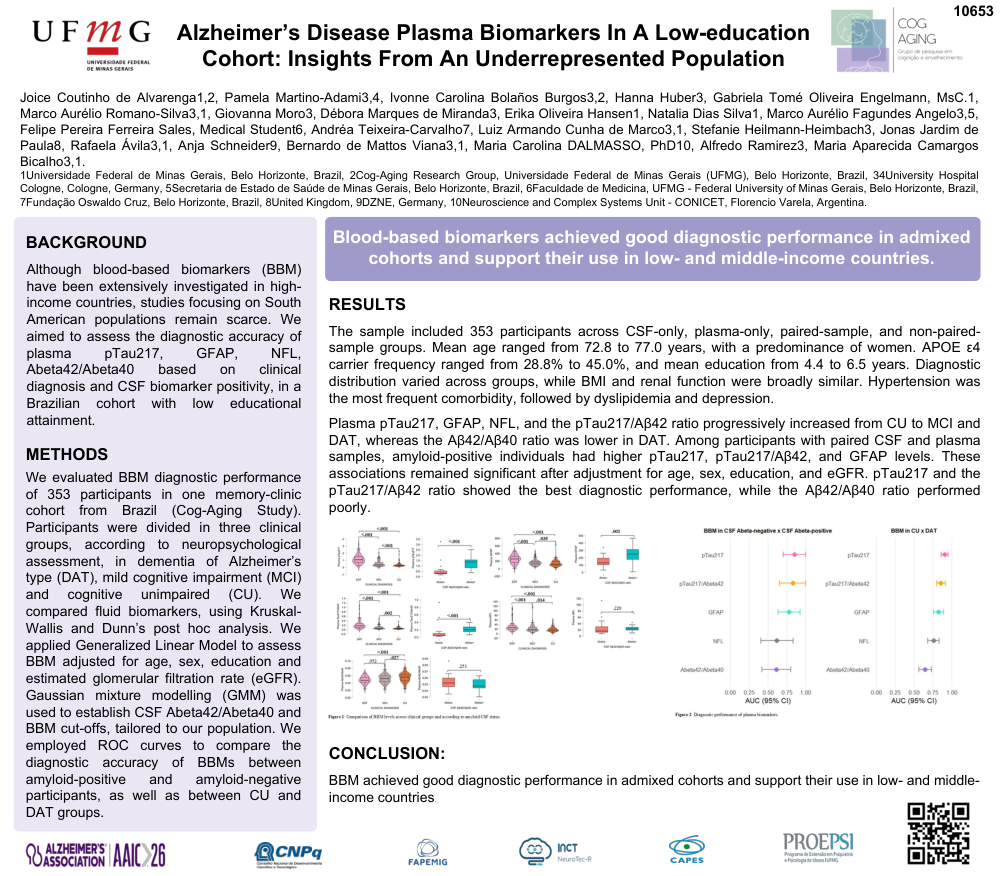
Results: The characteristics of participants are shown in Table 1. Comparisons across clinical groups demonstrated that plasma levels of pTau217, GFAP, NFL, and the pTau217/Abeta42 ratio were significantly higher in DAT, followed by MCI and CU participants. In contrast, the Abeta42/Abeta40 ratio was significantly lower in the DAT group compared to MCI and CU, with no significant difference observed between MCI and CU. In the subset of participants with paired CSF and plasma samples (n=45), pTau217, the pTau217/Aβ42 ratio, and GFAP were significantly higher in individuals positive for amyloid pathology compared with those who were amyloid-negative. No significant differences were observed between the groups for the Abeta42/Abeta40 ratio or NFL (Figure 1). The BBM differences between the groups remained significant after adjusting for age, sex, education and eGFR. The diagnostic performance of BBM was evaluated for CU versus DAT and amyloid-positive versus amyloid-negative participants. Both pTau217 and the pTau217/Aβ42 ratio showed the highest accuracy, whereas the Abeta42/Abeta40 ratio demonstrated poor diagnostic performance (Figure 2).
Conclusion: BBM achieved good diagnostic performance in admixed cohorts and support their use in low- and middle-income countries.
Comments
Email is required but is not shown publicly.
Loading comments...