4,068 posters, 219 videos, 101 topics, 69 sessions, 14,365 authors, 6,128 institutions
ePostersLive by SciGen Technologies S.A. All rights reserved.
Alzheimer's Association International Conference 2026
July 12-15, 2026 | London, United Kingdom, and Online

1182
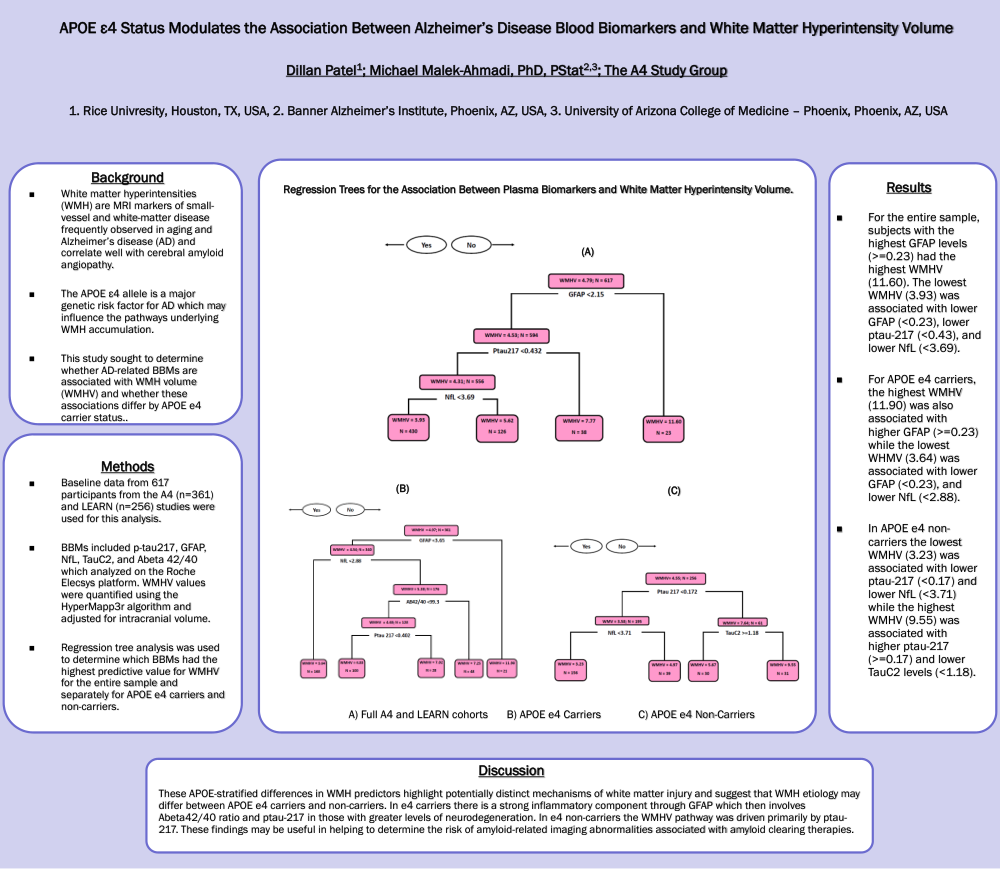
Apoe e4 Status Modulates The Association Between Alzheimer’S Disease Blood Biomarkers And White Matter Hyperintensity Volume
Poster Presenter
Authors
Affiliations
Part of Topic
Background
White matter hyperintensities (WMH) are MRI markers of small-vessel and white-matter disease frequently observed in aging and Alzheimer’s disease (AD) and correlate well with cerebral amyloid angiopathy. The APOE ε4 allele is a major genetic risk factor for AD which may influence the pathways underlying WMH accumulation. Blood biomarkers (BBMs) for AD are associated with amyloid and tau pathology, however their association with WMH is unclear. This study sought to determine whether AD-related BBMs are associated with WMH volume (WMHV) and whether these associations differ by APOE e4 carrier status.
Methods
Baseline data from 617 participants from the A4 (n=361) and LEARN (n=256) studies were used for this analysis. BBMs included p-tau217, GFAP, NfL, TauC2, and Abeta 42/40 which analyzed on the Roche Elecsys platform. WMH values were quantified using the HyperMapp3r algorithm and adjusted for intracranial volume. Regression tree analysis was used to determine which BBMs had the highest predictive value for WMH for the entire sample and separately for APOE e4 carriers and non-carriers.
Results
For the entire sample, subjects with the highest GFAP levels (>=0.23) had the highest WMH (11.60). The lowest WMH (3.93) was associated with lower GFAP (<0.23), lower ptau-217 (<0.43), and lower NfL (<3.69). For APOE e4 carriers, the highest WMHV (11.90) was also associated with higher GFAP (>=0.23) while the lowest WHM (3.64) was associated with lower GFAP (<0.23), and lower NfL (<2.88). In APOE e4 non-carriers the lowest WMH (3.23) was associated with lower ptau-217 (<0.17) and lower NfL (<3.71) while the highest WMH (9.55) was associated with higher ptau-217 (>=0.17) and lower TauC2 levels (<1.18).
Conclusion
These APOE-stratified differences in WMH predictors highlight potentially distinct mechanisms of white matter injury and suggest that WMH etiology may differ between APOE e4 carriers and non-carriers. In e4 carriers there is a strong inflammatory component through GFAP which then involves Abeta42/40 ratio and ptau-217 in those with greater levels of neurodegeneration. In e4 non-carriers the WMH pathway was driven primarily by ptau-217.
Comments
Email is required but is not shown publicly.
Loading comments...