4,068 posters, 219 videos, 101 topics, 69 sessions, 14,365 authors, 6,128 institutions
ePostersLive by SciGen Technologies S.A. All rights reserved.
Alzheimer's Association International Conference 2026
July 12-15, 2026 | London, United Kingdom, and Online

7031
The United States CADASIL Research Consortium: Baseline Findings
Poster Presenter
Authors
Part of Topic
Background
•Vascular cognitive impairment and dementia (VCID) is the second-leading cause of dementia.
•VCID research is limited by extreme heterogeneity.
•CADASIL is an effective model for highly prevalent sporadic VCID.
•This is the first US cohort to collect genetic, clinical, neuropsychological, functional, neuroimaging, and biofluid biomarkers of CADASIL.
Methods
•The United States CADASIL Consortium (USCC) is a collaboration of 12 academic sites.
•Clinical assessment, biofluid collection, and brain MRI occur every 18 months (three total visits).
•Companions provide external documentation of phenotype changes or functional declines.
•Statistical analysis: P-values were derived from Fisher exact tests for categorical variables and Kruskal-Wallis tests for continuous variables.
Results
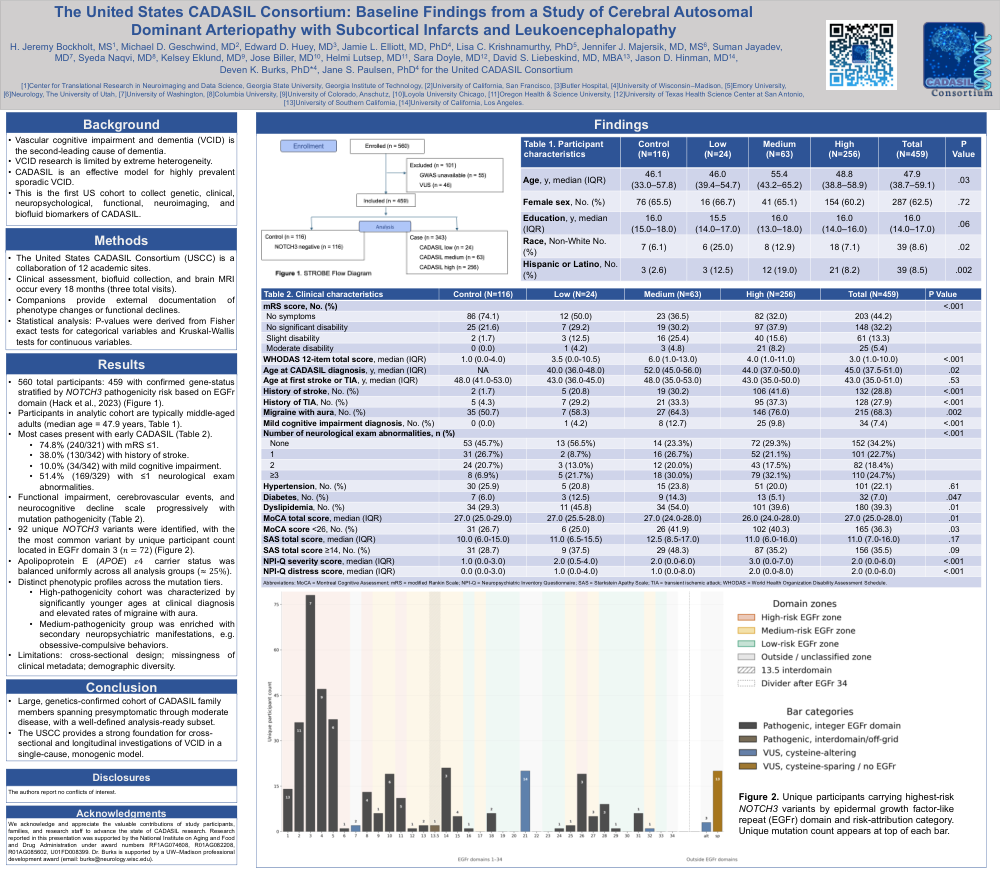
•560 total participants: 459 with confirmed gene-status stratified by NOTCH3 pathogenicity risk based on EGFr domain (Hack et al., 2023) (Figure 1).
•Participants in analytic cohort are typically middle-aged adults (median age = 47.9 years, Table 1).
•Most cases present with early CADASIL (Table 2).
•74.8% (240/321) with mRS ≤1.
•38.0% (130/342) with history of stroke.
•10.0% (34/342) with mild cognitive impairment.
•51.4% (169/329) with ≤1 neurological exam abnormalities.
•Functional impairment, cerebrovascular events, and neurocognitive decline scale progressively with mutation pathogenicity (Table 2).
•92 unique NOTCH3 variants were identified, with the the most common variant by unique participant count located in EGFr domain 3 (n=72) (Figure 2).
•Apolipoprotein E (APOE) ε4 carrier status was balanced uniformly across all analysis groups (≈25%).
•Distinct phenotypic profiles across the mutation tiers.
•High-pathogenicity cohort was characterized by significantly younger ages at clinical diagnosis and elevated rates of migraine with aura.
•Medium-pathogenicity group was enriched with secondary neuropsychiatric manifestations, e.g. obsessive-compulsive behaviors.
•Limitations: cross-sectional design; missingness of clinical metadata; demographic diversity.
Conclusion
•Large, genetics-confirmed cohort of CADASIL family members spanning presymptomatic through moderate disease, with a well-defined analysis-ready subset.
•The USCC provides a strong foundation for cross-sectional and longitudinal investigations of VCID in a single-cause, monogenic model.
Comments
Email is required but is not shown publicly.
Loading comments...