Loading...

4,068 posters, 219 videos, 101 topics, 69 sessions, 14,365 authors, 6,128 institutions

ePostersLive by SciGen Technologies S.A. All rights reserved.

Alzheimer's Association International Conference 2026

July 12-15, 2026 | London, United Kingdom, and Online

Alzheimer's Association International Conference 2026 banner

9820

Alzheimer’s Disease Co-pathology In Frontotemporal Dementia: Prevalence And Impact On Survival
Part of Topic

BACKGROUND
●Alzheimer’s disease (AD) co-pathology is associated with faster cognitive decline and shorter survival in dementia with Lewy bodies1,2
●The prevalence and prognostic significance of AD co-pathology in frontotemporal dementia (FTD) is largely unknown
●Prognostic biomarkers are needed to aid clinical management and trial design
 
AIM
To assess the prevalence and impact of AD co-pathology, reflected by amyloid PET or cerebrospinal fluid biomarkers, on survival in FTD
 
METHODS
Population 
●590 patients from the Amsterdam Dementia Cohort with a clinical diagnosis in the frontotemporal lobar degeneration (FTLD) spectrum
●Subset of 54 patients with pathological confirmation of FTLD as the primary pathology
 
Biomarkers
●Amyloid status based on available biomarkers (hierarchical):
    1. Amyloid PET, OR
    2. CSF p-tau/Aβ42 ratio, OR
    3. CSF Aβ42
 
Definitions
●Survival: interval from first memory clinic visit to death
●Censoring: at last clinical follow-up
 
Analysis
●Cox proportional hazards models: associations between amyloid status and survival
●Stratification by clinical subtype for the four largest subgroups
 
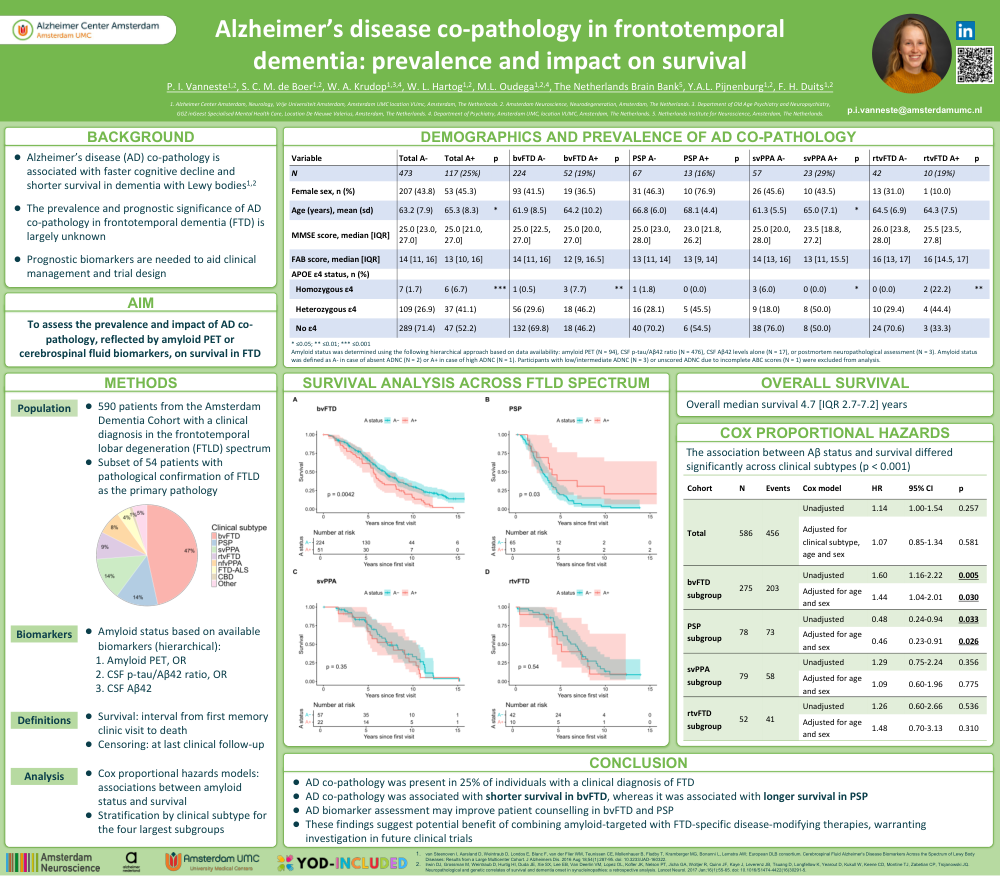
Overall median survival 4.7 [IQR 2.7-7.2] years
The association between Aβ status and survival differed significantly across clinical subtypes (p < 0.001)
 
CONCLUSION
●AD co-pathology was present in 25% of individuals with a clinical diagnosis of FTD
●AD co-pathology was associated with shorter survival in bvFTD, whereas it was associated with longer survival in PSP
●AD biomarker assessment may improve patient counselling in bvFTD and PSP
●These findings suggest potential benefit of combining amyloid-targeted with FTD-specific disease-modifying therapies, warranting investigation in future clinical trials
 
References
1.van Steenoven I, Aarsland D, Weintraub D, Londos E, Blanc F, van der Flier WM, Teunissen CE, Mollenhauer B, Fladby T, Kramberger MG, Bonanni L, Lemstra AW; European DLB consortium. Cerebrospinal Fluid Alzheimer's Disease Biomarkers Across the Spectrum of Lewy Body Diseases: Results from a Large Multicenter Cohort. J Alzheimers Dis. 2016 Aug 18;54(1):287-95. doi: 10.3233/JAD-160322.
2.Irwin DJ, Grossman M, Weintraub D, Hurtig HI, Duda JE, Xie SX, Lee EB, Van Deerlin VM, Lopez OL, Kofler JK, Nelson PT, Jicha GA, Woltjer R, Quinn JF, Kaye J, Leverenz JB, Tsuang D, Longfellow K, Yearout D, Kukull W, Keene CD, Montine TJ, Zabetian CP, Trojanowski JQ. Neuropathological and genetic correlates of survival and dementia onset in synucleinopathies: a retrospective analysis. Lancet Neurol. 2017 Jan;16(1):55-65. doi: 10.1016/S1474-4422(16)30291-5.

Comments

Email is required but is not shown publicly.

Loading comments...

aaic2026 banner
Copyright © 2015-2026, ePostersLive® SciGen is a registered trademark of SciGen Technologies S.A. Patent pending.

This website and third-party tools we use rely on cookies for the best user experience. By selecting "I agree", you agree to cookie usage as described in our Privacy Policy.