4,068 posters, 219 videos, 101 topics, 69 sessions, 14,365 authors, 6,128 institutions
ePostersLive by SciGen Technologies S.A. All rights reserved.
Alzheimer's Association International Conference 2026
July 12-15, 2026 | London, United Kingdom, and Online

3885
Peripheral Immunophenotypic Profiles As Predictors Of Cognitive Progression: Evidence From The Health And Retirement Study
Poster Presenter
Authors
Heya Luan, Xiaodong Han, Chang Xu, Aidi Shan, Xin Wang, Boye Wen, Cuibai Wei
Affiliations
Part of Topic
Abstract:
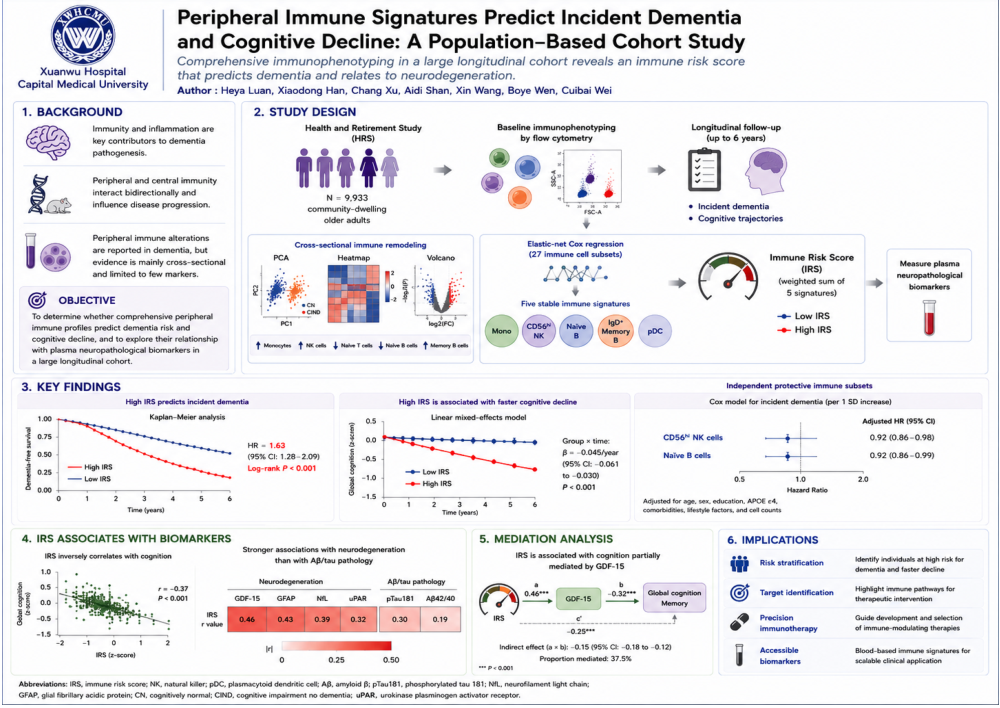
Background: Peripheral immune dysregulation is increasingly implicated in dementia pathogenesis, yet the comprehensive immune landscape associated with disease progression remains poorly mapped due to a reliance on cross-sectional designs. Evaluating the independent prognostic value of peripheral immunophenotypes for the longitudinal trajectory of cognitive decline is therefore critical.
Methods: We employed a comprehensive two-stage analytical framework leveraging the Health and Retirement Study (HRS). Peripheral blood mononuclear cells (PBMCs) were profiled via high-dimensional flow cytometry to quantify 24 major immune subsets. First, we mapped the cross-sectional immunophenotypic landscape in 9,008 older adults to delineate peripheral immune alterations distinguishing cognitive impairment from normal cognition. Second, to identify prognostic markers, we performed a 6-year longitudinal trajectory analysis on 4,464 participants who were cognitively normal at baseline and employed an elastic-net penalized Cox regression model coupled with stability selection. Selected features were synthesized into a weighted Immune Risk Score (IRS). The associations between IRS and incident cognitive impairment (CIND/Dementia) were evaluated using multivariable Cox proportional hazards models and Kaplan-Meier analysis. Furthermore, Linear Mixed-Effects Models (LMM) assessed the rate of cognitive decline, adjusting for age, sex, race, education, and latent CMV serostatus.
Results: We identified three distinct immune subsets as robust predictors of cognitive maintenance. Specifically, higher abundances of T cells, CD56ʰⁱ NK cells, and naïve B cells were consistently associated with reduced risk of cognitive progression. Based on these features, participants were stratified into high- and low-immune risk groups. Kaplan-Meier analysis revealed that the high-risk group exhibited significantly higher progression to cognitive impairment (Log-rank P < 0.0001). In fully adjusted Cox models, the IRS remained an independent predictor of incident cognitive impairment (HR: 1.69, 95%CI: 1.30-2.20, P < 0.001). Moreover, higher immune risk burden was associated with a steeper rate of global cognitive decline over the follow-up period (P < 0.05).
Conclusion: This large-scale longitudinal study identifies a specific peripheral immune signature, characterized by the depletion of key lymphoid subsets, as a robust, independent predictor of cognitive trajectories. Peripheral immunophenotyping offering a scalable biomarker for early risk stratification and precision surveillance in community settings.
Comments
Email is required but is not shown publicly.
Loading comments...