4,068 posters, 219 videos, 101 topics, 69 sessions, 14,365 authors, 6,128 institutions
ePostersLive by SciGen Technologies S.A. All rights reserved.
Alzheimer's Association International Conference 2026
July 12-15, 2026 | London, United Kingdom, and Online

5967
Longitudinal Digital Speech Assessment In Progressive Supranuclear Palsy
Poster Presenter
Authors
Part of Topic
Introduction
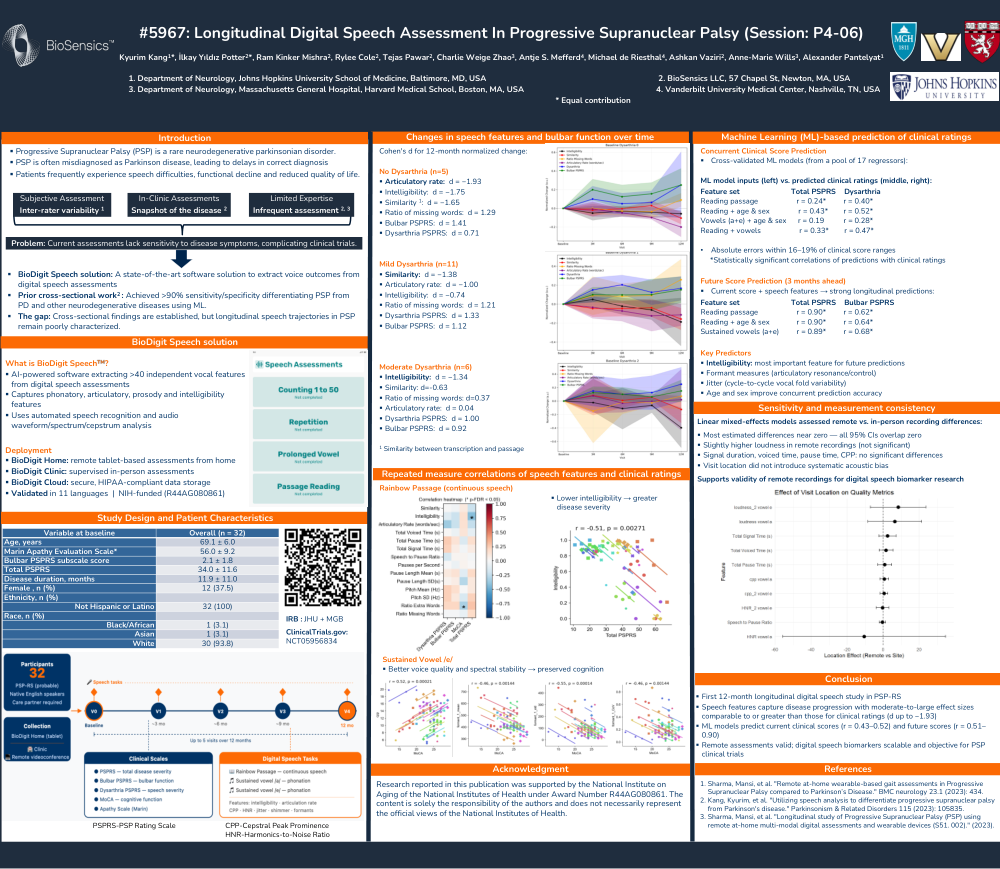
Progressive Supranuclear Palsy (PSP) is a rare neurodegenerative parkinsonian disorder that is often misdiagnosed as Parkinson disease, which can delay correct diagnosis and treatment. Patients frequently experience speech difficulties, functional decline, and reduced quality of life. Current clinical assessments such as the PSP Rating Scale and the Montreal Cognitive Assessment are limited by subjectivity, inter-rater variability, infrequent measurement, and suboptimal sensitivity to change. The study addresses the need for scalable, objective digital speech biomarkers to better track disease progression in PSP.
Study Design
This was a longitudinal digital speech assessment study in PSP-Richardson Syndrome (PSP-RS), following participants over 12 months. Speech was collected both remotely at home and in-person using BioDigit Speech technology, which extracts more than 40 vocal features from digital speech tasks. Digital assessments included continuous speech (Rainbow Passage) and sustained vowels /e/ and /a/. The study evaluated remote vs. in-person measurement consistency, changes in speech features over time, and machine-learning-based prediction of clinical ratings. The cohort included 32 participants at baseline, and the study was conducted under NIH funding with IRB approval from Johns Hopkins University and Massachusetts General Hospital.
Results
Remote and in-person recordings showed strong measurement consistency, with most estimated differences near zero and all 95% confidence intervals overlapping zero. Slightly higher loudness was observed in remote recordings, but this was not significant. Signal duration, voiced time, pause time, and cepstral peak prominence did not differ significantly by visit location, supporting the validity of remote assessments. Several speech features changed over 12 months with moderate-to-large effect sizes. In participants without dysarthria, articulatory rate, intelligibility, and similarity showed large worsening over time, and bulbar-related clinical scores also changed meaningfully. In mild dysarthria, similarity, articulatory rate, and intelligibility declined. Machine learning models predicted current clinical scores with correlations of 0.43–0.52 and future scores with correlations of 0.51–0.90. Key predictors included intelligibility, formant measures, jitter, age, and sex. Better voice quality and spectral stability were associated with preserved cognition, while lower intelligibility was associated with greater disease severity.
Conclusions
This is the first 12-month longitudinal digital speech study in PSP-RS. The findings show that speech features capture disease progression with moderate-to-large effect sizes, in some cases comparable to or greater than clinical ratings. Remote recordings were valid and did not introduce systematic acoustic bias, supporting the use of at-home digital speech biomarkers for PSP monitoring and clinical trials. The results suggest that objective speech analysis can provide scalable, sensitive measures of disease progression in PSP.
Comments
Email is required but is not shown publicly.
Loading comments...