4,068 posters, 219 videos, 101 topics, 69 sessions, 14,365 authors, 6,128 institutions
ePostersLive by SciGen Technologies S.A. All rights reserved.
Alzheimer's Association International Conference 2026
July 12-15, 2026 | London, United Kingdom, and Online

10026
From Fit-for-storage To Fit-for-purpose: NCRAD's Approach To Biospecimen Quality In Alzheimer’s Disease Research
Poster Presenter
Part of Topic
Background
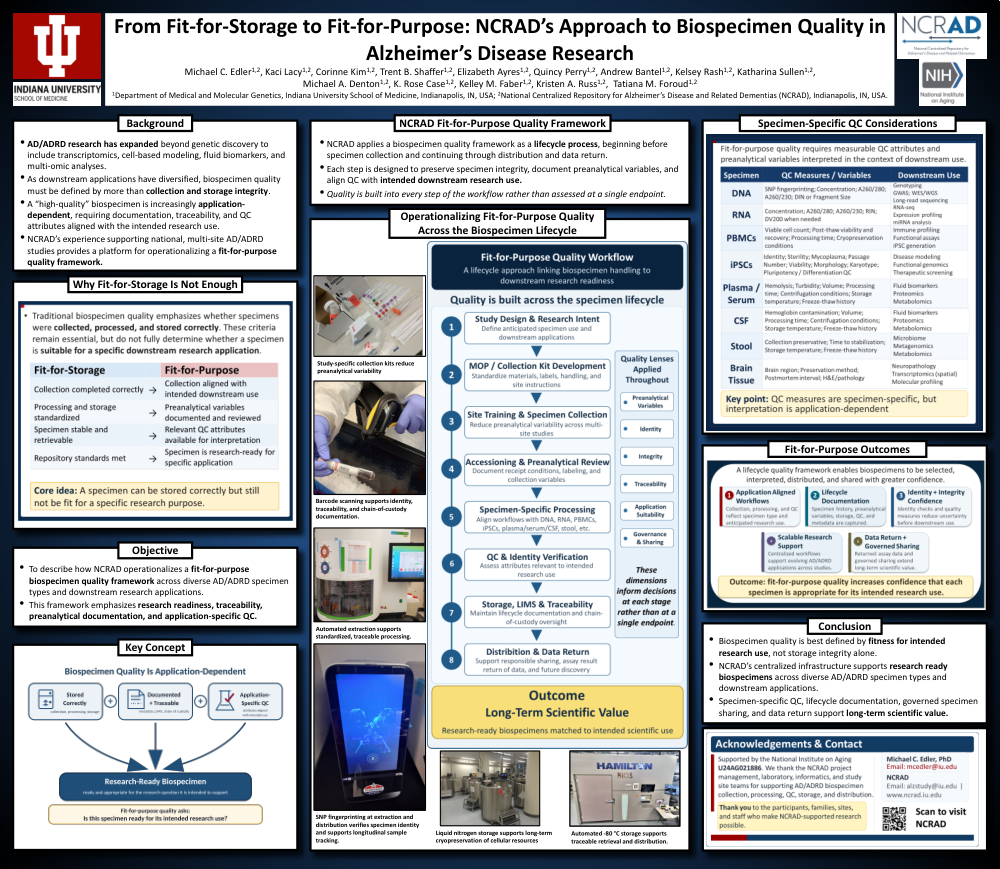
As Alzheimer’s disease (AD) research has evolved from primarily genetic discovery toward functional genomics, transcriptomics, cell-based modeling, and fluid-based investigations, expectations for biospecimen quality have expanded. Traditional definitions of “high-quality” biospecimens, focused largely on collection integrity and long-term storage, are increasingly insufficient to support diverse downstream research applications. Over more than three decades supporting national, multi-site AD and ADRD studies, the National Centralized Repository for Alzheimer’s Disease and Related Dementias (NCRAD) has adapted its biospecimen quality framework to emphasize research readiness and fitness for intended use.
Methods
We describe NCRAD’s platform-level approach to biospecimen quality based on its longitudinal experience supporting over 90 multi-site studies. This framework encompasses diverse specimen types, including DNA, RNA, peripheral blood mononuclear cells (PBMCs), induced pluripotent stem cells (iPSCs), stool, and fluid biospecimens such as plasma, serum, and cerebrospinal fluid (CSF). Operational workflows, preanalytical considerations, quality control (QC) strategies, automation infrastructure, and governance practices are examined to illustrate how biospecimen handling and QC are aligned with anticipated downstream applications rather than storage requirements alone.
Results
Implementation of a research-ready framework at NCRAD has resulted in clearly defined, application-focused biospecimen workflows across specimen types. Standardized, study-specific protocols support consistent collection and processing while accommodating differing downstream research needs. Integration of automation and laboratory information management systems enables comprehensive documentation, traceability, and lifecycle oversight. QC practices extend beyond traditional integrity checks to consider attributes relevant to downstream use, including RNA suitability for transcriptomic studies, PBMC handling for iPSC generation, and preanalytical quality considerations for plasma, serum, and CSF intended for subsequent analysis. Governance models emphasizing responsible reuse and data return further support long-term scientific value.
Conclusions
These observations underscore that biospecimen quality is best defined by fitness for intended research use rather than storage integrity alone. NCRAD’s experience illustrates how centralized biobanking infrastructure can operationalize a fit-for-purpose quality framework to support evolving scientific demands. Emphasizing research readiness provides a scalable model for enabling reproducible, high-impact AD research across a broad range of downstream applications.
Comments
Email is required but is not shown publicly.
Loading comments...