4,068 posters, 219 videos, 101 topics, 69 sessions, 14,365 authors, 6,128 institutions
ePostersLive by SciGen Technologies S.A. All rights reserved.
Alzheimer's Association International Conference 2026
July 12-15, 2026 | London, United Kingdom, and Online

6670
High Throughput Single Pre-synapse Multiplex Proteomics in Alzheimer's Disease
Poster Presenter
Part of Topic
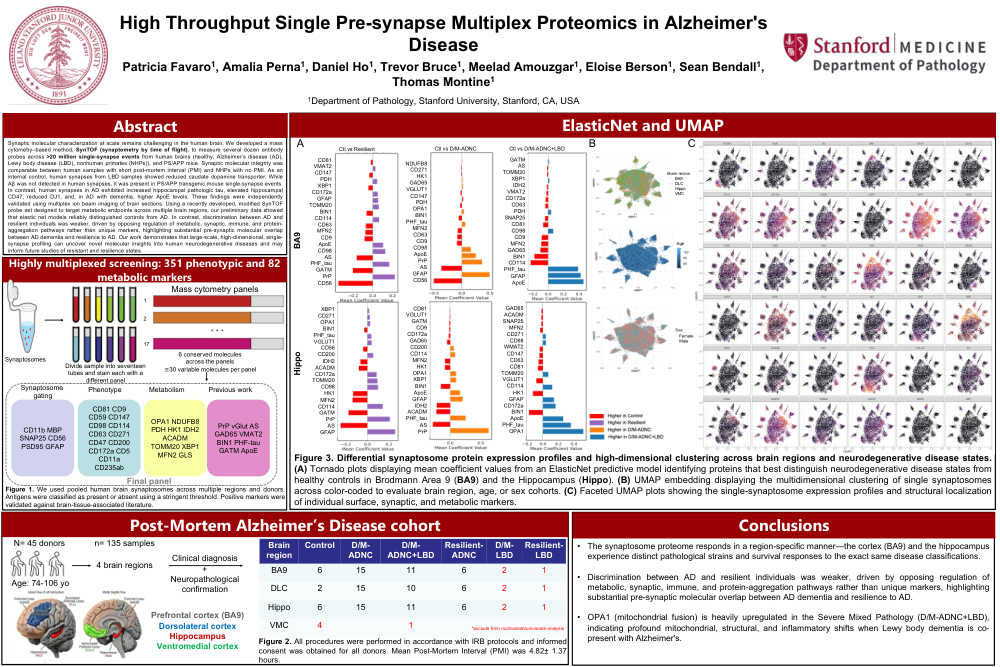
Synaptic molecular characterization at scale remains challenging in the human brain. We developed a mass cytometry–based method, SynTOF (synaptometry by time of flight), to measure several dozen antibody probes across >20 million single-synapse events from human brains (healthy, Alzheimer’s disease (AD), Lewy body disease (LBD), nonhuman primates (NHPs)), and PS/APP mice. Synaptic molecular integrity was comparable between human samples with short post-mortem interval (PMI) and NHPs with no PMI. As an internal control, human synapses from LBD samples showed reduced caudate dopamine transporter. While Aβ was not detected in human synapses, it was present in PS/APP transgenic mouse single-synapse events. In contrast, human synapses in AD exhibited increased hippocampal pathologic tau, elevated hippocampal CD47, reduced DJ1, and, in AD with dementia, higher ApoE levels. These findings were independently validated using multiplex ion beam imaging of brain sections. Using a recently developed, modified SynTOF probe set designed to target metabolic endpoints across multiple brain regions, our preliminary data showed that elastic net models reliably distinguished controls from AD. In contrast, discrimination between AD and resilient individuals was weaker, driven by opposing regulation of metabolic, synaptic, immune, and protein-aggregation pathways rather than unique markers, highlighting substantial pre-synaptic molecular overlap between AD dementia and resilience to AD. Our work demonstrates that large-scale, high-dimensional, single-synapse profiling can uncover novel molecular insights into human neurodegenerative diseases and may inform future studies of resistant and resilience states.
Comments
Email is required but is not shown publicly.
Loading comments...