4,068 posters, 219 videos, 101 topics, 69 sessions, 14,365 authors, 6,128 institutions
ePostersLive by SciGen Technologies S.A. All rights reserved.
Alzheimer's Association International Conference 2026
July 12-15, 2026 | London, United Kingdom, and Online

10981
Proteomic Analysis Of Conditioned Media From Hone-npcs In Sporadic Alzheimer’S Disease: A Mexican Cohort.
Poster Presenter
Part of Topic
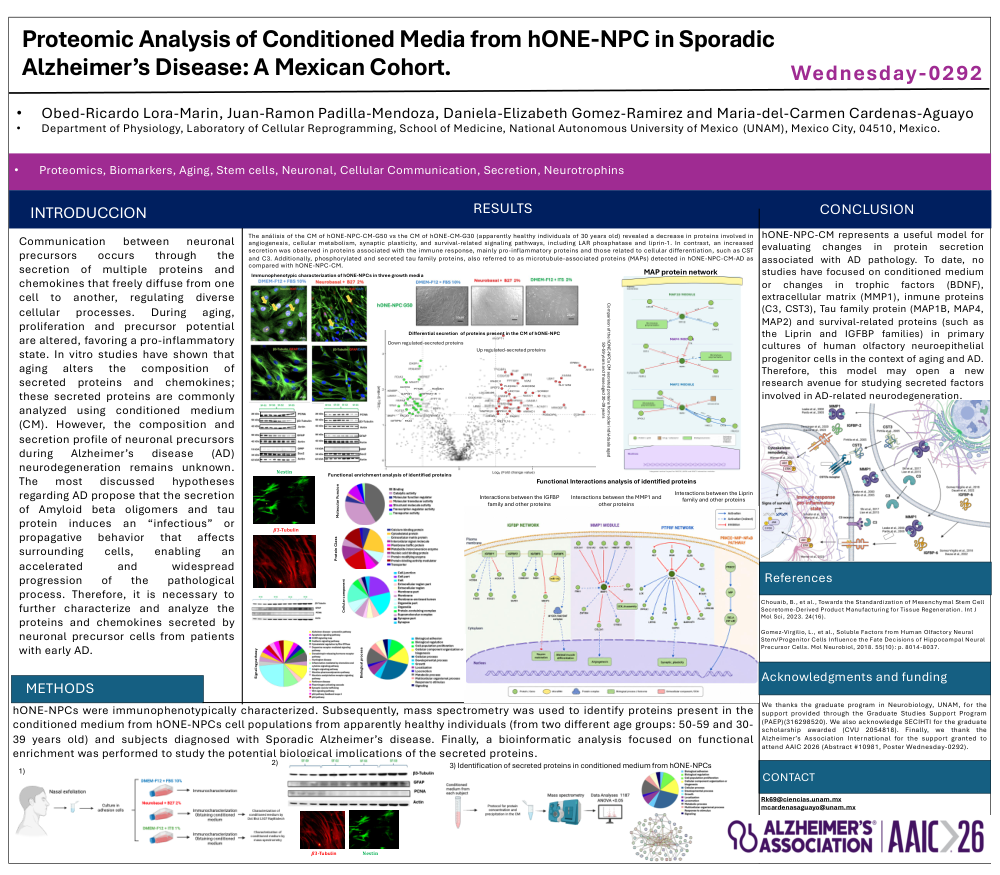
Background: Communication between neuronal precursors occurs through the secretion of multiple proteins and chemokines that freely diffuse from one cell to another, regulating diverse cellular processes. During aging, proliferation and precursor potential are altered, favoring a pro-inflammatory state. In vitro studies have shown that aging alters the composition of secreted proteins and chemokines; these secreted proteins are commonly analyzed using conditioned medium (CM). However, the composition and secretion profile of neuronal precursors during Alzheimer’s disease (AD) neurodegeneration remains unknown. The most discussed hypotheses regarding AD propose that the secretion of Amyloid-beta oligomers and tau protein induces an “infectious” or propagative behavior that affects surrounding cells, enabling an accelerated and widespread progression of the pathological process. Therefore, it is necessary to further characterize and analyze the proteins and chemokines secreted by neuronal precursor cells from patients with early AD.
To perform a proteomic analysis of the conditioned medium derived from neuronal precursor cells of the human olfactory neuroepithelium from apparently healthy Mexican individuals (hONE-NPC-CM) and from individuals clinically diagnosed with sporadic Alzheimer-type dementia (hONE-NPC-CM-AD).
Methods: Olfactory neuroepithelial Neuronal precursor cell cultures were immunophenotypically characterized. Subsequently, mass spectrometry was used to identify proteins present in conditioned medium from both cell populations: apparently healthy individuals and subjects diagnosed with Sporadic Alzheimer’s disease. Finally, a bioinformatic analysis focused on functional enrichment was performed to study the potential biological implications of the secreted proteins.
Results: A decrease was observed in the CM of hONE-NPC-CM-AD proteins involved in angiogenesis, cellular metabolism, synaptic plasticity, and survival-related signaling pathways, including LAR phosphatase and liprin-1. In contrast, an increased secretion was observed in proteins associated with the immune response, mainly pro-inflammatory proteins and those related to cellular differentiation, such as CST and C3. Additionally, phosphorylated and secreted tau protein was detected in hONE-NPC-CM-AD as compared with hONE-NPC-CM.
Conclusion: hONE-NPC-CM is a good model for evaluating changes in protein secretion associated with AD pathology. To date, no studies have focused on CM or changes in trophic factors during tauopathies, such as AD, in primary cultures of human olfactory neuroepithelial progenitor cells, thereby opening a new research avenue.
Comments
Email is required but is not shown publicly.
Loading comments...