4,068 posters, 219 videos, 101 topics, 69 sessions, 14,365 authors, 6,128 institutions
ePostersLive by SciGen Technologies S.A. All rights reserved.
Alzheimer's Association International Conference 2026
July 12-15, 2026 | London, United Kingdom, and Online

5832
Microglial Depletion Induces Sex-specific Changes In Immune Response, Microglial Signatures And Behavior To Systemic Inflammation
Poster Presenter
Authors
Affiliations
Part of Topic
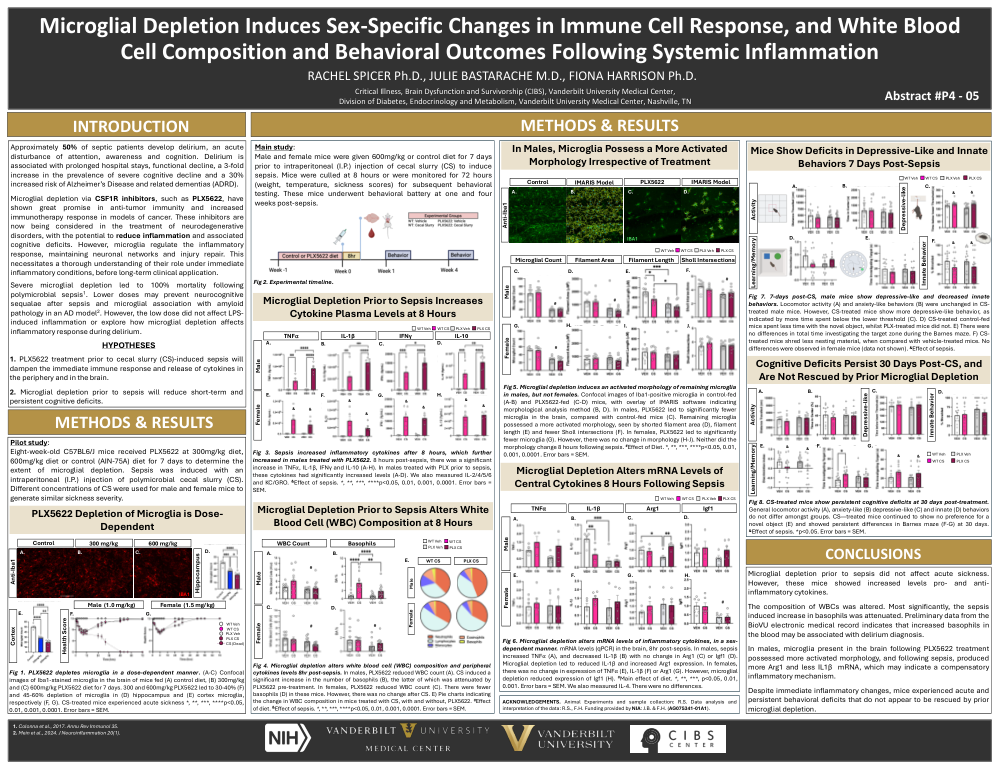
Microglial Depletion Induces Sex-Specific Changes in Immune Cell Response, and White Blood Cell Composition and Behavioral Outcomes Following Systemic Inflammation. Rachel Spicer, PhD., Julie Bastarache, MD., Fiona Harrison, PhD. Vanderbilt University Medical Center.
INTRODUCTION
Approximately 50% of septic patients develop delirium, an acute disturbance of attention, awareness and cognition. Delirium is associated with prolonged hospital stays, functional decline, a 3-fold increase in the prevalence of severe cognitive decline and a 30% increased risk of Alzheimer’s Disease and related dementias (ADRD). Microglial depletion via CSF1R inhibitors, such as PLX5622, have shown great promise in anti-tumor immunity and increased immunotherapy response in models of cancer. These inhibitors are now being considered in the treatment of neurodegenerative disorders, with the potential to reduce inflammation and associated cognitive deficits. However, microglia regulate the inflammatory response, maintaining neuronal networks and injury repair. This necessitates a thorough understanding of their role under immediate inflammatory conditions, before long-term clinical application. Severe microglial depletion led to 100% mortality following polymicrobial sepsis1. Lower doses may prevent neurocognitive sequalae after sepsis and microglial association with amyloid pathology in an AD model2. However, the low dose did not affect LPS-induced inflammation or explore how microglial depletion affects inflammatory response during delirium.
HYPOTHESES
1. PLX5622 treatment prior to cecal slurry (CS)-induced sepsis will dampen the immediate immune response and release of cytokines in the periphery and in the brain.
2. Microglial depletion prior to sepsis will reduce short-term and persistent cognitive deficits which may correlate to onset and progression of Alzheimer's Disease and related dementia in the future.
METHODS
Pilot study:
Eight-week-old C57BL6/J mice received PLX5622 at 300mg/kg diet, 600mg/kg diet or control (AIN-75A) diet for 7 days to determine the extent of microglial depletion. Sepsis was induced with an intraperitoneal (I.P.) injection of polymicrobial cecal slurry (CS). Different concentrations of CS were used for male and female mice to generate similar sickness severity.
Main study:
Male and female mice were given 600mg/kg or control diet for 7 days prior to intraperitoneal (I.P.) injection of cecal slurry (CS) to induce sepsis. Mice were culled at 8 hours or were monitored for 72 hours (weight, temperature, sickness scores) for subsequent behavioral testing. These mice underwent behavioral battery at one and four weeks post-sepsis.
MAIN RESULTS
Microglial Depletion Prior to Systemic Inflammation Increases Cytokine Plasma Levels at 8 Hours
Fig 3. Sepsis increased inflammatory cytokines after 8 hours, which further increased in males treated with PLX5622. 8 hours post-sepsis, there was a significant increase in TNF⍺, IL-1β, IFNγ and IL-10 (A-H). In males treated with PLX prior to sepsis, these cytokines had significantly increased levels (A-D). We also measured IL-2/4/5/6 and KC/GRO.
Microglial Depletion Prior to Systemic Inflammation Alters White Blood Cell (WBC) Composition at 8 Hours
Fig 4. Microglial depletion alters white blood cell (WBC) composition and peripheral cytokines levels 8hr post-sepsis. In males, PLX5622 reduced WBC count (A). CS induced a significant increase in the number of basophils (B), the latter of which was attenuated by PLX5622 pre-treatment. In females, PLX5622 reduced WBC count (C). There were fewer basophils (D) in these mice. However, there was no change after CS. E) Pie charts indicating the change in WBC composition in mice treated with CS, with and without, PLX5622.
Microglia Possess a More Acticated Morphology irrespective of Inflammation, In Males, Only.
Fig 5. Microglial depletion induces an activated morphology of remaining microglia in males, but not females. Confocal images of Iba1-positive microglia in control-fed (A-B) and PLX5622-fed (C-D) mice, with overlay of IMARIS software indicating morphological analysis method (B, D). In males, PLX5622 led to significantly fewer microglia in the brain, compared with control-fed mice (C). Remaining microglia possessed a more activated morphology, seen by shorted filament area (D), filament length (E) and fewer Sholl intersections (F). In females, PLX5622 led to significantly fewer microglia (G). However, there was no change in morphology (H-J). Neither did the morphology change 8 hours following sepsis.
Microglial Depletion Alters mRNA Levels of Central Cytokines 8 Hours Following Systemic Inflammation
Fig 6. Microglial depletion alters mRNA levels of inflammatory cytokines, in a sex-dependent manner. mRNA levels (qPCR) in the brain, 8hr post-sepsis. In males, sepsis increased TNF⍺ (A), and decreased IL-1β (B) with no change in Arg1 (C) or Igf1 (D). Microglial depletion led to reduced IL-1β and increased Arg1 expression. In females, there was no change in expression of TNF⍺ (E), IL-1β (F) or Arg1 (G). However, microglial depletion reduced expression of Igf1 (H).
Mice Show Deficits in Depressive-Like and Innate Behaviors 7 Days following Inflammatory Insult
Fig 7. 7-days post-CS, male mice show depressive-like and decreased innate behaviors. Locomotor activity (A) and anxiety-like behaviors (B) were unchanged in CS-treated male mice. However, CS-treated mice show more depressive-like behavior, as indicated by more time spent below the lower threshold (C). D) CS-treated control-fed mice spent less time with the novel object, whilst PLX-treated mice did not. E) There were no differences in total time investigating the target zone during the Barnes maze. F) CS-treated mice shred less nesting material, when compared with vehicle-treated mice. No differences were observed in female mice (data not shown).
Cognitive Deficits Persist 30 Days Post-Inflammatory Insult, and Are Not Rescued by Prior Microglial Depletion
Fig 8. CS-treated mice show persistent cognitive deficits at 30 days post-treatment. General locomotor activity (A), anxiety-like (B) depressive-like (C) and innate (D) behaviors do not differ amongst groups. CS—treated mice continued to show no preference for a novel object (E) and showed persistent differences in Barnes maze (F-G) at 30 days.
CONCLUSIONS
Microglial depletion prior to systemic inflammation did not affect acute sickness. However, these mice showed increased levels pro- and anti- inflammatory cytokines.
The composition of White Blood Cells was significantly altered in mice with prior microglial depletion. Most significantly, the sepsis induced increase in basophils was attenuated. Preliminary data from the BioVU electronic medical record indicates that increased basophils in the blood may be associated with delirium diagnosis.
In males, microglia present in the brain following PLX5622 treatment possessed more activated morphology, and following sepsis, produced more Arg1 and less IL1β mRNA, which may indicate a compensatory inflammatory mechanism.
Despite immediate inflammatory changes, mice experienced acute and persistent behavioral deficits that do not appear to be rescued by prior microglial depletion.
Comments
Email is required but is not shown publicly.
Loading comments...