4,068 posters, 219 videos, 101 topics, 69 sessions, 14,365 authors, 6,128 institutions
ePostersLive by SciGen Technologies S.A. All rights reserved.
Alzheimer's Association International Conference 2026
July 12-15, 2026 | London, United Kingdom, and Online

2440
A Peripheral Innate Immune Cell Recruitment Blocker Alters Immune Response In Brains Of Amyloid Depositing APP/PS1 Mice.
Poster Presenter
Authors
Stevin Zorn, Katie Dunton, Brie Achorn, Ken Rose, Frank Menniti, Robert Nelson
Affiliations
Part of Topic
Introduction
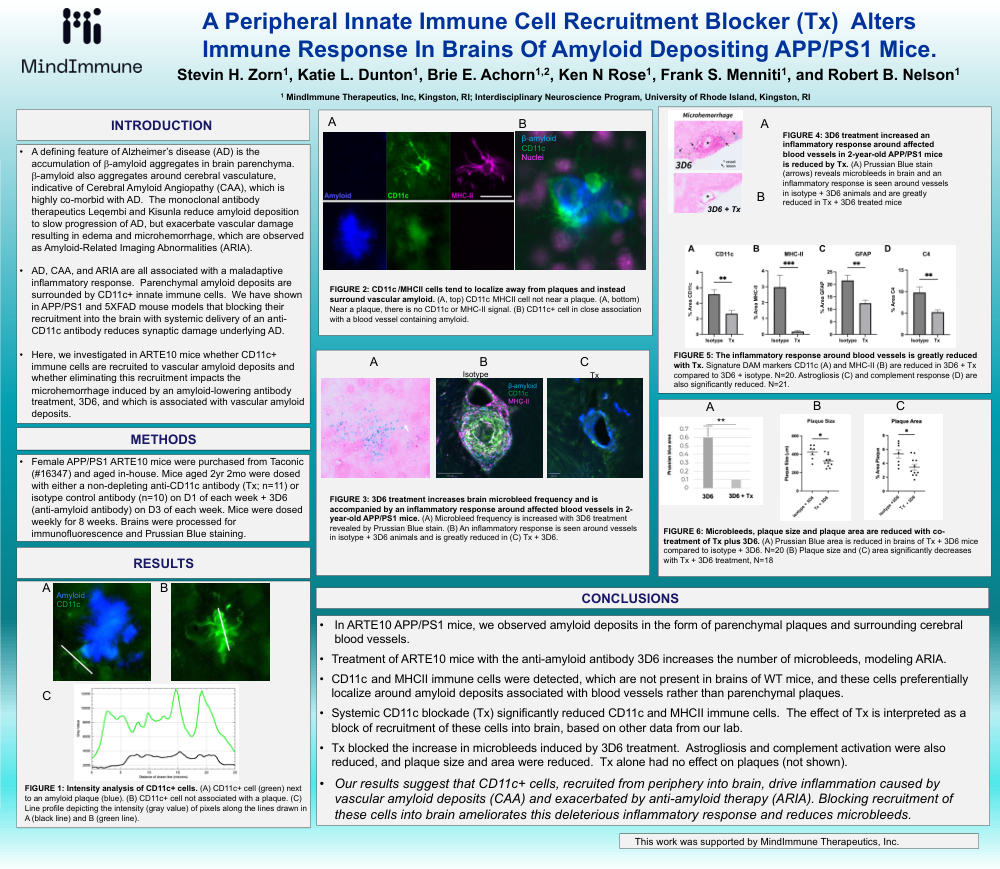
•A defining feature of Alzheimer’s disease (AD) is the accumulation of b-amyloid aggregates in brain parenchyma. b-amyloid also aggregates around cerebral vasculature, indicative of Cerebral Amyloid Angiopathy (CAA), which is highly co-morbid with AD. The monoclonal antibody therapeutics Leqembi and Kisunla reduce amyloid deposition to slow progression of AD, but exacerbate vascular damage resulting in edema and microhemorrhage, which are observed as Amyloid-Related Imaging Abnormalities (ARIA).
•AD, CAA, and ARIA are all associated with a maladaptive inflammatory response. Parenchymal amyloid deposits are surrounded by CD11c+ innate immune cells. We have shown in APP/PS1 and 5XFAD mouse models that blocking their recruitment into the brain with systemic delivery of an anti-CD11c antibody reduces synaptic damage underlying AD.
•Here, we investigated in ARTE10 mice whether CD11c+ immune cells are recruited to vascular amyloid deposits and whether eliminating this recruitment impacts the microhemorrhage induced by an amyloid-lowering antibody treatment, 3D6, and which is associated with vascular amyloid deposits.
Conclusions
•In ARTE10 APP/PS1 mice, we observed amyloid deposits in the form of parenchymal plaques and surrounding cerebral blood vessels.
•Treatment of ARTE10 mice with the anti-amyloid antibody 3D6 increases the number of microbleeds, modeling ARIA.
•CD11c and MHCII immune cells were detected, which are not present in brains of WT mice, and these cells preferentially localize around amyloid deposits associated with blood vessels rather than parenchymal plaques.
•Systemic CD11c blockade (Tx) significantly reduced CD11c and MHCII immune cells. The effect of Tx is interpreted as a block of recruitment of these cells into brain, based on other data from our lab.
•Tx blocked the increase in microbleeds induced by 3D6 treatment. Astrogliosis and complement activation were also reduced, and plaque size and area were reduced. Tx alone had no effect on plaques (not shown).
•Our results suggest that CD11c+ cells, recruited from periphery into brain, drive inflammation caused by vascular amyloid deposits (CAA) and exacerbated by anti-amyloid therapy (ARIA). Blocking recruitment of these cells into brain ameliorates this deleterious inflammatory response and reduces microbleeds.
Comments
Email is required but is not shown publicly.
Loading comments...