4,068 posters, 219 videos, 101 topics, 69 sessions, 14,365 authors, 6,128 institutions
ePostersLive by SciGen Technologies S.A. All rights reserved.
Alzheimer's Association International Conference 2026
July 12-15, 2026 | London, United Kingdom, and Online

9622
Analysis Of CagA And LTBP2 Protein Concentration And APOE Gene Variants In Patients With Alzheimer's Disease
Poster Presenter
Authors
Joanna Poszwa, Wojciech Owecki, Julia Brząkalska, Oliwia Szymanowicz, Bartosz Słowikowski, Paweł P. Jagodziński, Wojciech Kozubski, Jolanta Dorszewska
Affiliations
Poznan University of Medical Sciences, Laboratory of Neurobiology, Department of Neurology, Poznan, Poland, Poznan University of Medical Sciences, Laboratory of Neurobiology, Department of Neurology, Poznan, Poland; Student Scientific Society of Poznan University of Medical Sciences, Poznan, Poland, Poznan University of Medical Sciences, Department of Biochemistry and Molecular Biology, Poznan, Poland, Poznan University of Medical Sciences, Department of Neurology, Poznan, Poland,
Part of Topic
Analysis of CagA and LTBP2 protein concentration and APOE gene variants in patients with Alzheimer's disease
Background: Alzheimer's disease (AD) is a progressive neurodegenerative disease, the main symptom of which is dementia. There are four hypotheses for the development of AD: amyloid cascade, inflammatory factors, vascular factors, and infectious factors. Literature data indicate that Helicobacter pylori may participate in the pathogenesis of AD with the participation of its key virulent factor, cytotoxin-associated gene A (CagA), which may lead to the development of dementia through the development of neuroinflammation. Increased inflammation results in increased expression of latent transforming growth factor beta binding protein 2 (LTBP2), which further amplifies neuroinflammation, promoting tau pathology and neurodegeneration. The regulation of the inflammatory response in AD is largely genetically controlled. Currently, the biggest genetic risk factor of AD is APOE, present in 3 alleles: protective (ε2), neutral (ε3), and pathogenic (ε4). It has been shown that APOE ε4 may enhance LTBP2 expression, which suggests the existence of a common axis linking inflammatory, infectious, and genetic factors. However, so far the participation of CagA in the regulation of LTBP2 levels in the presence of APOE genetic variants in the course of AD has not been studied. The aim of the study was to analyze CagA and LTBP2 protein concentration and the APOE genetic variants in the perypherial blood of AD patients and related (CR) and unrelated (CU) controls.
Method: The control group included 34 CR and 33 CU. The APOE genotype was determined by real-time PCR. CagA and LTBP2 levels were analyzed by the ELISA method.
Results: Our study showed a statistically significant increase in LTBP2 levels observed without the presence of the APOE ε4 allele in AD compared with CU (p=0.0224). In addition, a trend toward elevated LTBP2 levels was noted in CagA-positive AD patients compared with the CU group (p=0.0762). Furthermore, a trend toward increased CagA concentrations was observed in AD compared with CU (p=0.0740).
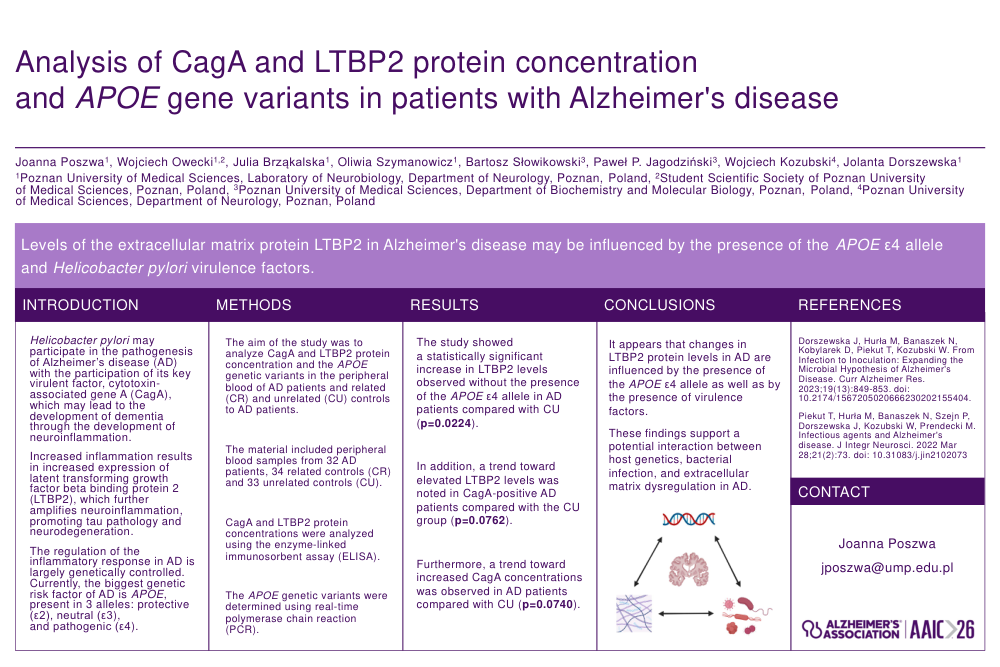
Conclusion: It appears that changes in LTBP2 protein levels in AD are influenced by the presence of the APOE ε4 allele as well as by the presence of virulence factors.
Comments
Email is required but is not shown publicly.
Loading comments...