4,068 posters, 219 videos, 101 topics, 69 sessions, 14,365 authors, 6,128 institutions
ePostersLive by SciGen Technologies S.A. All rights reserved.
Alzheimer's Association International Conference 2026
July 12-15, 2026 | London, United Kingdom, and Online

5422
Sex-specific Microglial Responses To Amyloid-ί Pathology In The Murine Brain
Poster Presenter
Authors
Jillian Cox, Ewa Poljanska, Zsabre Wright, Sunghwan Ko, Manu Thomas, Sarah Ocanas
Affiliations
1 Neuroscience Program, University of Oklahoma Health Campus (OUHC), Oklahoma City, OK (OKC), USA; 2 Genes and Human Disease, Oklahoma Medical Research Foundation (OMRF), OKC, USA, 2 Genes and Human Disease, Oklahoma Medical Research Foundation (OMRF), OKC, USA, 1Neuroscience Program, University of Oklahoma Health Campus (OUHC), Oklahoma City, OK (OKC), USA; 2 Genes & Human Disease Program, Oklahoma Medical Research Foundation, OKC, USA; 3 Department of Biochemistry and Physiology, OUHC, OKC, USA
Part of Topic
Title: Sex-specific microglial responses to amyloid-β pathology in the murine brain
Authors and Affiliations: Jillian E.J. Cox1,2, Ewa Poljanska2, Zsabre Wright2, Sunghwan Ko1,2, Manu A. Thomas2, Sarah R. Ocañas1,2,3
1Neuroscience Program, University of Oklahoma Health Campus (OUHC), Oklahoma City, OK (OKC), USA, 2Genes & Human Disease Program, Oklahoma Medical Research Foundation, OKC, USA, 3Department of Biochemistry and Physiology, OUHC, OKC, USA
Funding: National Institutes of Health (NIH) (DP5OD033443, P30AG050911, T32AG052363), Alzheimer’s Association (SAGA23-1072406), and an award from the Presbyterian Health Foundation.
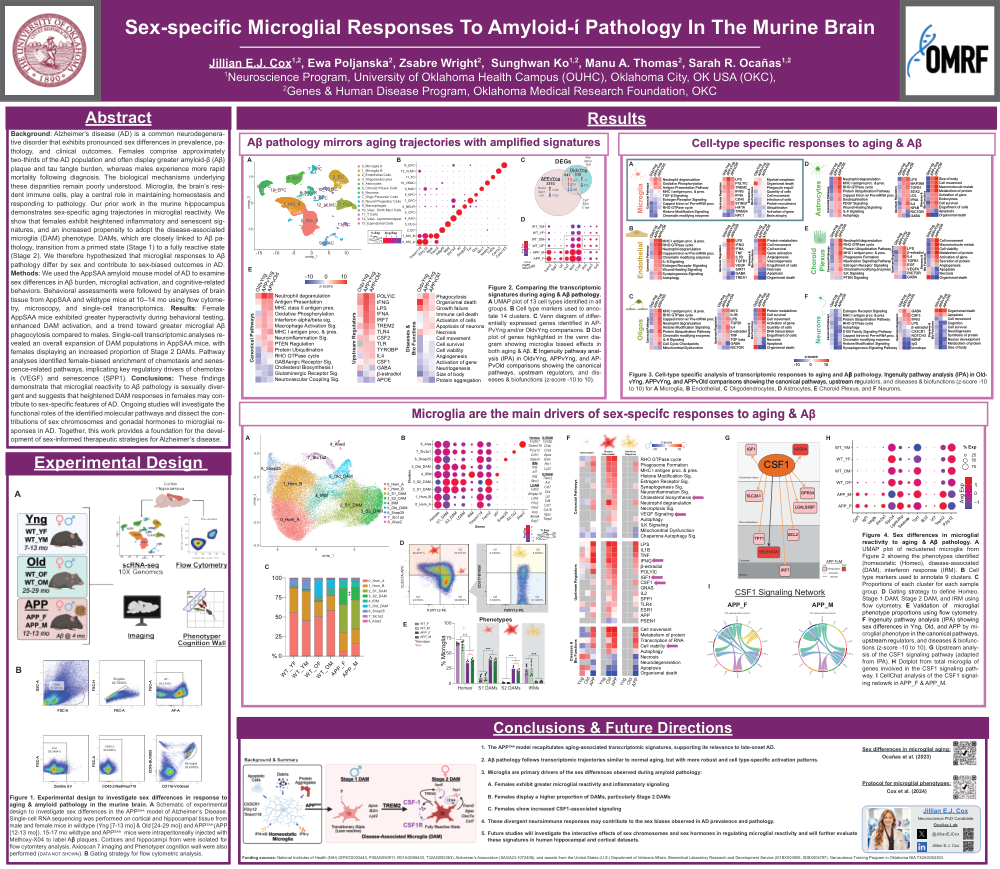
Background: Alzheimer’s disease (AD) is a common neurodegenerative disorder that exhibits pronounced sex differences in prevalence, pathology, and clinical outcomes. Females comprise approximately two-thirds of the AD population and often display greater amyloid-β (Aβ) plaque and tau tangle burden, whereas males experience more rapid mortality following diagnosis. The biological mechanisms underlying these disparities remain poorly understood. Microglia, the brain’s resident immune cells, play a central role in maintaining homeostasis and responding to pathology. Our prior work in the murine hippocampus demonstrates sex-specific aging trajectories in microglial reactivity. We show that females exhibit heightened inflammatory and senescent signatures, and an increased propensity to adopt the disease-associated microglia (DAM) phenotype. DAMs, which are closely linked to Aβ pathology, transition from a primed state (Stage 1) to a fully reactive state (Stage 2). We therefore hypothesized that microglial responses to Aβ pathology differ by sex and contribute to sex-biased outcomes in AD.
Methods: We used the AppSAA amyloid mouse model of AD to examine sex differences in Aβ burden, microglial activation, and cognitive-related behaviors. Behavioral assessments were followed by analyses of brain tissue from AppSAA and wildtype mice at 10–14 mo using flow cytometry, microscopy, and single-cell transcriptomics.
Results: Female AppSAA mice exhibited greater hyperactivity during behavioral testing, enhanced DAM activation, and a trend toward greater microglial Aβ phagocytosis compared to males. Single-cell transcriptomic analyses revealed an overall expansion of DAM populations in AppSAA mice, with females displaying an increased proportion of Stage 2 DAMs. Pathway analyses identified female-biased enrichment of chemotaxis and senescence-related pathways, implicating key regulatory drivers of chemotaxis (VEGF) and senescence (SPP1).
Conclusions: These findings demonstrate that microglial reactivity to Aβ pathology is sexually divergent and suggests that heightened DAM responses in females may contribute to sex-specific features of AD. Ongoing studies will investigate the functional roles of the identified molecular pathways and dissect the contributions of sex chromosomes and gonadal hormones to microglial responses in AD. Together, this work provides a foundation for the development of sex-informed therapeutic strategies for Alzheimer’s disease.
Comments
Email is required but is not shown publicly.
Loading comments...