4,068 posters, 219 videos, 101 topics, 69 sessions, 14,365 authors, 6,128 institutions
ePostersLive by SciGen Technologies S.A. All rights reserved.
Alzheimer's Association International Conference 2026
July 12-15, 2026 | London, United Kingdom, and Online

3331
Exploring The Role Of Endothelial Cldn5 Expression In Alzheimer’s Disease Pathology
Poster Presenter
Authors
Emily Groom, Molly Batchelder, Riane Richard, Kasey Belanger-Mayer, Rachel Smith, Qingfen Li, Bryce Thibodeau, Ramon Bossardi Ramos, Christina Thrasher, Kevin Pumiglia, Kristen Zuloaga
Affiliations
Department of Neuroscience and Experimental Therapeutics Albany Medical College, Department of Regenerative and Cancer Cell Biology Albany Medical College, Department of Molecular and Cellular Physiology Albany Medical College
Part of Topic
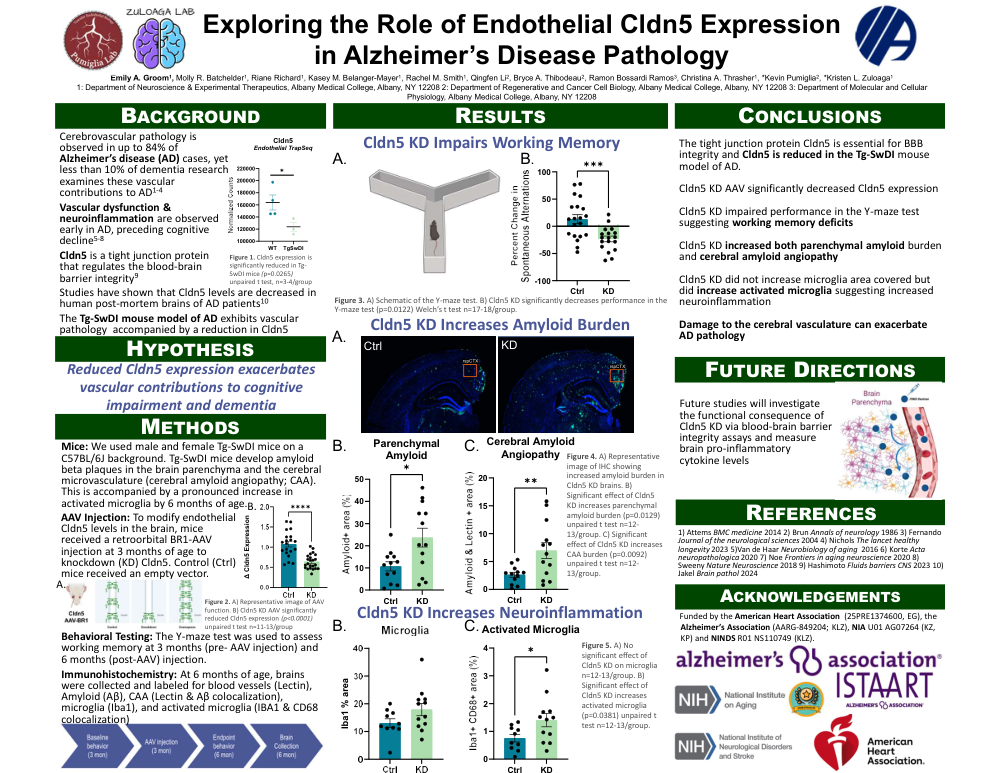
Background: Cerebrovascular pathology is observed in up to 84% of Alzheimer’s disease (AD) cases, yet less than 10% of dementia research examines these vascular contributions to AD. Evidence of vascular dysfunction is observed early in AD, preceding cognitive decline and neurodegeneration, making it an ideal target for early intervention and prevention of AD. Examples of this vascular dysfunction include increased permeability of the blood-brain barrier (BBB). Increased BBB permeability contributes to AD pathology by exacerbating neuroinflammation and amyloid accumulation around cerebral microvessels. However, the mechanisms behind this phenomenon are not fully understood. To further investigate this, we performed endothelial TRAP-sequencing and identified genes that were altered in a mouse model of AD. Of these genes, Cldn5, an endothelial tight junction protein, was decreased in our AD mouse model and other studies have shown it decreased in postmortem brains of AD patients. We hypothesized that knockdown of Cldn5 in our AD mousse model would exacerbate behavioral and vascular outcomes.
Methods: At 3 months of age, male and female TgSwDI mice received a retroorbital BR1-AAV injection containing a Cldn5 knockdown or an empty vector. Behavioral testing for working memory and neuropathology assessments for amyloid beta deposition and vascular changes were conducted at 6 months of age.
Results: We first validated our knockdown using qPCR and confirmed a 36% decrease in expression in our knockdown mice. Our results showed that Cldn5 knockdown impaired working memory at 6 months of age. Our neuropathology assessment revealed that Cldn5 knockdown increases amyloid beta plaques and vascular density.
Conclusion: This data suggests that Cldn5 is a vascular risk gene for AD and reduced Cldn5 expression can contribute to behavioral and neuropathological outcomes in AD. These effects suggest that strategies preventing or mitigating Cldn5 loss may be a potential therapeutic avenue for AD. Ongoing work is investigating how Cldn5 loss exerts these effects by investigating changes in neuroinflammation and BBB integrity.
Comments
Email is required but is not shown publicly.
Loading comments...