4,068 posters, 219 videos, 101 topics, 69 sessions, 14,365 authors, 6,128 institutions
ePostersLive by SciGen Technologies S.A. All rights reserved.
Alzheimer's Association International Conference 2026
July 12-15, 2026 | London, United Kingdom, and Online

9731
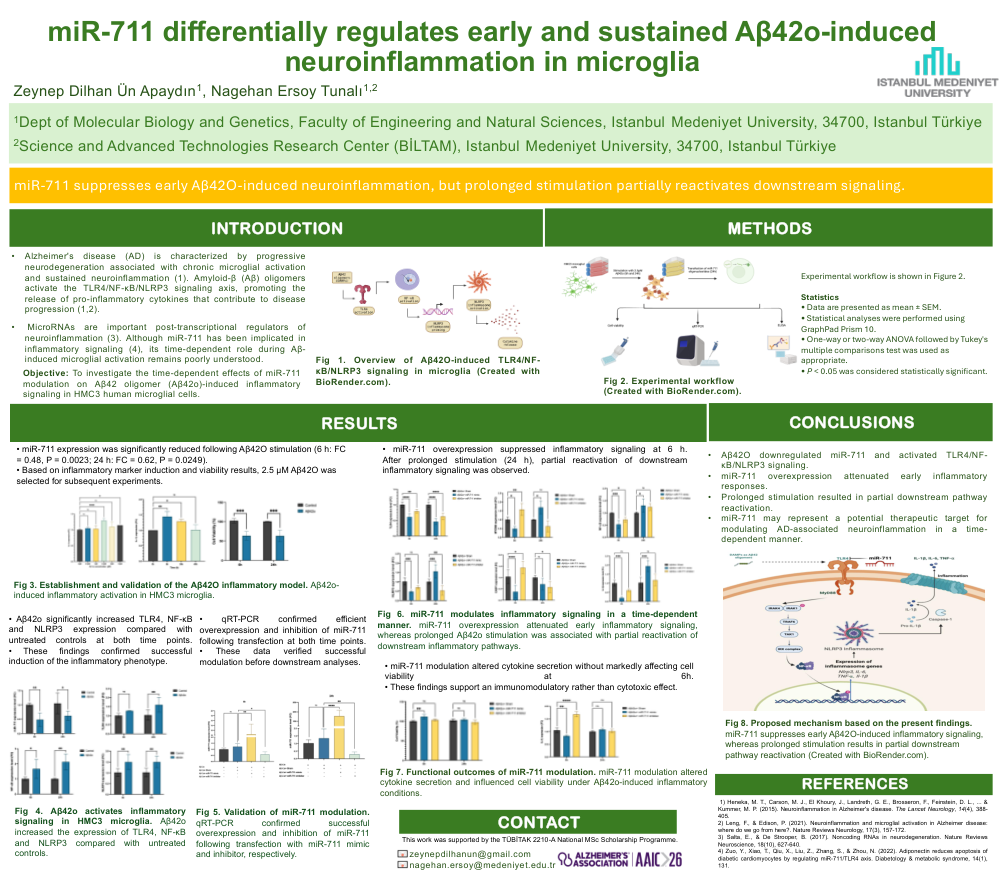
Mir-711 Differentially Regulates Early And Sustained aί42o-induced Neuroinflammation In Microglia
Part of Topic
Mir-711 Differentially Regulates Early And Sustained aβ42o-induced
Neuroinflammation In Microglia
Background: Neuroinflammation is a central driver of Alzheimer’s disease (AD) progression
and is mainly mediated by microglial activation. Activation of Toll-like receptor 4 (TLR4) by
Aβ species initiates MYD88-dependent NF-κB signaling and NLRP3 inflammasome priming,
leading to release of pro-inflammatory cytokines. MicroRNAs (miRNAs) have emerged as
critical post-transcriptional regulators of microglial immune responses, and miR-711 has
attracted attention for its modulation of inflammation. However, the role of miR-711, which
targets TLR4, in Aβ42o-induced neuroinflammation remains poorly defined.
Methods: Human microglial HMC3 cells were stimulated with Aβ1-42 oligomers (Aβ42o) to
establish an i n vi t r o neuroinflammatory model at early (6 h) and prolonged (24 h) time
points. miR-711 expression and the TLR4/MYD88/NF-κB/NLRP3/CASP1 signaling axis were
evaluated using qRT-PCR, Western blotting, ELISA, and viability assays. The regulatory impact
of miR-711 on microglial activation was assessed using gain- and loss-of-function
approaches. Statistical analyses were performed using Student’s t-test for comparisons
between two groups and one-way or two-way ANOVA for comparisons involving more than
two groups. A p-value < 0.05 was considered statistically significant.
Results: Aβ42o stimulation significantly downregulated miR-711 expression while
upregulating TLR4/NF-κB/NLRP3 signaling and pro-inflammatory cytokine release.
Overexpression of miR-711 markedly suppressed TLR4 (p<0.0001), NF-κB (p<0.0001), and
NLRP3 (p<0.001) expression levels, reduced IL-1β secretion (p<0.05), while rescuing cell
viability by approximately 15% during early Aβ42o exposure (p<0.001). However, MYD88 and
CASP1 expression levels were exacerbated (p<0.001; p<0.0001, respectively), and cytokine
release was enhanced after miR-711 inhibition. Conversely, prolonged Aβ42o exposure
resulted in partial reactivation of inflammatory signaling despite miR-711 overexpression,
characterized by increased MYD88 (p<0.001), NLRP3 (p <0.01), and NF-κB (p<0.05)
expression, while TLR4 (p < 0.0001) and CASP1 (ns) remained suppressed.
Conclusion: miR-711 functions as a dynamic molecular brake that attenuates early microglial
activation while allowing partial immune adaptation during sustained Aβ42o exposure. These
findings position miR-711 as a promising therapeutic target for limiting acute
neuroinflammation while highlighting compensatory late-phase signaling that may limit the
durability of its protective effects. Time-dependent miR-711-based interventions could be
investigated to refine therapeutic strategies mitigating microglial-driven neuroinflammation.
Comments
Email is required but is not shown publicly.
Loading comments...