4,068 posters, 219 videos, 101 topics, 69 sessions, 14,365 authors, 6,128 institutions
ePostersLive by SciGen Technologies S.A. All rights reserved.
Alzheimer's Association International Conference 2026
July 12-15, 2026 | London, United Kingdom, and Online

3751
Early Social Experience And Resilience To Social Isolation: Behavioral And Neurochemical Evidence InDrosophila Melanosgaster
Poster Presenter
Authors
Affiliations
Part of Topic
Video
Background: Social isolation is a well-documented, modifiable risk factor for dementia, linked to cognitive decline and reduced cognitive reserve (Huang, 2023; Drinkwater et al., 2022). Using Drosophila melanogaster, given its functional homology with human stress-related neurotransmitters (Sokolowski, 2010), we tested whether early socialization protects behavioral stability against later isolation, explicitly accounting for sex.
Methods: Subjects were Drosophila melanogaster (Canton-S), 106 individuals, both sexes, recorded at 1 and 4 weeks of adulthood. Three social histories were compared: chronic isolation (Group A), early socialization followed by isolation (Group B), and continuous socialization (Group C). Behavioral measures were obtained from a 10-minute video in a standardized grid: crossings, direction changes, jumps, and resting episodes. Statistics: three-way ANOVA (Group × Age × Sex, Type III SS), with Welch's ANOVA and Games-Howell post-hoc for variance heterogeneity; negative binomial GLM for jumps (overdispersed). R v4.6.0.
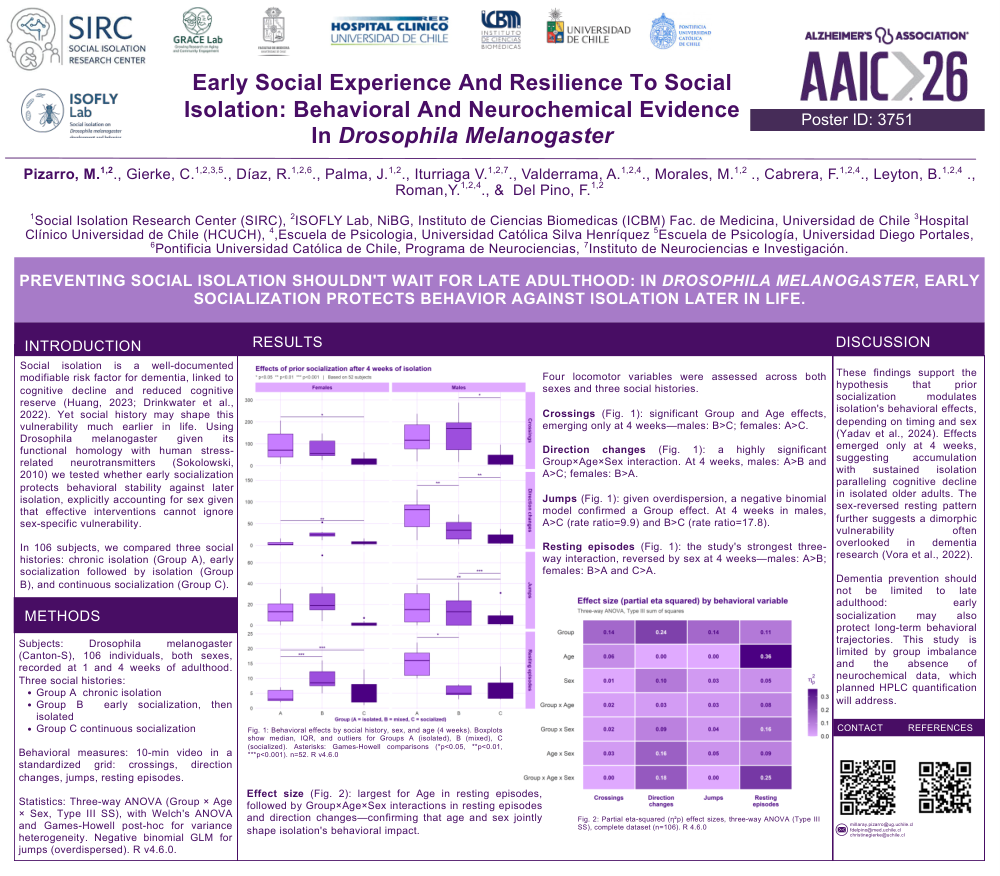
Results: Effects emerged only at 4 weeks. Crossings showed significant Group and Age effects (males: B>C; females: A>C). Direction changes showed a highly significant Group×Age×Sex interaction (males: A>B and A>C; females: B>A). Jumps showed a Group effect (males: A>C, rate ratio=9.9; B>C, rate ratio=17.8). Resting episodes showed the study's strongest three-way interaction, reversed by sex at 4 weeks (males: A>B; females: B>A and C>A). Effect size was largest for Age in resting episodes, followed by Group×Age×Sex interactions in resting episodes and direction changes.
Conclusions: These findings support the hypothesis that prior socialization modulates isolation's behavioral effects, depending on timing and sex (Yadav et al., 2024). Effects emerging only at 4 weeks suggest accumulation with sustained isolation, paralleling cognitive decline in isolated older adults. Dementia prevention should not be limited to late adulthood: early socialization may also protect long-term behavioral trajectories. This study is limited by group imbalance and the absence of neurochemical data, which planned HPLC quantification will address.
Comments
Email is required but is not shown publicly.
Loading comments...