4,068 posters, 219 videos, 101 topics, 69 sessions, 14,365 authors, 6,128 institutions
ePostersLive by SciGen Technologies S.A. All rights reserved.
Alzheimer's Association International Conference 2026
July 12-15, 2026 | London, United Kingdom, and Online

280
Hdl-bound S1p Affects The Subventricular Niche And Early Neuropathological Features Of Alzheimer’S Disease
Poster Presenter
Authors
Part of Topic
HDL-bound S1P affects the subventricular niche and early neuropathological features of Alzheimer’s disease
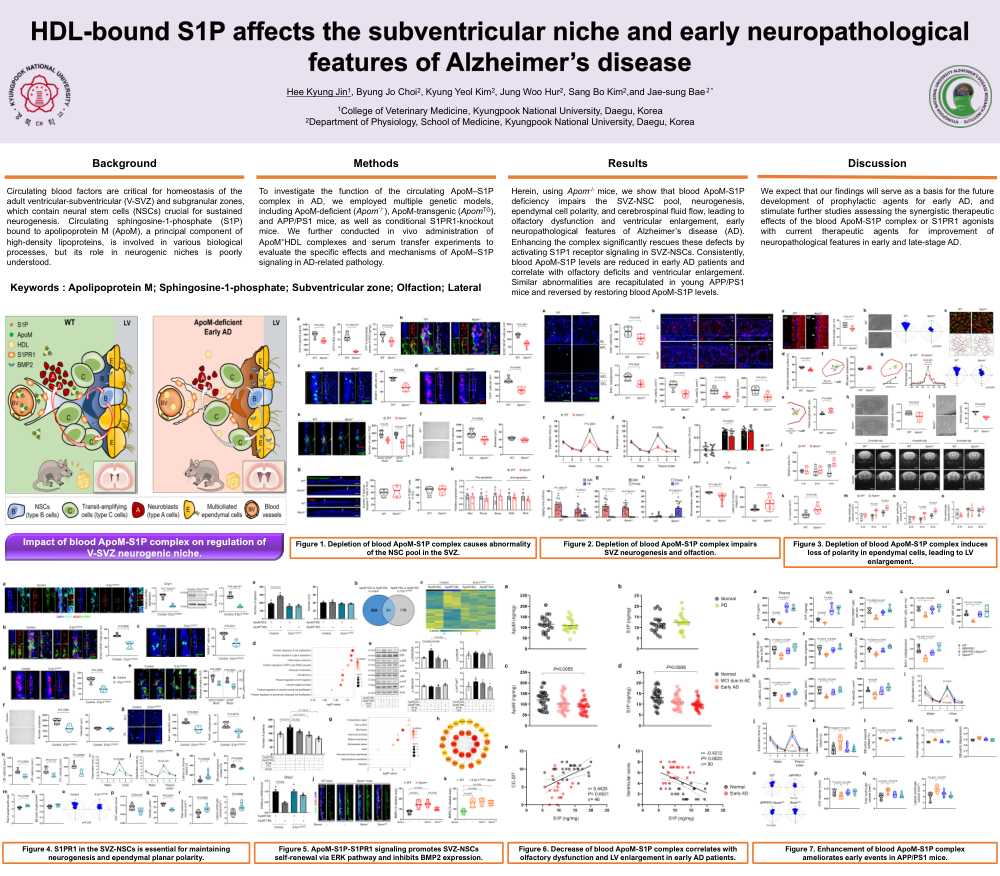
Background:Circulating blood factors are critical for homeostasis of the adult ventricular-subventricular (V-SVZ) and subgranular zones, which contain neural stem cells (NSCs) crucial for sustained neurogenesis. Circulating sphingosine-1-phosphate (S1P) bound to apolipoprotein M (ApoM), a principal component of high-density lipoproteins, is involved in various biological processes, but its role in neurogenic niches is poorly understood.
Methods: To investigate the function of the circulating ApoM–S1P complex in AD, we employed multiple genetic models, including ApoM-deficient (Apom⁻/⁻), ApoM-transgenic (ApomTG), and APP/PS1 mice, as well as conditional S1PR1-knockout mice. We further conducted in vivo administration of ApoM+HDL complexes and serum transfer experiments to evaluate the specific effects and mechanisms of ApoM–S1P signaling in AD-related pathology.
Results: Herein, using Apom-/- mice, we show that blood ApoM-S1P deficiency impairs the SVZ-NSC pool, neurogenesis, ependymal cell polarity, and cerebrospinal fluid flow, leading to olfactory dysfunction and ventricular enlargement, early neuropathological features of Alzheimer’s disease (AD). Enhancing the complex significantly rescues these defects by activating S1P1 receptor signaling in SVZ-NSCs. Consistently, blood ApoM-S1P levels are reduced in early AD patients and correlate with olfactory deficits and ventricular enlargement. Similar abnormalities are recapitulated in young APP/PS1 mice and reversed by restoring blood ApoM-S1P levels.
Conclusions:We expect that our findings will serve as a basis for the future development of prophylactic agents for early AD, and stimulate further studies assessing the synergistic therapeutic effects of the blood ApoM-S1P complex or S1PR1 agonists with current therapeutic agents for improvement of neuropathological features in early and late-stage AD.
Comments
Email is required but is not shown publicly.
Loading comments...