4,068 posters, 219 videos, 101 topics, 69 sessions, 14,365 authors, 6,128 institutions
ePostersLive by SciGen Technologies S.A. All rights reserved.
Alzheimer's Association International Conference 2026
July 12-15, 2026 | London, United Kingdom, and Online

8736
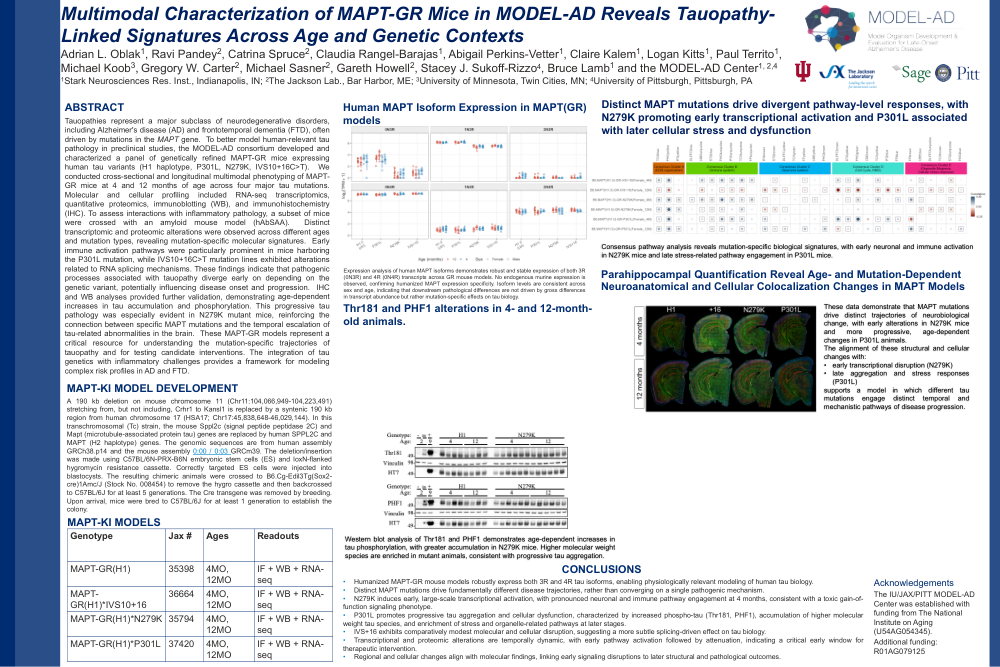
Multimodal Characterization Of MAPT-GR Mice In Model-AD Reveals Tauopathy-linked Signatures Across Age And Genetic Contexts
Poster Presenter
Part of Topic
ABSTRACT
Tauopathies represent a major subclass of neurodegenerative disorders, including Alzheimer's disease (AD) and frontotemporal dementia (FTD), often driven by mutations in the MAPT gene. To better model human-relevant tau pathology in preclinical studies, the MODEL-AD consortium developed and characterized a panel of genetically refined MAPT-GR mice expressing human tau variants (H1 haplotype, P301L, N279K, IVS10+16C>T). We conducted cross-sectional and longitudinal multimodal phenotyping of MAPT-GR mice at 4 and 12 months of age across four major tau mutations. Molecular and cellular profiling included RNA-seq transcriptomics, quantitative proteomics, immunoblotting (WB), and immunohistochemistry (IHC). To assess interactions with inflammatory pathology, a subset of mice were crossed with an amyloid mouse model (hAbSAA). Distinct transcriptomic and proteomic alterations were observed across different ages and mutation types, revealing mutation-specific molecular signatures. Early immune activation pathways were particularly prominent in mice harboring the P301L mutation, while IVS10+16C>T mutation lines exhibited alterations related to RNA splicing mechanisms. These findings indicate that pathogenic processes associated with tauopathy diverge early on depending on the genetic variant, potentially influencing disease onset and progression. IHC and WB analyses provided further validation, demonstrating age-dependent increases in tau accumulation and phosphorylation. This progressive tau pathology was especially evident in N279K mutant mice, reinforcing the connection between specific MAPT mutations and the temporal escalation of tau-related abnormalities in the brain. These MAPT-GR models represent a critical resource for understanding the mutation-specific trajectories of tauopathy and for testing candidate interventions. The integration of tau genetics with inflammatory challenges provides a framework for modeling complex risk profiles in AD and FTD.
MAPT-KI MODEL DEVELOPMENT
A 190 kb deletion on mouse chromosome 11 (Chr11:104,066,949-104,223,491) stretching from, but not including, Crhr1 to Kansl1 is replaced by a syntenic 190 kb region from human chromosome 17 (HSA17; Chr17:45,838,648-46,029,144). In this transchromosomal (Tc) strain, the mouse Sppl2c (signal peptide peptidase 2C) and Mapt (microtubule-associated protein tau) genes are replaced by human SPPL2C and MAPT (H2 haplotype) genes. The genomic sequences are from human assembly GRCh38.p14 and the mouse assembly 0:00 / 0:03 GRCm39. The deletion/insertion was made using C57BL/6N-PRX-B6N embryonic stem cells (ES) and loxN-flanked hygromycin resistance cassette. Correctly targeted ES cells were injected into blastocysts. The resulting chimeric animals were crossed to B6.Cg-Edil3Tg(Sox2-cre)1Amc/J (Stock No. 008454) to remove the hygro cassette and then backcrossed to C57BL/6J for at least 5 generations. The Cre transgene was removed by breeding. Upon arrival, mice were bred to C57BL/6J for at least 1 generation to establish the colony.
Conclusions
Comments
Email is required but is not shown publicly.
Loading comments...