4,068 posters, 219 videos, 101 topics, 69 sessions, 14,365 authors, 6,128 institutions
ePostersLive by SciGen Technologies S.A. All rights reserved.
Alzheimer's Association International Conference 2026
July 12-15, 2026 | London, United Kingdom, and Online

1993
Could Branched-chain Amino Acids Link Metabolic Dysregulation And Early Cognitive Decline?
Poster Presenter
Authors
Affiliations
Part of Topic
Could branched-chain amino acids link metabolic dysregulation and early cognitive decline?
Simon McArthur & Patrick Pallier
Background
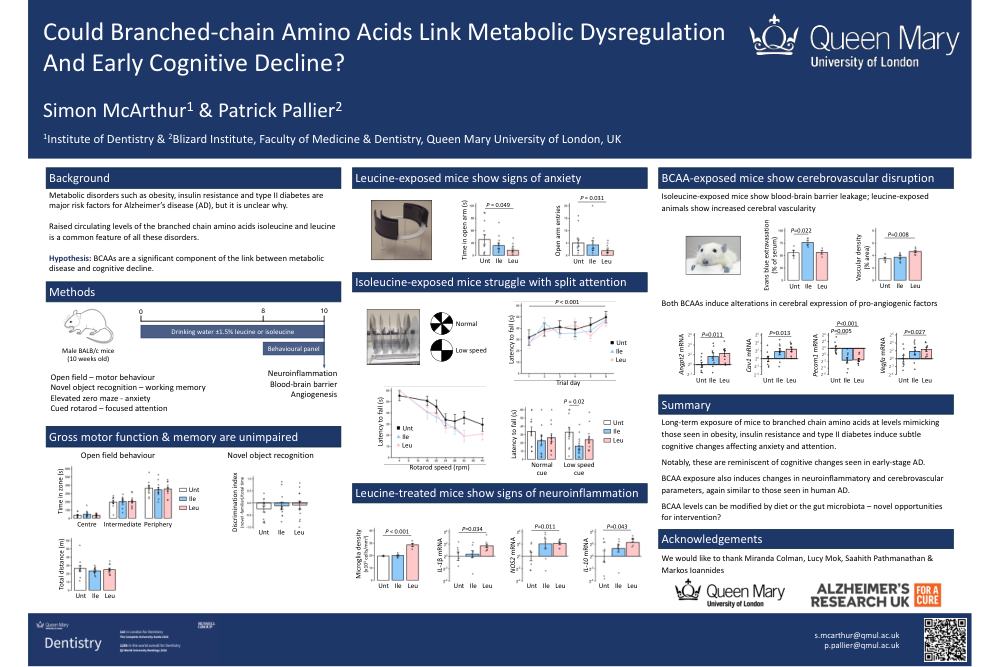
Metabolic disorders, such as insulin resistance, obesity, and type 2 diabetes, are major risk factors for Alzheimer's disease (AD), but it is not clear why. They are characterised by increased circulating levels of the branched-chain amino acids (BCAAs) leucine and isoleucine, and raised plasma isoleucine has been independently implicated as a risk factor for AD. Hence, we hypothesised that BCAAs could contribute to the link between metabolic disease and cognitive decline. We therefore studied the effects of long-term dietary leucine or isoleucine supplementation upon murine cerebrovascular and neuroinflammatory parameters and behavioural reactivity and cognitive dysfunction.
Methods
Wild-type male BALB/c mice (n=12) were treated for ten weeks with drinking water containing either leucine or isoleucine at 1.5% w/v, assessed with a battery of behavioural tasks to test for attention (cued rotarod), recognition memory (novel object recognition), behavioural reactivity and anxiety-like behaviours (test of rousability, open field and elevated zero maze), activities of daily living (nest building and burrowing tests) and neurological health (mNSS). Brains were then collected for assessment of blood-brain barrier function and integrity (tracer extravasation), angiogenic markers, cortical microglial density and cytokine expression.
Results
Mice treated with isoleucine exhibited increased distractibility, performing more poorly than untreated controls on tasks requiring attention, whereas mice treated with leucine showed increased behavioural reactivity and signs of anxiety; neither gross motor performance nor memory function were affected by either treatment. At the cerebrovascular level, isoleucine-treated mice exhibited weakened blood-brain barrier integrity, while leucine-treated mice showed increased cerebral vascular density, raised expression of angiogenic markers and reduced blood-brain barrier permeability. Moreover, cortical microgliosis and increased pro-inflammatory cytokine expression were identified in leucine-, but not isoleucine-treated mice, despite the absence of any direct neuroinflammatory challenge.
Conclusion
Together, these data indicate that extended exposure to high doses of BCAAs can potently alter brain function, inducing behavioural, cerebrovascular and neuroinflammatory changes highly reminiscent of those seen in the early stages of dementia. Further studies investigating molecular mechanisms of action are ongoing, but these data already emphasise the importance of disordered metabolism as a driver of brain phenotype and behavioural and cognitive functions.
Comments
Email is required but is not shown publicly.
Loading comments...