4,068 posters, 219 videos, 101 topics, 69 sessions, 14,365 authors, 6,128 institutions
ePostersLive by SciGen Technologies S.A. All rights reserved.
Alzheimer's Association International Conference 2026
July 12-15, 2026 | London, United Kingdom, and Online

554
Hippocampal GLUT-1 And CaMKII-a Downregulation Associates With Aluminum Nanoparticle-induced Memory Impairment In Mice
Poster Presenter
Part of Topic
Hippocampal GLUT-1 and CaMKII-α Downregulation Associates with Aluminum Nanoparticle–Induced Memory Impairment in Mice
Background:
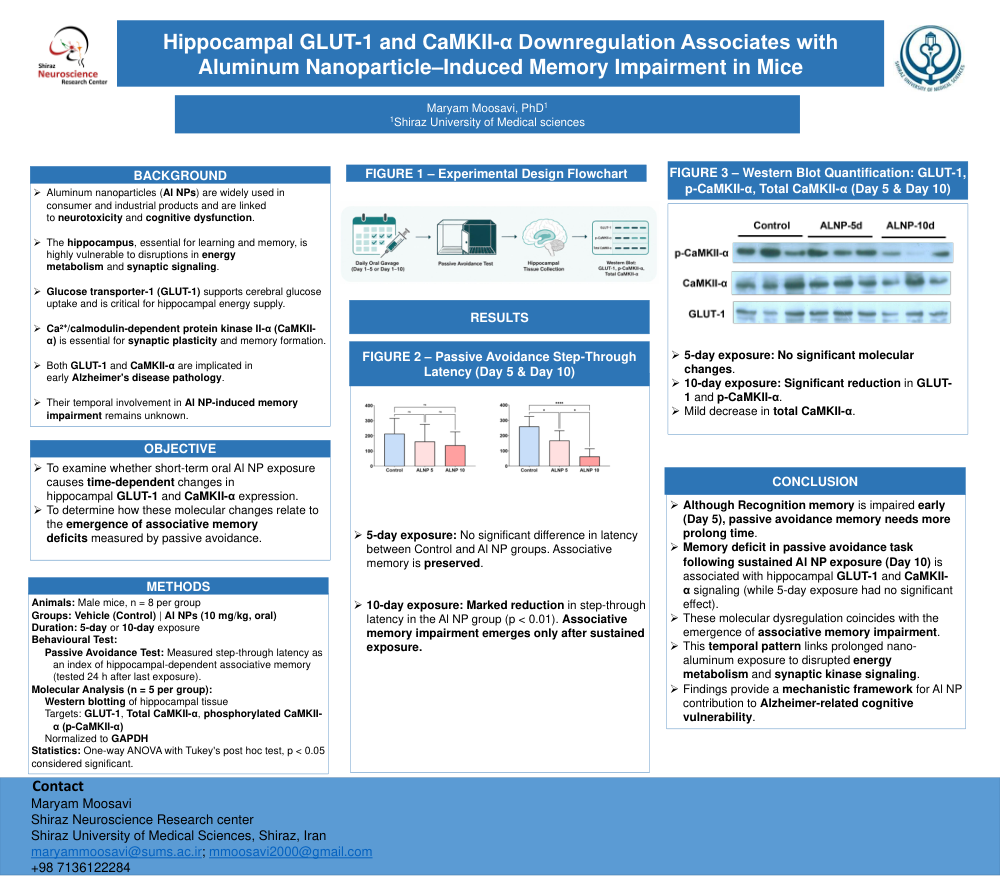
Aluminum nanoparticles (Al NPs) are widely used in consumer and industrial products and have been linked to neurotoxicity and cognitive dysfunction. The hippocampus, essential for learning and memory, is particularly vulnerable to disruptions in energy metabolism and synaptic signaling. Glucose transporter-1 (GLUT-1) supports cerebral glucose uptake, and calcium/calmodulin-dependent protein kinase II-α (CaMKII-α) is critical for synaptic plasticity. Both are implicated in early Alzheimer’s disease pathology. This study examined whether short-term oral Al NP exposure produces time-dependent alterations in hippocampal GLUT-1 and CaMKII-α expression and how these changes relate to recognition and passive avoidance memory deficits.
Methods:
Male mice (n = 8 per group) received vehicle or Al NPs (10 mg/kg, oral) for 5 or 10 days. Novel object recognition (NOR) and passive avoidance tests assessed recognition and associative memory. Hippocampal tissues from a subset (n = 5 per group) were analyzed by Western blotting for GLUT-1, total CaMKII-α, and phosphorylated CaMKII-α, normalized to GAPDH. Data were analyzed using one-way ANOVA with Tukey’s post hoc test.
Results:
Five-day Al NP exposure impaired NOR performance without affecting passive avoidance retention, whereas 10-day exposure disrupted both tasks. At the molecular level, only 10-day exposure significantly reduced hippocampal GLUT-1 and phosphorylated CaMKII-α, with a mild decrease in total CaMKII-α. These molecular alterations coincided with the onset of passive avoidance deficits.
Conclusion:
Ten-day Al NP exposure produced a progression from early recognition-memory impairment to later associative-memory deficits. Recognition memory declined by day 5 without detectable molecular changes, whereas downregulation of GLUT-1 and CaMKII-α emerged only after 10 days, aligning with passive avoidance impairment. This temporal pattern indicates that sustained exposure disrupts hippocampal energy metabolism and synaptic kinase signaling, providing a mechanistic framework for how nano-aluminum may contribute to Alzheimer-related cognitive vulnerability.
Comments
Email is required but is not shown publicly.
Loading comments...