4,068 posters, 219 videos, 101 topics, 69 sessions, 14,365 authors, 6,128 institutions
ePostersLive by SciGen Technologies S.A. All rights reserved.
Alzheimer's Association International Conference 2026
July 12-15, 2026 | London, United Kingdom, and Online

4536
The Gut-brain Axis As A Driver Of Neuroinflammation: A Non-amyloid Pathogenesis Framework For Alzheimer’s
Poster Presenter
Authors
Vinu Sherimon, Abraham Varghese, Sherimon P.C., Rahul V. Nair, Nithyasri Parthasarathi
Affiliations
Department of Computing and Information Sciences, University of Technology and Applied Sciences, Muscat, Sultanate of Oman, Department of Supporting Requirements, University of Technology and Applied Sciences, Muscat, Sultanate of Oman, Faculty of Computer Studies, Arab Open University, Muscat, Sultanate of Oman, Chief Medical Officer, Al Rayan Medical Clinic, Ibra, Sultanate of Oman, Chemical and Biomolecular Engineering, Whiting School of Engineering, Johns Hopkins University, Baltimore, MD, USA
Part of Topic
The Gut-Brain Axis as a Driver of Neuroinflammation: A Non-Amyloid Pathogenesis Framework for Alzheimer’s
Background
Even though the traditional Amyloid Cascade Hypothesis identifies the deposition of Amyloid-beta as the primary cause of Alzheimer’s disease (AD), several clinical trials targeting amyloid therapies suggests that may signify a late-stage symptom rather than a key driver. Emerging research studies show that AD is not merely a central nervous system disorder, but a systemic multi-organ disorder. Precisely, the Microbiota-Gut-Brain Axis (MGBA) has grown as a compelling regulator of neuroinflammation, recognizing it as an important factor in the pathogenesis and early-stage progression of AD.
Method
Using PRISMA 2020 guidelines, a meta-synthetic methodology was followed. Through a systematic search, clinical data from high-impact literature (2022-2025) were evaluated. We selected 25 studies for synthesis and theoretical modeling of the gut-brain inflammatory axis. The focus of the review was on studies linking Dysbiosis to Microglial Activation, explicitly the role of microbial metabolites such as Lipopolysaccharides (LPS) and Short-Chain Fatty Acids (SCFAs) in lowering microglial phenotypes.
Results
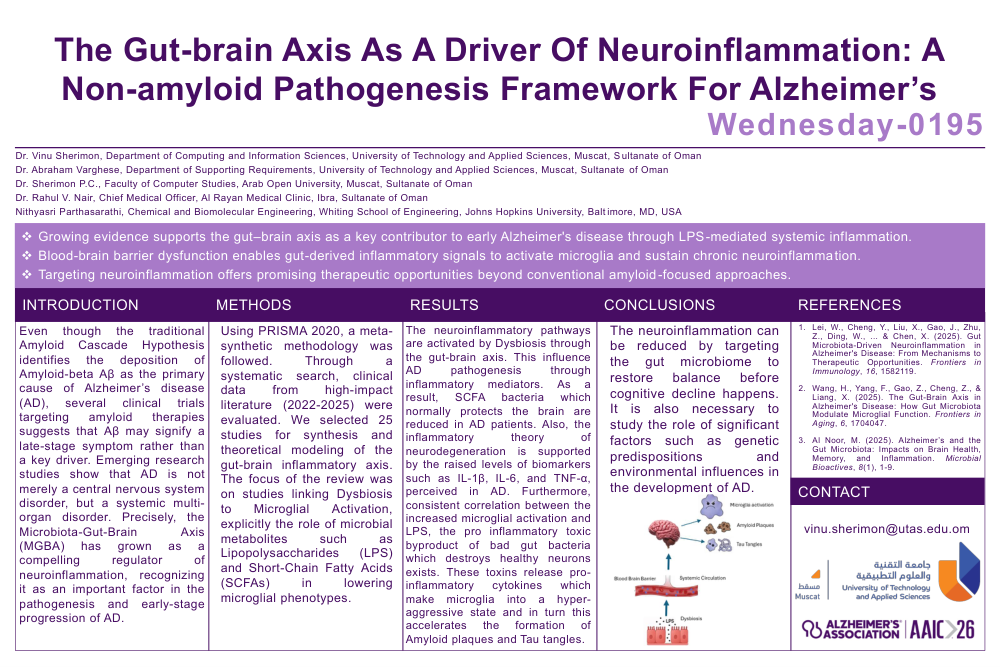
The neuroinflammatory pathways are activated by Dysbiosis through the gut-brain axis. This influence AD pathogenesis through inflammatory mediators. As a result, SCFA bacteria which normally protects the brain are reduced in AD patients. Also, the inflammatory theory of neurodegeneration is supported by the raised levels of inflammatory biomarkers such as , , and , perceived in AD. Furthermore, consistent correlation between the increased microglial activation and LPS, the pro-inflammatory toxic byproduct of bad gut bacteria which destroys healthy neurons exists. These toxins release pro-inflammatory cytokines which make microglia into a hyper-aggressive state and in turn this accelerates the formation of Amyloid plaques and Tau tangles.
Conclusion
The neuroinflammation can be reduced by targeting the gut microbiome to restore balance before cognitive decline happens. It offers a scalable, low-cost strategy for preventing AD, especially in areas where advanced neuroimage is not easily accessible. While this framework is promising, it is also necessary to study the role of significant factors such as genetic predispositions and environmental influences in the development of AD. Future research is required to fully understand the complex interactions within the gut-brain axis and its implications in the treatment of AD.
References
Lei, W., Cheng, Y., Liu, X., Gao, J., Zhu, Z., Ding, W., ... & Chen, X. (2025). Gut Microbiota-Driven Neuroinflammation in Alzheimer's Disease: From Mechanisms to Therapeutic Opportunities. Frontiers in Immunology, 16, 1582119.
Wang, H., Yang, F., Gao, Z., Cheng, Z., & Liang, X. (2025). The Gut-Brain Axis in Alzheimer's Disease: How Gut Microbiota Modulate Microglial Function. Frontiers in Aging, 6, 1704047.
Al Noor, M. (2025). Alzheimer’s and the Gut Microbiota: Impacts on Brain Health, Memory, and Inflammation. Microbial Bioactives, 8(1), 1-9.
Fernández, S. J. F., Aparicio, J. G. P., Lopez, L. F. J., Casillas, M. C., Quijano, M. H., Valle, I. M., ... & Tarazona, M. A. C. (2025). The Gut–Brain Axis in Alzheimer’s Disease: Microbiota Dysbiosis, Neuroinflammation, and Systemic Implications. IECCMEXICO, 3(1).
Kang, J. W., Khatib, L. A., Heston, M. B., Dilmore, A. H., Labus, J. S., Deming, Y., ... & Bendlin, B. B. (2025). Gut microbiome compositional and functional features associate with Alzheimer's disease pathology. Alzheimer's & Dementia, 21(7), e70417.
Kaur, S., Kumari, D., & Dandekar, M. P. (2025). Importance of Gut Microbiota Dysbiosis and Circadian Disruption–Associated Biomarkers in Emergence of Alzheimer’s Disease. Molecular Neurobiology, 62(5), 6308-6316.
Comments
Email is required but is not shown publicly.
Loading comments...