4,068 posters, 219 videos, 101 topics, 69 sessions, 14,365 authors, 6,128 institutions
ePostersLive by SciGen Technologies S.A. All rights reserved.
Alzheimer's Association International Conference 2026
July 12-15, 2026 | London, United Kingdom, and Online

9568
Molecular Interplay Between Human Iapp And Tau Pathology In A Double-transgenic Mouse Model Of Type 2 Diabetes And Tauopathy
Part of Topic
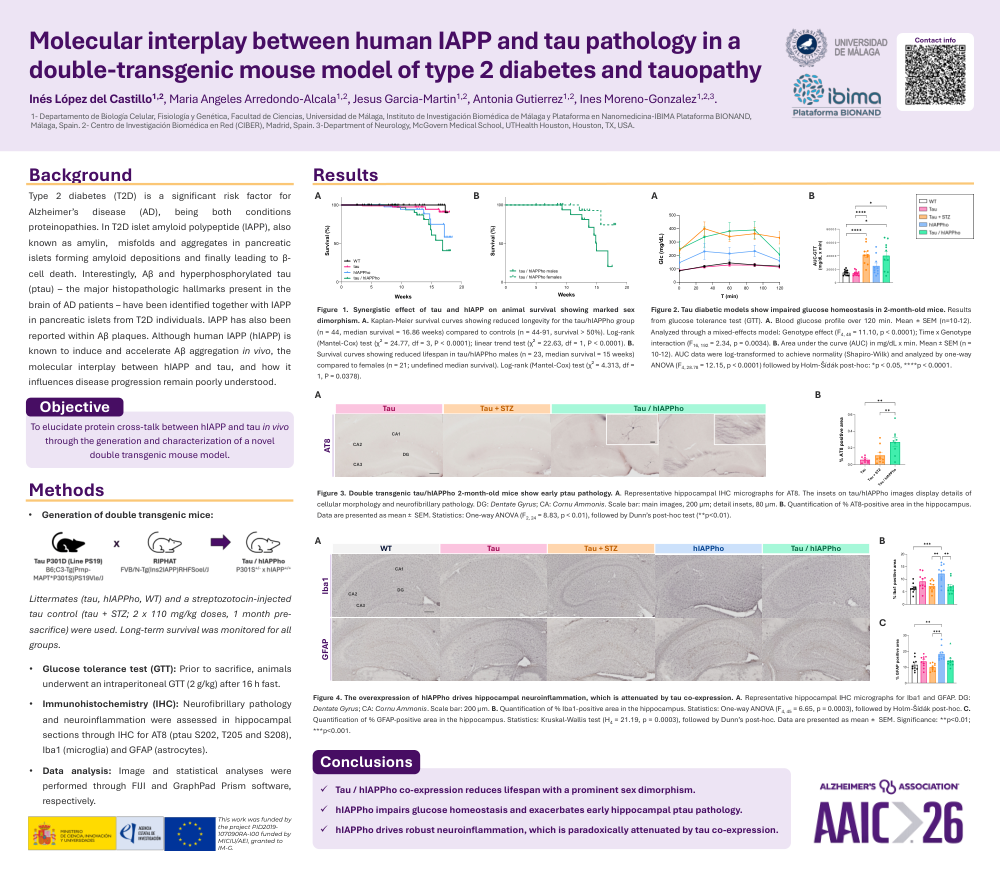
Background: Type 2 diabetes (T2D) is a significant risk factor for Alzheimer’s disease (AD), being both conditions proteinopathies. In T2D islet amyloid polypeptide (IAPP) misfolds and aggregates in pancreatic islets leading to β-cell death. Interestingly, Aβ and hyperphosphorylated tau (ptau) – the major histopathologic hallmarks present in the brain of AD patients – have been identified together with IAPP in pancreatic islets from T2D individuals. IAPP has also been reported within Aβ plaques. Although human IAPP (hIAPP) is known to promote Aβ aggregation, the molecular interplay between hIAPP and tau pathology remains poorly understood.
Methods: To elucidate protein crosstalk between hIAPP and tau, we generated a double transgenic model of T2D and tauopathies (RIPHAT × PS19) which overexpresses hIAPP and mutant tau (P301S), developing pancreatic amyloid deposits and tau neuropathology. Clinical and metabolic assessment was performed on the double-transgenic mice followed by a biochemical and histological evaluation of tau-hIAPP interaction in pancreas, brain, and plasma. The neuroinflammatory state was assessed through the analysis of glial markers.
Results: The RIPHAT×PS19 model displayed a faster clinical progression compared to single transgenic mice. The homozygous hIAPP background induced profound metabolic dysfunction, including persistent hyperglycemia and glucose intolerance, resulting in a significant reduction in lifespan (median survival ~16 weeks). This accelerated mortality preceded the typical onset of memory impairment in the PS19 line. Histological assessments of these animals revealed the presence of tau phosphorylation in the hippocampus, and microglial and astroglial activation, indicating that the co-expression of hIAPP and mutant tau induces an early neuroinflammatory environment.
Conclusions: Our results suggest that the convergence of metabolic dysfunction and hIAPP overexpression significantly impacts survival and is associated with early pathological changes in tau and neuroinflammatory markers. The RIPHAT×PS19 model demonstrates how a systemic metabolic environment can influence the progression of tauopathy prior to the onset of advanced neurodegeneration. Consequently, this dual-transgenic approach provides a robust platform to investigate the metabolic underpinnings of proteinopathies and novel therapeutic interventions directed at the IAPP-tau cross-talk.
Comments
Email is required but is not shown publicly.
Loading comments...