4,068 posters, 219 videos, 101 topics, 69 sessions, 14,365 authors, 6,128 institutions
ePostersLive by SciGen Technologies S.A. All rights reserved.
Alzheimer's Association International Conference 2026
July 12-15, 2026 | London, United Kingdom, and Online

910
Better Slow-wave Sleep Quality Associates With Better Glymphatic Function And Slows Down Cognitive Decline In Preclinical AD
Poster Presenter
Authors
Núria Tort-Colet, Ana Fernández-Arcos, Mariateresa Buongiorno, Natalia Soldevila-Domenech, Sebastian C. Holst, Michalis Kassinopoulos, Gonzalo Sanchez-Benavides, Oriol Grau-Rivera
Affiliations
Clinical and Risk Factors for Neurodegenerative Diseases Research Group, BarcelonaBeta Brain ResearchCenter, Barcelona, Spain, Vall d'Hebron Research Institute, Barcelona, Spain, Roche Pharma Research and Early Development,Neuroscience and Rare Diseases, Roche Innovation Center Basel, F. Hoffmann, BarcelonaBeta Brain ResearchCenter, Barcelona, Spain
Part of Topic
INTRODUCTION:
• Alzheimer's disease (AD) is characterized by the pathological accumulation of Aβ and tau proteins, detectable decades before cognitive symptoms emerge1, granting a critical window for prevention strategies.
• The glymphatic system plays a key role in clearing these proteins, a process that occurs primarily during slow-wave sleep (SWS)2, which is also the sleep stage during which memory consolidation takes place3. Therefore, SWS emerges as a potential modifiable risk factor in AD pathophysiology.
• However, whether objective SWS quality associates with glymphatic and cognitive function over time in cognitively healthy adults at elevated AD risk remains poorly understood.
• Given that AD disproportionately affects women, it is also unknown whether these associations differ by sex, a gap that could help explain women's unequal vulnerability to the disease.
AIM:
To test wheter SWS parameters are related to glymphatic function and cognitive trajectories in a cohort of healthy older adults at increased risk of AD.
METHODS:
Cohort:
The study comprised 76 cognitively unimpaired ALFA+ cohort participants (65.09 ± 4.56 years, 57.9% women, 65.8 APOE-ε4 carriers) followed every 3 years for 2-4 visits. (Table 1)
PSG:
Polysomnography was performed at visit 2, when participants were free of sleep medication. Individuals presenting severe sleep apnea (AHI>30) were excluded.
SWS parameters:
• PSG time during lights off was classified into sleep stages. Only deep non rapid eye movement (NREM) sleep periods (N2 and N3) were considered.
• EEG signals from the frontal channels (F3 and F4) were used to compute the power spectral density at different frequency ranges:
- Slow oscillation (SO, 0.5-1Hz),
- delta (1-4Hz), and
- slow-wave activity (SWA, 0.5-4Hz)
• Slow waves (SW) were detected following the YASA4 algorithm. Average SW slope and peak-to-peak (PTP) amplitude (Figure 1) were measured for each individual.
Glymphatic function:
Diffusion Tensor Image Analysis Along the Perivascular Space (DTI-ALPS)5 was measured as a proxy for the glymphatic function in each available visit (mean 2.8 visits, range 6.30 ± 0.59 years)
Cognitive performance:
Cognitive performance was evaluated with the Preclinical Alzheimer Cognitive Composite (PACC) in each available visit (mean 3.1 visits, range 6.60 ± 0.87 years).
Statistics:
• Linear mixed-effects models were used to test associations between sleep metrics and DTI-ALPS and between sleep metrics and PACC.
• Models were adjusted for age, sex, and APOE-ɛ4 status, and for education for cognitive outcomes.
• Stratified analyses were performed to test sex differences in these associations.
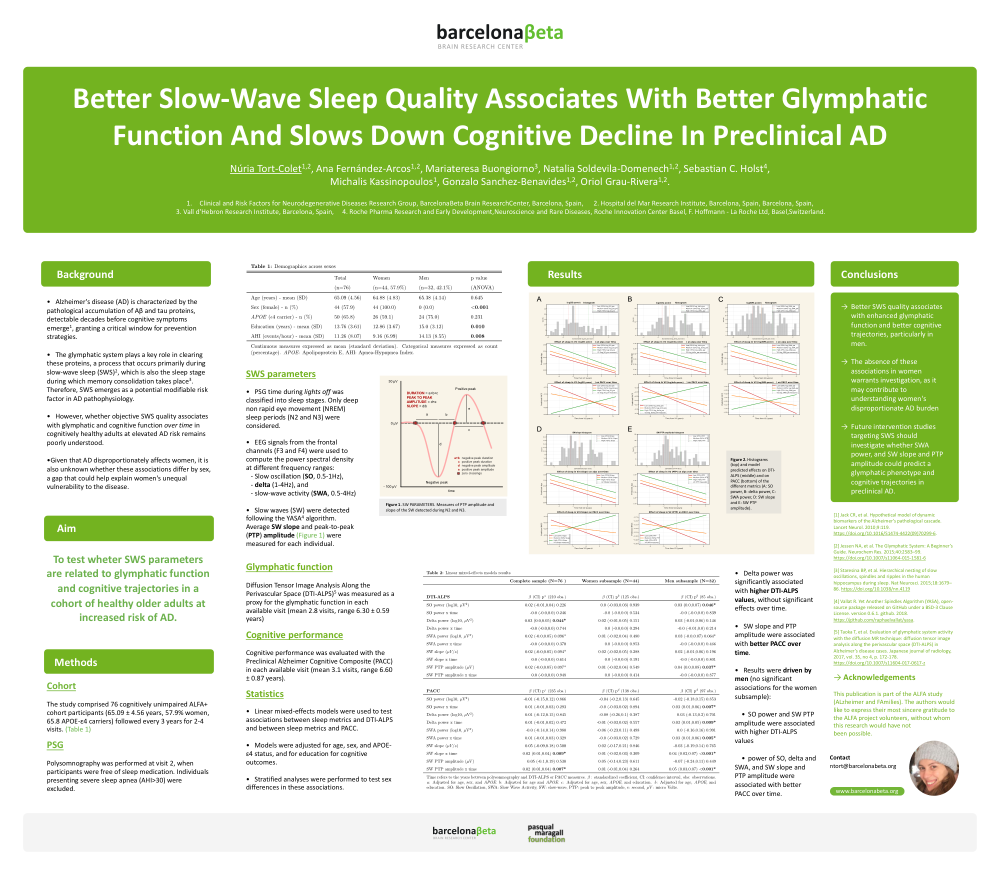
RESULTS:
• Delta power was significantly associated with higher DTI-ALPS values, without significant effects over time.
• SW slope and PTP amplitude were associated with better PACC over time.
• Results were driven by men (no significant associations for the women subsample):
• SO power and SW PTP amplitude were associated with higher DTI-ALPS values
• power of SO, delta and SWA, and SW slope and PTP amplitude were associated with better PACC over time.
CONCLUSIONS:
[1] Jack CR, et al. Hypothetical model of dynamic biomarkers of the Alzheimer’s pathological cascade. Lancet Neurol. 2010;9:119. https://doi.org/10.1016/S1474-4422(09)70299-6.
[2] Jessen NA, et al. The Glymphatic System: A Beginner’s Guide. Neurochem Res. 2015;40:2583–99. https://doi.org/10.1007/s11064-015-1581-6
[3] Staresina BP, et al. Hierarchical nesting of slow oscillations, spindles and ripples in the human hippocampus during sleep. Nat Neurosci. 2015;18:1679–86. https://doi.org/10.1038/nn.4119
[4] Vallat R. Yet Another Spindles Algorithm (YASA), open-source package released on GitHub under a BSD-3 Clause License. version 0.6.1. github. 2018. https://github.com/raphaelvallat/yasa.
[5] Taoka T, et al. Evaluation of glymphatic system activity with the diffusion MR technique: diffusion tensor image analysis along the perivascular space (DTI-ALPS) in Alzheimer’s disease cases. Japanese journal of radiology, 2017, vol. 35, no 4, p. 172-178.https://doi.org/10.1007/s11604-017-0617-z
This publication is part of the ALFA study (ALzheimer and FAmilies). The authors would like to express their most sincere gratitude to the ALFA project volunteers, without whom this research would have not been possible.
Comments
Email is required but is not shown publicly.
Loading comments...