4,068 posters, 219 videos, 101 topics, 69 sessions, 14,365 authors, 6,128 institutions
ePostersLive by SciGen Technologies S.A. All rights reserved.
Alzheimer's Association International Conference 2026
July 12-15, 2026 | London, United Kingdom, and Online

11773
Age And Phenotype Shape Thalamic Subnuclear Tau Vulnerability In Progressive Supranuclear Palsy
Poster Presenter
Part of Topic
Background
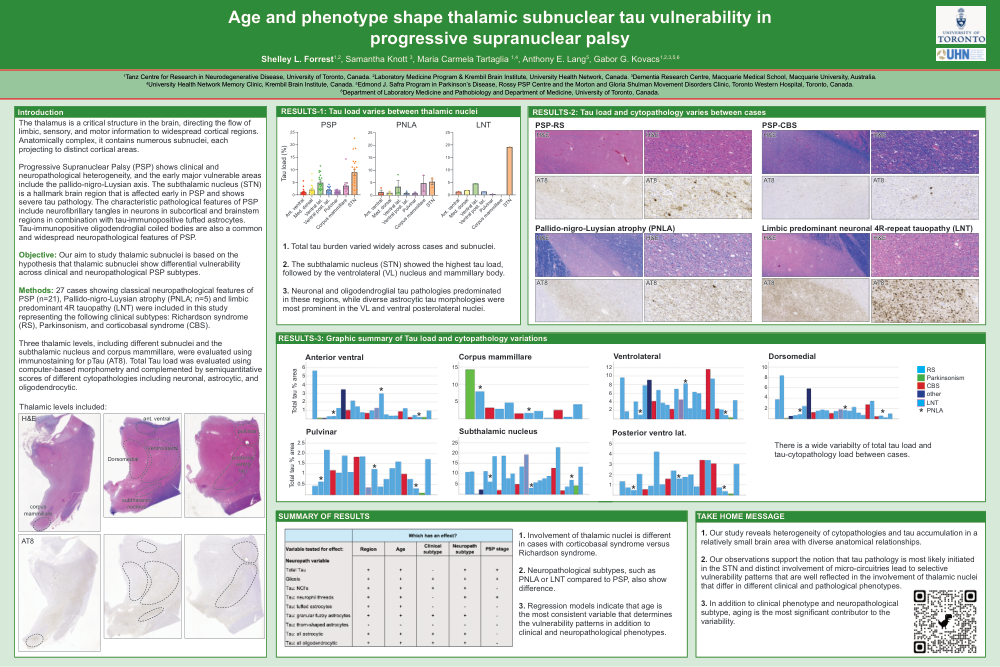
The thalamus is a central relay structure integrating limbic, sensory, and motor pathways. Progressive Supranuclear Palsy (PSP) is clinically and neuropathologically heterogeneous, with early involvement of the pallido–nigro–Luysian axis. We hypothesized that thalamic subnuclei show differential vulnerability across clinical phenotypes and neuropathological subtypes of 4R-tauopathy.
Methods
We examined 27 cases with classical PSP pathology (n = 21), pallido–nigro–Luysian atrophy (PNLA; n = 5), and limbic predominant 4R tauopathy (LNT; n = 1), representing Richardson syndrome (RS), PSP-parkinsonism, and corticobasal syndrome (CBS). Three thalamic levels encompassing seven subnuclei were assessed using AT8 pTau immunohistochemistry. Total tau burden was quantified using computer-based morphometry, complemented by semiquantitative assessment of neuronal, astrocytic, and oligodendroglial tau cytopathologies. Multivariable regression analyses were used to control for demographic and clinicopathological variables.
Results
Total tau burden varied widely across cases and subnuclei. The subthalamic nucleus (STN) showed the highest tau load, followed by the ventrolateral (VL) nucleus and mammillary body. Neuronal and oligodendroglial tau pathologies predominated in these regions, while diverse astrocytic tau morphologies were most prominent in the VL and ventral posterolateral nuclei. Thorn-shaped astrocytes were selectively observed in the mammillary body. PSP and PNLA differed significantly in the distribution of tau cytopathologies, and CBS showed a distinct thalamic subnuclear involvement compared to RS. Regression analyses identified age as the most consistent determinant of vulnerability patterns, in addition to clinical phenotype and neuropathological subtype.
Conclusion
Thalamic tau pathology in PSP-spectrum disorders is highly heterogeneous and subnucleus-specific. Our findings support a model in which tau pathology is most prominent, and potentially initiated, in the STN, with propagation through distinct thalamic micro-circuitries.giving rise to selective vulnerability patterns. These patterns differ across clinical phenotypes and neuropathological subtypes, with aging emerging as a major contributor to variability.
Comments
Email is required but is not shown publicly.
Loading comments...