4,068 posters, 219 videos, 101 topics, 69 sessions, 14,365 authors, 6,128 institutions
ePostersLive by SciGen Technologies S.A. All rights reserved.
Alzheimer's Association International Conference 2026
July 12-15, 2026 | London, United Kingdom, and Online

7268
Functional Ultrasound Reveals Distinct Cerebral Blood Volume Dynamics In The Late Stage Of An Alzheimer’S Mouse Model.
Poster Presenter
Part of Topic
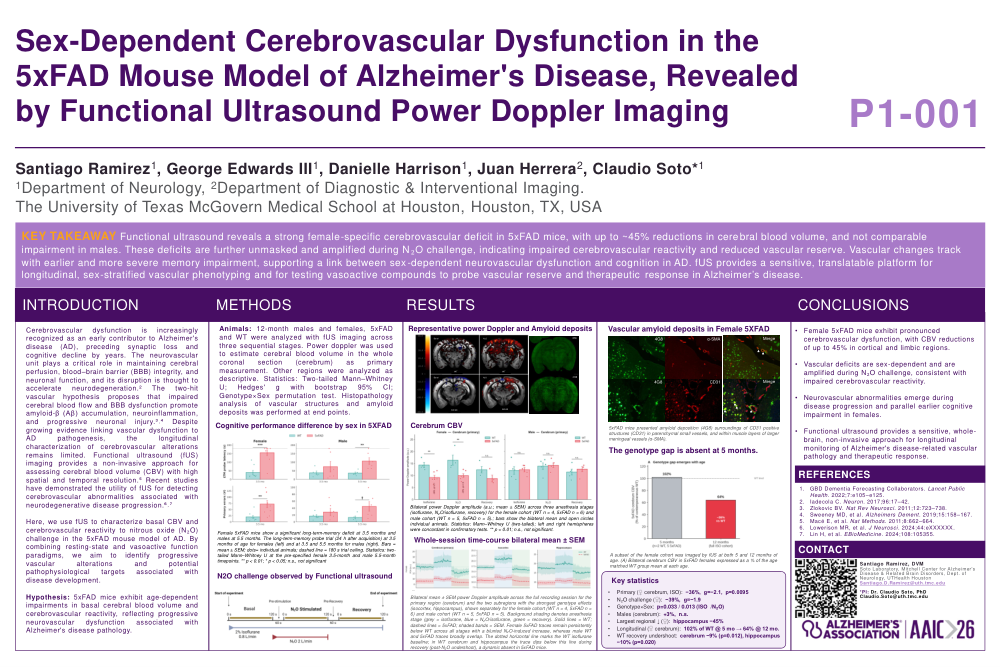
Sex-Dependent Cerebrovascular Dysfunction in the 5xFAD Mouse Model of Alzheimer's Disease, Revealed by Functional Ultrasound Power Doppler Imaging
Cerebrovascular dysfunction is increasingly recognized as an early contributor to Alzheimer's disease (AD), preceding synaptic loss and cognitive decline by years. The neurovascular unit plays a critical role in maintaining cerebral perfusion, blood–brain barrier (BBB) integrity, and neuronal function, and its disruption is thought to accelerate neurodegeneration.² The two-hit vascular hypothesis proposes that impaired cerebral blood flow and BBB dysfunction promote amyloid-β (Aβ) accumulation, neuroinflammation, and progressive neuronal injury.³˒⁴ Despite growing evidence linking vascular dysfunction to AD pathogenesis, the longitudinal characterization of cerebrovascular alterations remains limited. Functional ultrasound (fUS) imaging provides a non-invasive approach for assessing cerebral blood volume (CBV) with high spatial and temporal resolution.⁵ Recent studies have demonstrated the utility of fUS for detecting cerebrovascular abnormalities associated with neurodegenerative disease progression.⁶˒⁷ Here, we use fUS to characterize basal CBV and cerebrovascular reactivity to nitrous oxide (N₂O) challenge in the 5xFAD mouse model of AD. By combining resting-state and vasoactive function paradigms, we aim to identify progressive vascular alterations and potential pathophysiological targets associated with disease development.
Hypothesis: 5xFAD mice exhibit age-dependent impairments in basal cerebral blood volume and cerebrovascular reactivity, reflecting progressive neurovascular dysfunction associated with Alzheimer's disease pathology.
Comments
Email is required but is not shown publicly.
Loading comments...