4,068 posters, 219 videos, 101 topics, 69 sessions, 14,365 authors, 6,128 institutions
ePostersLive by SciGen Technologies S.A. All rights reserved.
Alzheimer's Association International Conference 2026
July 12-15, 2026 | London, United Kingdom, and Online

495
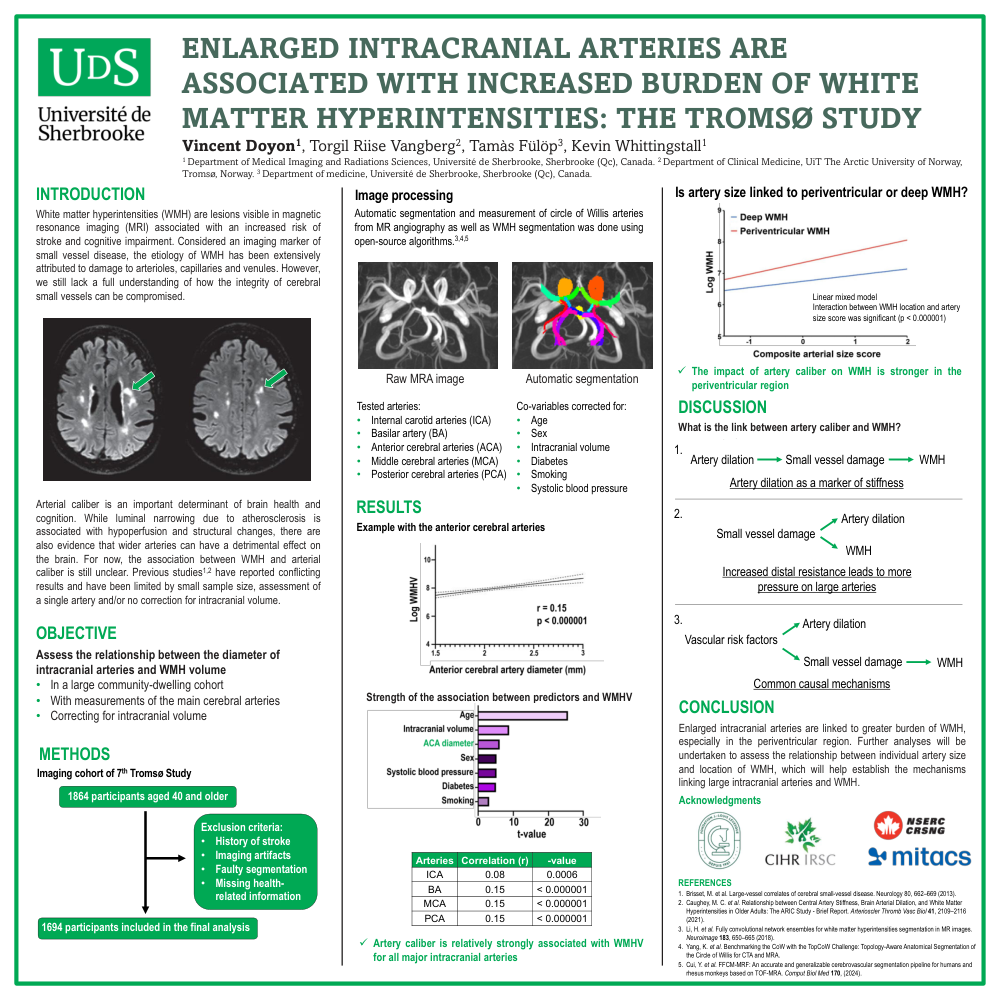
Enlarged Intracranial Arteries Are Associated With Increased Burden Of White Matter Hyperintensities
Poster Presenter
Authors
Vincent Doyon, Torgil Vangberg, Tamàs Fülöp, Kevin Whittingstall
Affiliations
Department of Medical Imaging and Radiations Sciences, Université de Sherbrooke, Sherbrooke (Qc), Canada., Department of Clinical Medicine, UiT The Arctic University of Norway, Tromsø, Norway., Department of medicine, Université de Sherbrooke, Sherbrooke (Qc), Canada.
Part of Topic
Introduction
White matter hyperintensities (WMH) are lesions visible in magnetic resonance imaging (MRI) associated with an increased risk of stroke and cognitive impairment. Considered an imaging marker of small vessel disease, the etiology of WMH has been extensively attributed to damage to arterioles, capillaries and venules. However, we still lack a full understanding of how the integrity of cerebral small vessels can be compromised.
Arterial caliber is an important determinant of brain health and cognition. While luminal narrowing due to atherosclerosis is associated with hypoperfusion and structural changes, there are also evidence that wider arteries can have a detrimental effect on the brain. For now, the association between WMH and arterial caliber is still unclear. Previous studies1,2 have reported conflicting results and have been limited by small sample size, assessment of a single artery and/or no correction for intracranial volume.
OBJECTIVE
Assess the relationship between the diameter of intracranial arteries and WMH volume
In a large community-dwelling cohort
With measurements of the main cerebral arteries
Correcting for intracranial volume
Automatic segmentation and measurement of circle of Willis arteries from MR angiography as well as WMH segmentation was done using open-source algorithms.3,4,5
CONCLUSION
Enlarged intracranial arteries are linked to greater burden of WMH, especially in the periventricular region. Further analyses will be undertaken to assess the relationship between individual artery size and location of WMH, which will help establish the mechanisms linking large intracranial arteries and WMH.
Comments
Email is required but is not shown publicly.
Loading comments...