4,068 posters, 219 videos, 101 topics, 69 sessions, 14,365 authors, 6,128 institutions
ePostersLive by SciGen Technologies S.A. All rights reserved.
Alzheimer's Association International Conference 2026
July 12-15, 2026 | London, United Kingdom, and Online

4306
Tracking Of Amyloid-ί Aggregation Transitions And Inhibitor Effects By Foppr Binding Kinetics
Poster Presenter
Authors
Affiliations
Part of Topic
Background:
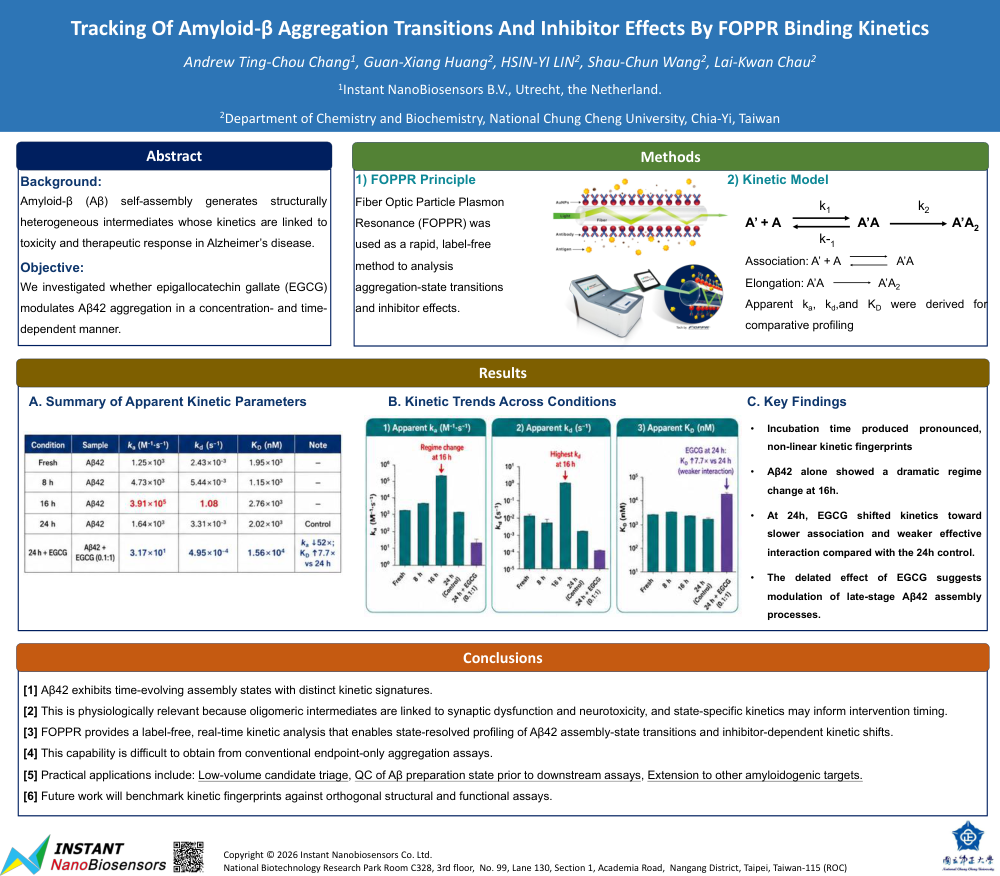
Amyloid-β (Aβ) self-assembly proceeds through structurally heterogeneous intermediates whose formation kinetics are linked to toxicity and therapeutic response in Alzheimer’s disease. Epigallocatechin gallate (EGCG) has been reported to modulate Aβ42 aggregation in a concentration and time-dependent manner, motivating rapid, label-free methods that can resolve aggregation-state transitions and inhibitor effects.
Methods:
Fiber Optic Particle Plasmon Resonance (FOPPR) on an Au nanoparticle-modified optical fiber (commercial INB D8 analyzer) was used to monitor Aβ-Aβ interactions in real time. Surface-immobilized Aβ monomer (A′) was used to probe the binding between A’ and soluble Aβ42 freshly prepared or pre-incubated (8, 16, 24 h), as well as using the same conditions in the presence of EGCG (EGCG:Aβ42 = 0.1:1). Sensorgrams were analyzed with a sequential self-assembly model comprising reversible dimer formation (A′ + A ⇌ A′A; k1, k−1) followed by an effectively irreversible stabilization step (A′A + A → A′A2; k2) over the measurement window; apparent ka, kd, and KD were derived for comparative profiling.
Results:
Incubation time produced pronounced, non-linear kinetic fingerprints. For Aβ42 alone, apparent ka increased from 1.25×10³ (fresh) to 4.73×10³ (8 h), surged to 3.91×10⁵ (16 h), then returned toward baseline at 1.64×10³ (24 h), with a parallel regime shift in kd (2.43×10⁻³ fresh; 5.44×10⁻³ at 8 h; 1.08 at 16 h; 3.31×10⁻³ at 24 h), consistent with discrete aggregation/conformational transitions in solution. At 24 h, EGCG shifted the binding kinetics toward slower association and weaker effective interaction versus the 24 h control (ka 3.17×101 vs 1.64×10³; KD 1.56×10⁴ vs 2.02×10³ nM) with reduced kd (4.95×10⁻⁴ vs 3.31×10⁻³).
Conclusion:
Aβ42 exhibits time-evolving assembly states with distinct kinetic signatures; this is physiologically relevant because the abundance and persistence of oligomeric intermediates are linked to synaptic dysfunction and neurotoxicity, and state-specific kinetics may inform intervention timing. The FOPPR sensor provides a label-free, real-time kinetic analysis that enables state-resolved profiling of Aβ42 assembly-state transitions and inhibitor-dependent kinetic shifts. The workflow is feasible for low-volume candidate triage, QC of Aβ preparation state prior to downstream assays, and extension to other amyloidogenic targets; future work will benchmark kinetic fingerprints against orthogonal structural and functional assays.
Comments
Email is required but is not shown publicly.
Loading comments...