4,068 posters, 219 videos, 101 topics, 69 sessions, 14,365 authors, 6,128 institutions
ePostersLive by SciGen Technologies S.A. All rights reserved.
Alzheimer's Association International Conference 2026
July 12-15, 2026 | London, United Kingdom, and Online

1280
The Neurogenic Fence: A Spatial Transcriptomic Blueprint Of Hippocampal Niche Maintenance And Implications For Alzheimer’s Pathogenesis
Poster Presenter
Authors
Affiliations
Part of Topic
Title: The Neurogenic Fence: A Spatial Transcriptomic Blueprint of Hippocampal Neurogenic Niche Maintenance and Implications for Alzheimer's Pathogenesis
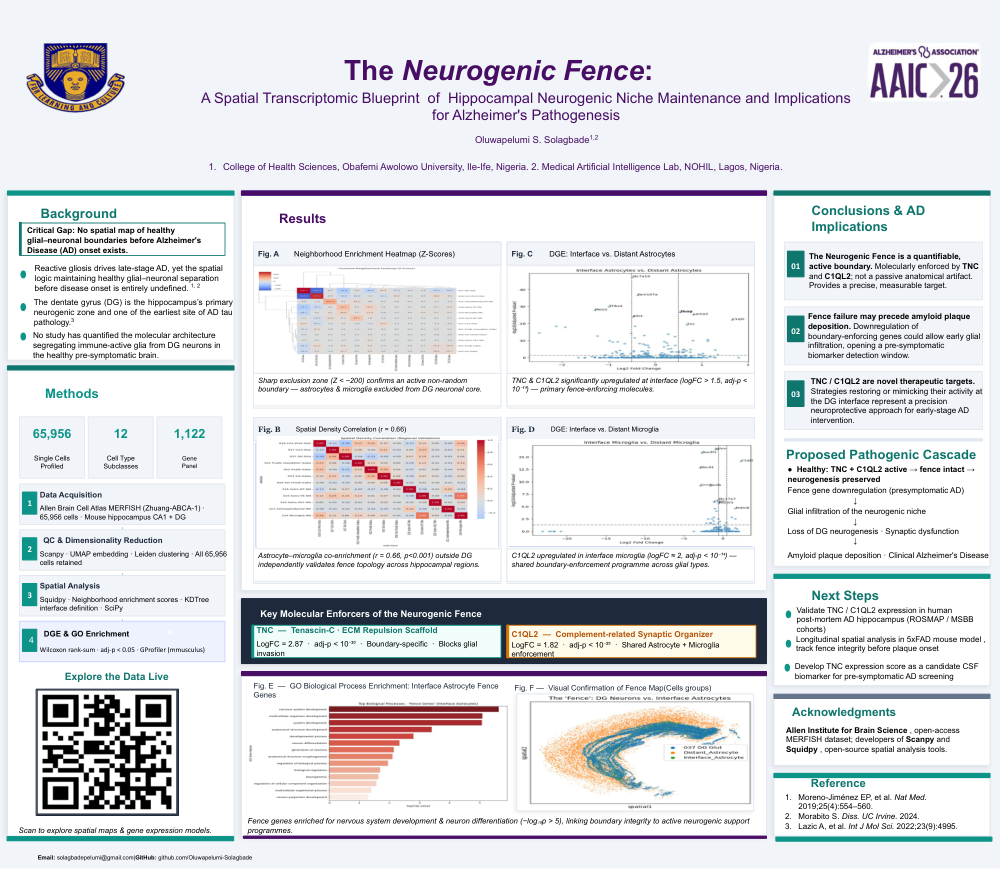
Background: Reactive gliosis drives late-stage Alzheimer's disease (AD), yet the spatial logic maintaining healthy glial-neuronal separation before disease onset remains entirely undefined. The dentate gyrus (DG) is the hippocampus's primary neurogenic zone and one of the earliest sites of AD tau pathology. No study has quantified the molecular architecture segregating immune-active glia from DG neurons in the healthy pre-symptomatic brain.
Methods: We conceptualized and executed an end-to-end computational analysis of the Allen Brain Cell Atlas (MERFISH dataset) profiling 65,956 cells across the mouse hippocampus (CA1 and DG subfields). Using Scanpy for dimensional reduction and clustering, and Squidpy for spatial neighborhood enrichment scores and KDTree interface definition, we mapped the healthy blueprint of the hippocampal niche. Differential gene expression (DGE) and Gene Ontology (GO) enrichment analyses were performed via Wilcoxon rank-sum tests to identify specific boundary-enforcing candidates.
Results: Spatial analysis revealed a sharp exclusion zone (Z < -200), confirming an active, non-random boundary where astrocytes and microglia are strictly excluded from the DG neuronal core—a phenomenon we term the "Neurogenic Fence." Tenascin-C (TNC, logFC = 2.87, adj-p < 10^-29) and Complement-component-1q-like-2 (C1QL2, logFC = 1.82, adj-p < 10^-20) were significantly upregulated at the interface, serving as primary boundary-enforcing molecules. Independent spatial density correlation outside the DG (r = 0.66, p < 0.001) validated this fence topology. GO terms for interface genes were heavily enriched for nervous system development and active neurogenic support programs.
Conclusions: The Neurogenic Fence is a quantifiable, active molecular boundary enforced by TNC and C1QL2 rather than a passive anatomical artifact. We propose a pathogenic cascade where the downregulation of these boundary-enforcing genes precedes amyloid deposition, allowing early glial infiltration into the neurogenic niche and driving subsequent DG neurogenesis loss. TNC and C1QL2 represent novel therapeutic targets for preserving niche integrity in pre-symptomatic AD.
Comments
Email is required but is not shown publicly.
Loading comments...