4,068 posters, 219 videos, 101 topics, 69 sessions, 14,365 authors, 6,128 institutions
ePostersLive by SciGen Technologies S.A. All rights reserved.
Alzheimer's Association International Conference 2026
July 12-15, 2026 | London, United Kingdom, and Online

9835
Divergent Neuroinflammatory Pathways In Alzheimer’s Disease And Down Syndrome: Multifactorial Mechanisms Vs. Genetic Overexpression
Part of Topic
Key:
CSF proteomics reveals that sporadic AD (LOAD) is driven by chronic trophic and lipid homeostatic failure, whereas genetic forms (ADAD and 21AD) are fueled by acute oxidative stress and neuroinflammation
Introduction:
Alzheimer's Disease (AD) exhibits distinct clinical and genetic trajectories across different etiologies, including Late-Onset AD (LOAD), Autosomal Dominant AD (ADAD), and AD associated with Down Syndrome (21AD). Cerebrospinal fluid (CSF) proteomics provides a critical window into these pathological variations. This study aims to compare the functional CSF proteomic landscapes across LOAD, ADAD, and 21AD to delineate shared core pathways and etiology-specific molecular signatures.
Methods:
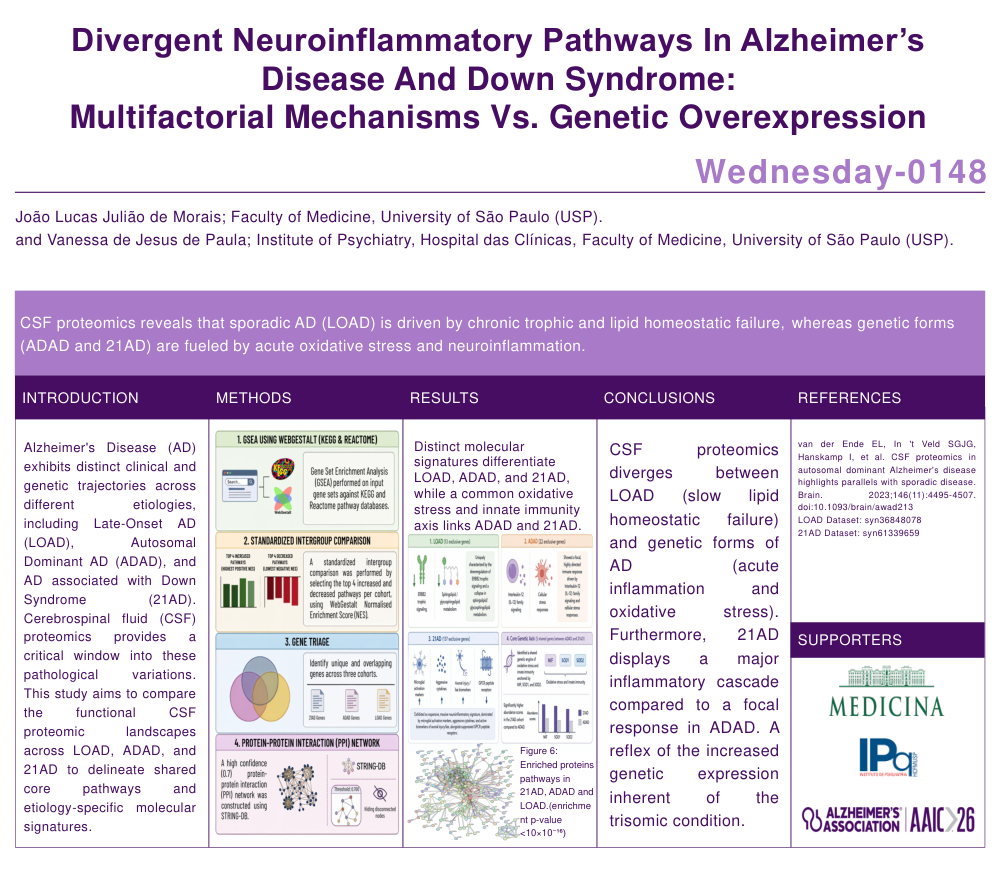
Gene Set Enrichment Analysis (GSEA) was performed via WebGestalt against KEGG and Reactome databases. To establish a standardized intergroup comparison, the top 4 increased (highest positive NES) and top 4 decreased (lowest negative NES) pathways were selected per cohort. Overlapping and unique genes were triaged, and a Protein-Protein Interaction (PPI) network was constructed using STRING-DB under a high-confidence threshold (0.700), hiding disconnected nodes.
Results:
Distinct molecular signatures differentiate LOAD, ADAD, and 21AD, while a common oxidative stress and innate immunity axis links ADAD and 21AD. Figure 6: Enriched proteins pathways in 21AD, ADAD and LOAD.(enrichment p-value <10×10⁻¹⁶)
Conclusions:
CSF proteomics diverges between LOAD (slow lipid homeostatic failure) and genetic forms of AD (acute inflammation and oxidative stress). Furthermore, 21AD displays a major inflammatory cascade compared to a focal response in ADAD. A reflex of the increased genetic expression inherent of the trisomic condition.
Comments
Email is required but is not shown publicly.
Loading comments...