4,068 posters, 219 videos, 101 topics, 69 sessions, 14,365 authors, 6,128 institutions
ePostersLive by SciGen Technologies S.A. All rights reserved.
Alzheimer's Association International Conference 2026
July 12-15, 2026 | London, United Kingdom, and Online

2300
TheGain-of-functionTREM2-T96KMutation Increases Alzheimer’S Disease Risk Via Impaired Microglial Function
Poster Presenter
Part of Topic
Background
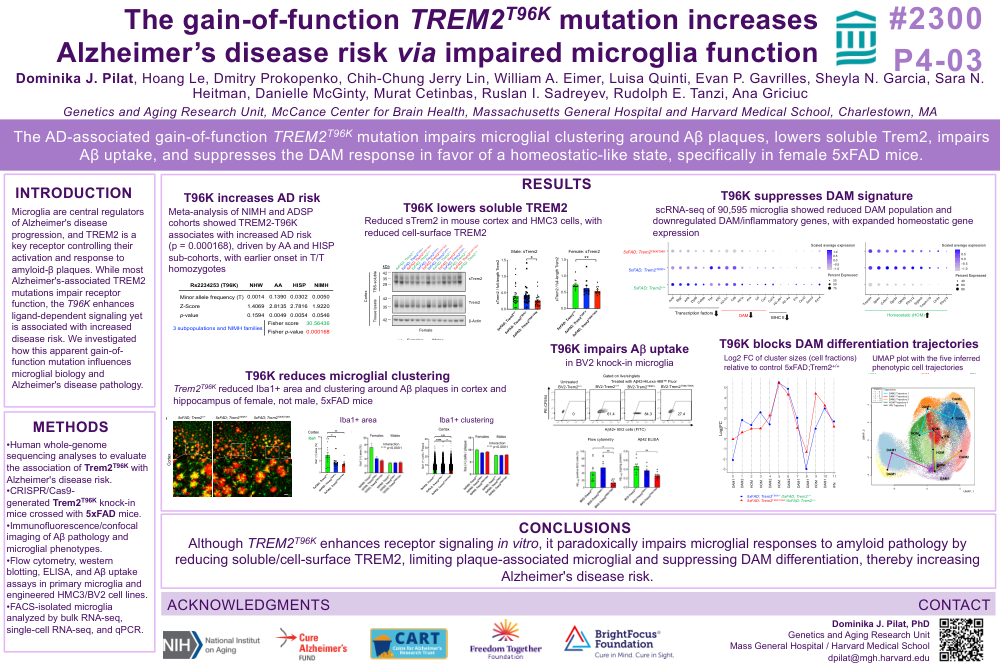
Triggering receptor expressed on myeloid cells 2 (TREM2) is a microglial receptor that modulates amyloid plaque containment, microglial phagocytosis, and inflammatory signaling in Alzheimer’s disease (AD). While most AD-associated TREM2 mutations are loss-of-function, the TREM2T96K substitution enhances ligand-dependent activation in vitro, raising the question of how this gain-of-function mutation impacts AD risk and microglial states in vivo.
Methods
To assess the clinical impact of TREM2T96K, whole-genome sequencing data from family-based and case-control AD cohorts were analyzed for association with disease risk. Trem2T96K knock-in mice on 5xFAD background were generated to examine amyloid plaque–associated microglial responses, soluble Trem2 (sTrem2) levels, and phagocytic capacity in a sex-stratified manner. Amyloid plaque–proximal microglial clustering and phagocytic area were quantified histologically, Aβ uptake was measured in BV2-Trem2T96K knock-in cells, and single-cell RNA sequencing profiled microglial transcriptional states and pathway perturbations.
Results
TREM2T96K significantly increases risk for AD in a whole-genome sequencing dataset comprised of family-based and case-control samples. In 5xFAD mice, Trem2T96K selectively reduced microglial clustering around β-amyloid plaques and decreased total area of phagocytic microglia in females, with no comparable effect in males. Female 5xFAD;Trem2T96K mice, and human microglial cultures harboring T96K exhibited reduced sTrem2 levels. Furthermore, we show an impaired Aβ uptake in Trem2T96K knock-in microglial cells. Single-cell RNA sequencing revealed that Trem2T96K limits the transition of homeostatic microglia into disease-associated microglia (DAM) in female 5xFAD mice and downregulates key inflammatory and signaling pathways, including IL-6/JAK/STAT3, complement, and interferon-γ response.
Conclusions
These data demonstrate that the gain-of-function TREM2T96K mutation increases AD risk and disrupts microglial clustering around amyloid plaques, phagocytosis, and DAM response in a sex-dependent manner. Similar to the loss-of-function R47H mutation, Trem2T96K adversely affects microglial protective functions, challenging the assumption that increased TREM2 activation is uniformly beneficial and underscoring the need for precision modulation of TREM2 signaling in AD.
Comments
Email is required but is not shown publicly.
Loading comments...