4,068 posters, 219 videos, 101 topics, 69 sessions, 14,365 authors, 6,128 institutions
ePostersLive by SciGen Technologies S.A. All rights reserved.
Alzheimer's Association International Conference 2026
July 12-15, 2026 | London, United Kingdom, and Online

8743
TOX-AD: Investigating Gene-Environment Interactions In Humanized Mouse Models Of Alzheimer’s Disease Exposed To Toxic Metals
Poster Presenter
Authors
Kevin P. Kotredes, Leandro Ceotto Freitas Lima, Ravi S. Pandey, Avijit Podder, Olga Minaeva, Juliet A. Moncaster, Gregory W. Carter, David Aylor, Greg Crawford, Paul R. Territo, Lee E. Goldstein, Gareth R. Howell
Affiliations
Boston University, Duke University, The Jackson Laboratory, Stark Neurosciences Research Institute, North Carolina State University
Part of Topic
Background
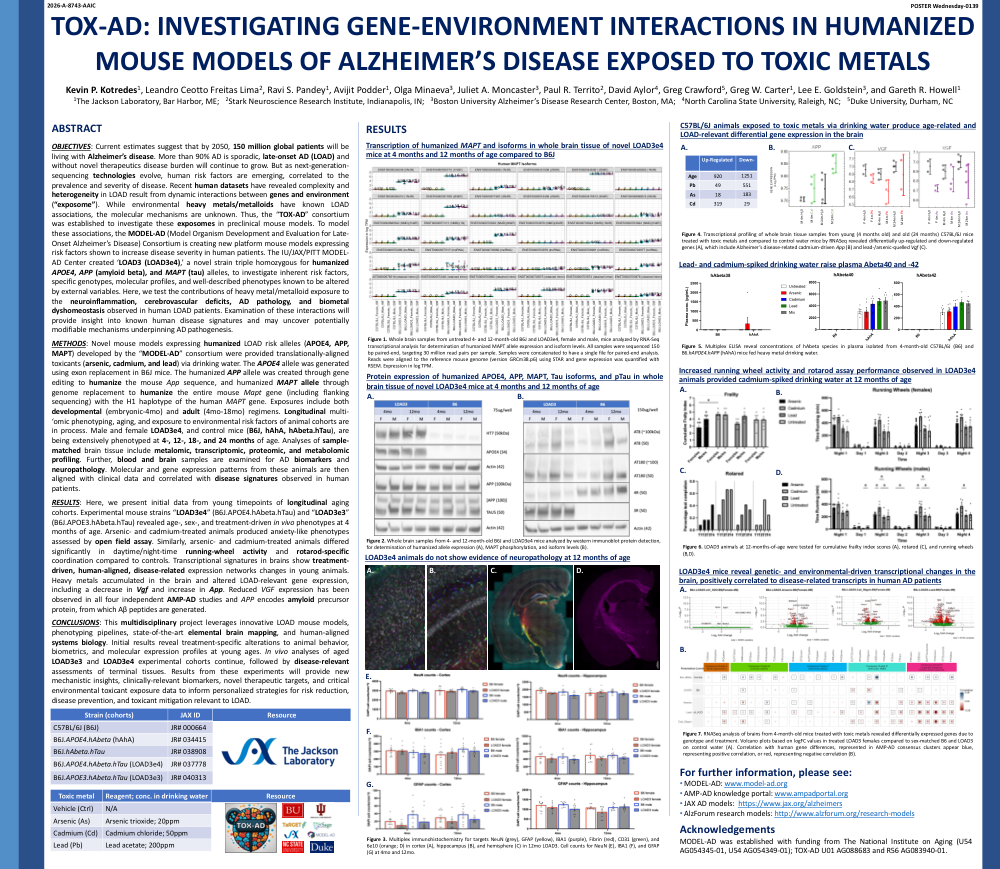
Current estimates suggest that by 2050, 150 million global patients will be living with Alzheimer’s disease. More than 90% AD is sporadic, late-onset AD (LOAD) and without novel therapeutics disease burden will continue to grow. But as next-generation-sequencing technologies evolve, human risk factors are emerging, correlated to the prevalence and severity of disease. Recent human datasets have revealed complexity and heterogeneity in LOAD result from dynamic interactions between genes and environment. While environmental heavy metals/metalloids have known LOAD associations, the molecular mechanisms are unknown. Thus, the “TOX-AD” consortium was established to investigate these exposomes in preclinical mouse models. Here, we test the contributions of heavy metal/metalloid exposure to the neuroinflammation, cerebrovascular deficits, AD pathology, and biometal dyshomeostasis observed in human LOAD patients. Examination of these interactions will provide insight into known human disease signatures and may uncover potentially modifiable mechanisms underpinning AD pathogenesis.
Methods
Novel mouse models expressing humanized LOAD risk alleles (APOE4, APP, MAPT) developed by the “MODEL-AD” consortium were provided translationally-aligned toxicants (arsenic, cadmium, and lead) via drinking water. Exposures include both developmental (embryonic-4mo) and adult (4mo-18mo) regimens, To capture the strongest LOAD risk factor, age, cohorts were examined for 18 months. In vivo phenotyping entailed longitudinal biometric, behavioral, and blood testing. Analyses of sample-matched brain tissue include metalomic, transcriptomic, proteomic, and metabolomic profiling. Further, blood and brain samples are examined for AD biomarkers and neuropathology. Molecular and gene expression patterns from these animals are then aligned with clinical data and correlated with disease signatures observed in human patients.
Results
Experimental mouse strains “LOAD3e4” (B6J.APOE4.hAbeta.hTau) and “LOAD3e3” (B6J.APOE3.hAbeta.hTau) revealed age-, sex-, and treatment-driven in vivo phenotypes at 4 months of age. Arsenic- and cadmium-treated animals produced anxiety-like phenotypes assessed by open field assay. Similarly, arsenic- and cadmium-treated animals differed significantly in daytime/night-time running-wheel activity and rotarod-specific coordination compared to controls. Transcriptional, proteomic, and metabolomic signatures in brains show treatment-driven, human-aligned, disease-related expression networks changes in young animals.
Conclusion
This multidisciplinary project leverages innovative LOAD mouse models, phenotyping pipelines, state-of-the-art elemental brain mapping, and human-aligned systems biology. Initial results reveal treatment-specific alterations to animal behavior, biometrics, and molecular expression profiles at young ages. In vivo analyses of aged LOAD3e3 and LOAD3e4 experimental cohorts continue, followed by disease-relevant assessments of terminal tissues.
Comments
Email is required but is not shown publicly.
Loading comments...