4,068 posters, 219 videos, 101 topics, 69 sessions, 14,365 authors, 6,128 institutions
ePostersLive by SciGen Technologies S.A. All rights reserved.
Alzheimer's Association International Conference 2026
July 12-15, 2026 | London, United Kingdom, and Online

9356
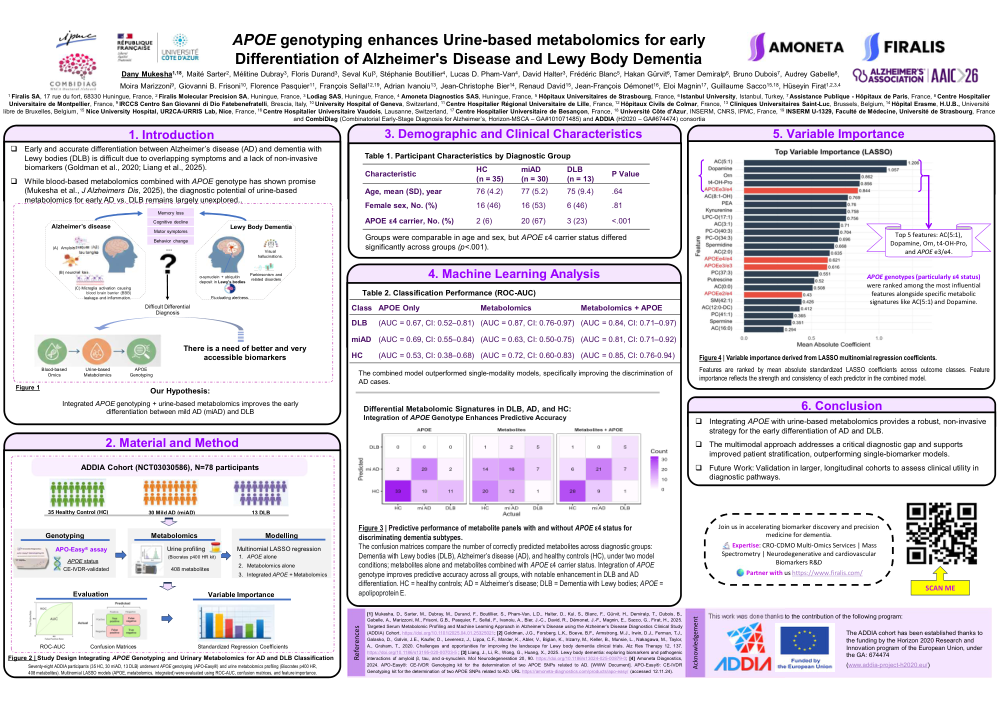
APOE Genotyping Enhances Urine-based Metabolomics For Early Differentiation Of Alzheimer's Disease And Lewy Body Dementia
Poster Presenter
Part of Topic
APOE Genotyping Enhances Urine-based Metabolomics for Early Differentiation of Alzheimer's Disease and Lewy Body Dementia
Dany Mukesha1,2,3, Mélitine Dubray2, Floris Durand2, Stéphanie Boutillier1, David Halter2, ADDIA CONSORTIUM Members, Guillaume Sacco3,4, Hüseyin Firat1,2.
1Firalis SA, Huningue, France, 2Lodiag SA, Huningue, France, 3University of Cote d'Azur, Nice, France, 4IPMC – Institut de Pharmacologie Moléculaire et Cellulaire, Nice, France.
Background: Accurate early diagnosis of Alzheimer’s disease (AD) and dementia with Lewy bodies (DLB) is hindered by overlapping symptoms and the lack of standardized, non-invasive biomarkers 1,2. Prior serum-based metabolomics studies, including our recent work (Mukesha et al., J Alzheimers Dis, 2025; Mukesha et al., Alzheimers Dement, 2025), demonstrated the utility of metabolic profiling combined with APOE genotype for distinguishing AD from healthy controls and DLB. However, urinary biomarkers and their integration with APOE for direct mild AD versus DLB differentiation remain unexplored. This study evaluated whether integrating APOE genotyping with urine metabolomics improves early differentiation between AD and DLB.
Methods: Seventy-eight participants from the ADDIA cohort (ClinicalTrials.gov NCT03030586) were included: 35 healthy controls (HC), 30 mild AD (miAD), and 13 DLB. APOE genotyping was performed for all participants using the CE-IVDR–validated APO-Easy® assay. In parallel, urine samples were profiled using the Biocrates AbsoluteIDQ® p400 HR kit, targeting 408 metabolites. Multinomial LASSO regression models were developed using APOE alone, metabolomics alone, and a combined multimodal approach. One-vs-rest classification was applied to assess discrimination for each diagnostic group. Performance was evaluated via ROC-AUC and confusion matrices, and feature importance was derived from standardized regression coefficients.
Results: Participant characteristics are summarized in Table 1. Groups were similar in age (mean 76 ± 5.7 y) and sex (49% female), whereas APOE ε4 carrier status differed significantly across groups (23% in DLB, 67% in miAD, 6% in HC; p<.001). Up to 100 urinary metabolites passed quality control and were included in modeling. The combined APOE–metabolomics model achieved the highest classification performance, outperforming either modality alone (Table 2). Incorporation of APOE markedly improved discrimination between miAD and DLB and reduced misclassification of early AD cases. APOE ε4 carrier status ranked among the top predictive features, alongside several lipid species. Metabolomics alone showed limited ability to separate AD from DLB, and APOE alone lacked sufficient discriminatory power, highlighting the need for multimodal approaches and demonstrating their utility in separating these types of dementias (Figure 1).
Conclusion: This finding underscores the added value of integrating urinary metabolomics with APOE genotyping, goes beyond single-modality biomarkers, offering a non-invasive strategy toward accurate early-differentiation of AD and DLB. The combined model could inform future biomarker development and patient stratification strategies, enhancing predictive performance well suited for clinical translation. Future studies will focus on larger, longitudinal cohorts and external validation.
Table 1. Participant Characteristics by Diagnostic Group
|
Characteristic |
DLB (n = 13) |
miAD (n = 30) |
HC (n = 35) |
P Value |
|
Age, mean (SD), years |
75 (9.4) |
77 (5.2) |
76 (4.2) |
.64 |
|
Female sex, No. (%) |
6 (46) |
16 (53) |
16 (46) |
.81 |
|
APOE ε4 carrier, No. (%) |
3 (23) |
20 (67) |
2 (6) |
<.001 |
Data are presented as mean (SD) or number (%). P values were calculated using one-way ANOVA for age and χ² tests for categorical variables. APOE ε4 carrier status was defined as the presence of at least one ε4 allele. DLB indicates dementia with Lewy bodies; miAD, mild Alzheimer’s disease; HC, healthy controls.
Table 2: Classification Performance (ROC-AUC)
|
Class |
Metabolomics |
Metabolomics + APOE |
APOE Only |
|
HC |
(AUC = 0.72, CI: 0.60-0.83) |
(AUC = 0.85, CI: 0.76-0.94) |
(AUC = 0.53, CI: 0.38–0.68) |
|
miAD |
(AUC = 0.63, CI: 0.50-0.75) |
(AUC = 0.81, CI: 0.71–0.92) |
(AUC = 0.69, CI: 0.55–0.84) |
|
DLB |
(AUC = 0.87, CI: 0.76-0.97) |
(AUC = 0.84, CI: 0.71–0.97) |
(AUC = 0.67, CI: 0.52–0.81) |
This table presents the Area Under the Curve (AUC) values along with 95% confidence intervals (CI) for the classification of three clinical groups: healthy controls (HC), mild Alzheimer's disease (miAD), and dementia with Lewy bodies (DLB). The performance is compared across three models: using only metabolomics data, using metabolomics data combined with APOE genotype, and using APOE genotype alone.
Figure 1. Variable importance derived from LASSO multinomial regression coefficients. Top 25 features ranked by mean absolute standardized LASSO coefficients across outcome classes. Feature importance reflects the strength and consistency of each predictor in the combined model.
References:
1. Liang J, Li R, Wong G, et al. Lewy body dementia: exploring biomarkers and pathogenic interactions of amyloid β, tau, and α-synuclein. Mol Neurodegeneration 2025; 20: 90.
2. Goldman JG, Forsberg LK, Boeve BF, et al. Challenges and opportunities for improving the landscape for Lewy body dementia clinical trials. Alz Res Therapy 2020; 12: 137.
Comments
Email is required but is not shown publicly.
Loading comments...