4,068 posters, 219 videos, 101 topics, 69 sessions, 14,365 authors, 6,128 institutions
ePostersLive by SciGen Technologies S.A. All rights reserved.
Alzheimer's Association International Conference 2026
July 12-15, 2026 | London, United Kingdom, and Online

10969
Beyond ‘Hispanic/latino’: Self-reported Race And Genetic Ancestry In The Redlat Latin American Cohort
Poster Presenter
Part of Topic
Introduction: People living in Latin America and the Caribbean are often grouped into a single "Hispanic/Latino" race/ethnicity category in research and public health surveys. However, this classification may obscure substantial variation in genetic ancestry, which can influence disease risk and other biomedical outcomes. We examined global ancestry proportions across self-reported US Census race/ethnicity categories among participants from six Latin American countries
(Mexico, Colombia, Peru, Chile, Argentina, and Brazil) enrolled in the ReDLat study. Participants included healthy controls (HC) and individuals diagnosed
with Alzheimer's disease (AD), frontotemporal dementia (FTD), or other neurodegenerative diseases. We also analyzed the ancestry composition
associated with local race/ethnicity self-identifications used in each country.
Methods: Blood samples were collected from all participants. DNA extraction and genotyping were performed at the HudsonAlpha Institute for Biotechnology, and
genotype quality control was conducted at the University of California, Santa Barbara. Participants self-reported the US Census race/ethnicity category with
which they most closely identified and also completed open-ended race and ethnicity fields to describe their identity using their own terms. Global genetic
ancestry proportions were estimated using the 1000 Genomes Project reference populations. Descriptive statistics were used to characterize the
study population. Linear regression models were fitted separately for each global ancestry component, using participants who self-reported as
Hispanic/Latino as the reference group. Differences in ancestry proportions among participants who self-identified with other US Census race/ethnicity
categories were estimated relative to the Hispanic/Latino reference group. Statistical significance was assessed using a two-sided significance threshold
of p < 0.05.
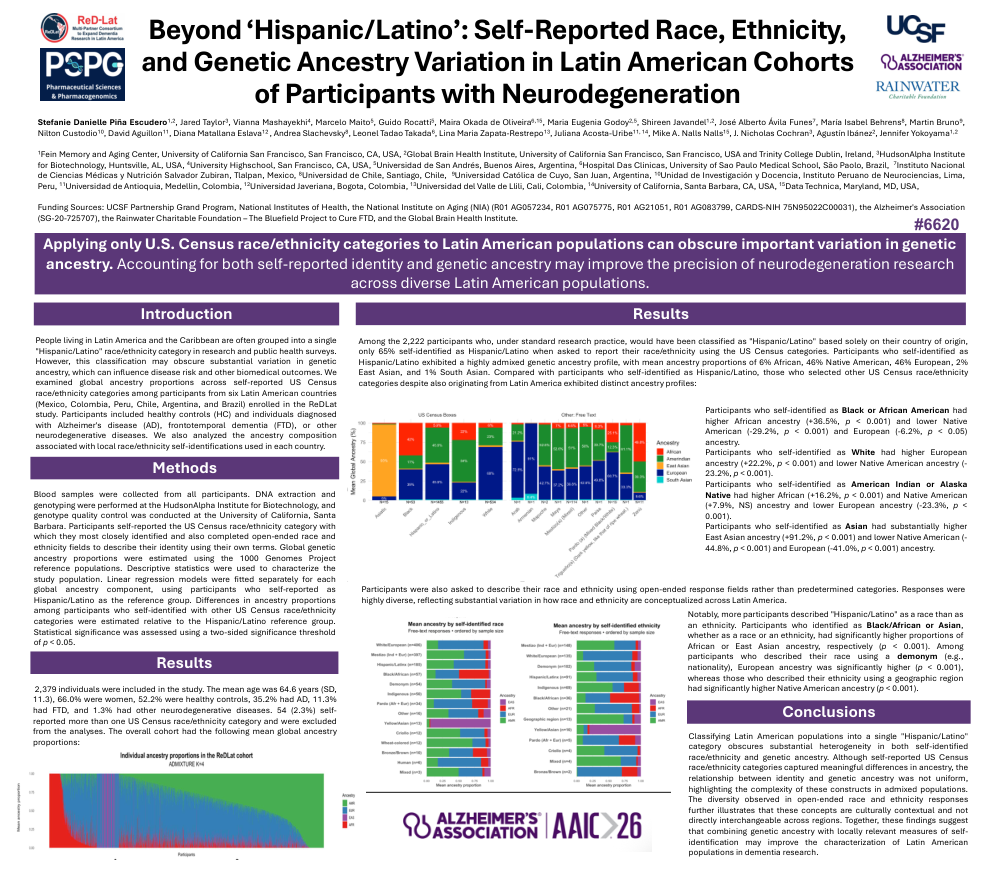
Results: 2,379 individuals were included in the study. The mean age was 64.6 years (SD, 11.3), 66.0% were women, 52.2% were healthy controls, 35.2% had AD, 11.3% had FTD, and 1.3% had other neurodegenerative diseases. 54 (2.3%) selfreported more than one US Census race/ethnicity category and were excluded
from the analyses. Among the 2,222 participants who, under standard research practice, would have been classified as "Hispanic/Latino" based solely on their country of origin, only 65% self-identified as Hispanic/Latino when asked to report their race/ethnicity using the US Census categories. Participants who self-identified as Hispanic/Latino exhibited a highly admixed genetic ancestry profile, with mean ancestry proportions of 6% African, 46% Native American, 46% European, 2% East Asian, and 1% South Asian. Compared with participants who self-identified as Hispanic/Latino, those who selected other US Census race/ethnicity categories despite also originating from Latin America exhibited distinct ancestry profiles Participants who self-identified as Black or African American had
higher African ancestry (+36.5%, p < 0.001) and lower Native American (-29.2%, p < 0.001) and European (-6.2%, p < 0.05) ancestry.
Participants who self-identified as White had higher European ancestry (+22.2%, p < 0.001) and lower Native American ancestry (- 23.2%, p < 0.001). Participants who self-identified as American Indian or Alaska Native had higher African (+16.2%, p < 0.001) and Native American (+7.9%, NS) ancestry and lower European ancestry (-23.3%, p <0.001). Participants who self-identified as Asian had substantially higher East Asian ancestry (+91.2%, p < 0.001) and lower Native American (- 44.8%, p < 0.001) and European (-41.0%, p < 0.001) ancestry.
Conclusions: Classifying Latin American populations into a single "Hispanic/Latino" category obscures substantial heterogeneity in both self-identifiedrace/ethnicity and genetic ancestry. Although self-reported US Census race/ethnicity categories captured meaningful differences in ancestry, the relationship between identity and genetic ancestry was not uniform, highlighting the complexity of these constructs in admixed populations. The diversity observed in open-ended race and ethnicity responses further illustrates that these concepts are culturally contextual and not directly interchangeable across regions. Together, these findings suggest that combining genetic ancestry with locally relevant measures of selfidentification may improve the characterization of Latin American populations in dementia research.
Comments
Email is required but is not shown publicly.
Loading comments...