4,068 posters, 219 videos, 101 topics, 69 sessions, 14,365 authors, 6,128 institutions
ePostersLive by SciGen Technologies S.A. All rights reserved.
Alzheimer's Association International Conference 2026
July 12-15, 2026 | London, United Kingdom, and Online

4942
Induction Of Alzheimer Pathology Modulates Transcriptomic Profile In A Non-human Primate
Part of Topic
Induction of Alzheimer pathology modulates transcriptomic profile in a non-human primate
L. Garcia1,2,*, L. Dupuis1,2,* S. Lam2, F. Petit2, JL. Picq1,2, D. Boche3, G. Piton4, C.Derbois5, E.Bonnet5, H. Hirbec6 and M. Dhenain1,2
1 U1195 Neuro-Bicêtre, Kremlin Bicêtre, FR
2 Commissariat à l’Energie Atomique et aux Energies Alternatives (CEA), Direction de la Recherche Fondamentale (DRF), Institut François Jacob, MIRCen, Fontenay aux roses, FR
3 University of Southampton, UK
4 Commissariat à l’Energie Atomique et aux Energies Alternatives (CEA), Direction de la Recherche Fondamentale (DRF), Institut François Jacob, DRCM, Fontenay aux roses, FR
5 Commissariat à l’Energie Atomique et aux Energies Alternatives (CEA), Direction de la Recherche Fondamentale (DRF), Institut François Jacob, CNRGH, Evry, FR
6 Institut de Génomique Fonctionnelle: Montpellier, Occitanie, FR
* These two authors participated equally to the work.
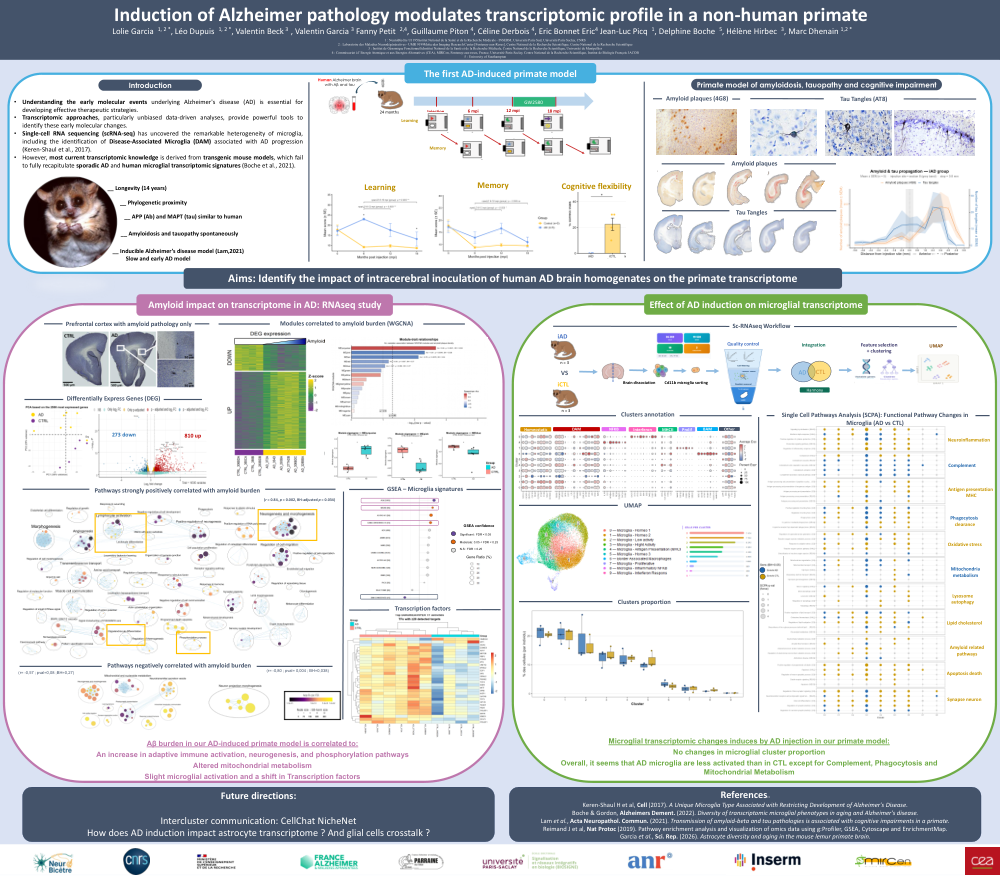
Background: Understanding the early molecular events underlying Alzheimer’s disease (AD) remains a major challenge for the development of effective therapeutic strategies. Transcriptomic approaches can reach this goal using a data-driven approach. For example, single-cell RNA sequencing has revealed heterogeneous microglial landscape, including Disease-Associated Microglia (DAM; Keren-Shaul, 2017) associated to AD progression. However, current data-driven knowledge largely relies on transgenic mouse models that poorly recapitulate sporadic AD and human transcriptomic signatures (Boche, 2021). The AD-induced mouse lemur primate model relies on intracerebral inoculation of AD brain extracts. It recapitulates key features of human AD, including amyloid and tau pathology, neurodegeneration, and cognitive decline (Lam, 2021). The aim of the present study was to investigate early transcriptomic and microglial changes associated with amyloid and tau pathology induction in this primate.
Methods:
Animals were intracerebrally injected with human AD brain extracts (iAD1, n=12; iAD2 n=10) or control brain extracts (iCTL1, n=6, iCTL2, n=5). Animals were sacrificed 18 months or 21 months post-injection. One brain hemisphere was used for immunohistochemistry, while the other was processed for bulk transcriptomic in frontal cortex or for single-cell RNA sequencing of isolated microglia (Fig. 1). Behavioral tests were conducted every six months to evaluate cognitive performance.
Results: The AD-induced mouse lemur model recapitulated key features of human AD, including amyloid and tau pathology and cognitive deficits. Bulk transcriptomic analyses indicated that Aβ burden was associated with activation of adaptive immune responses, neurogenesis-related pathways, protein phosphorylation, and altered mitochondrial metabolism. Single-cell RNA sequencing enabled characterization of microglial states in AD animals, revealing a complex and heterogeneous microglial landscape composed of 10 distinct clusters, including Homeostatic microglia, Proliferative microglia, Interferon Response Microglia, Inflammatory NF-kB microglia, Antigen Presentation Microglia and Border Associated Macrophages. AD microglia are enriched in pathways related to complement, phagocytosis and mitochondria metabolism.
Conclusion:
Our work identifies novel molecular pathways activated in response to amyloid pathology and reveals specific microglial responses in a model closely reflecting human AD.
Comments
Email is required but is not shown publicly.
Loading comments...