4,068 posters, 219 videos, 101 topics, 69 sessions, 14,365 authors, 6,128 institutions
ePostersLive by SciGen Technologies S.A. All rights reserved.
Alzheimer's Association International Conference 2026
July 12-15, 2026 | London, United Kingdom, and Online

10546
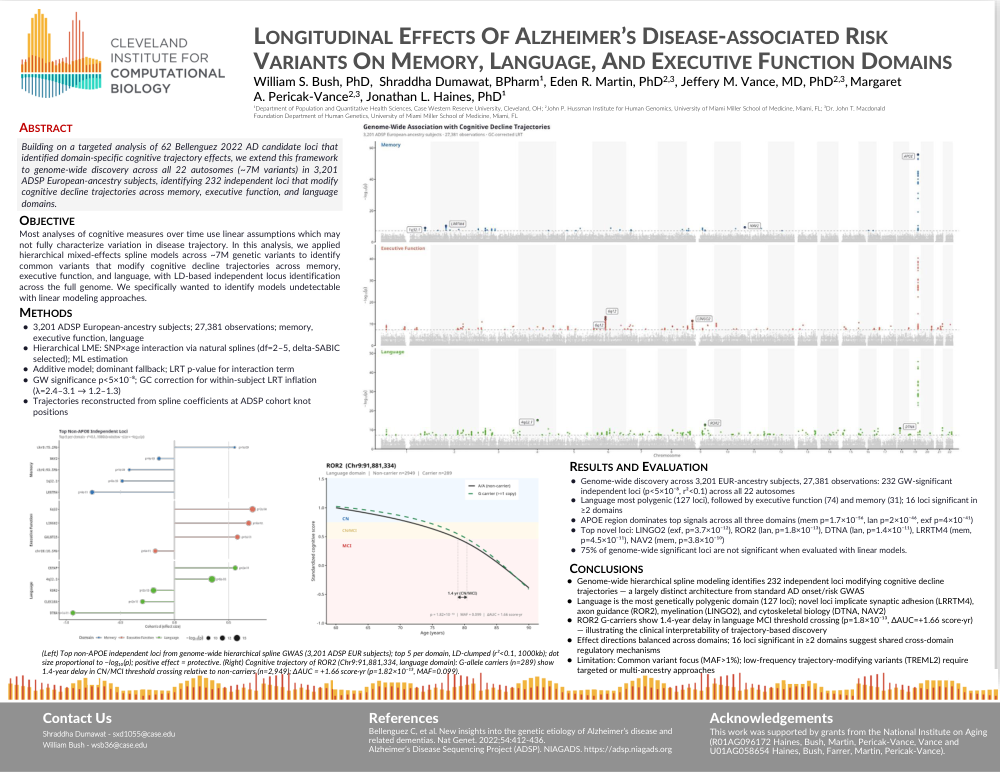
Longitudinal Effects Of Alzheimer’s Disease-associated Risk Variants On Memory, Language, And Executive Function Domains
Poster Presenter
Part of Topic
LONGITUDINAL EFFECTS OF ALZHEIMER’S DISEASE-ASSOCIATED RISK VARIANTS ON MEMORY, LANGUAGE, AND EXECUTIVE FUNCTION DOMAINS William S. Bush, PhD, Shraddha Dumawat, BPharm¹, Eden R. Martin, PhD2,3, Jeffery M. Vance, MD, PhD2,3,Margaret A. Pericak-Vance2,3, Jonathan L. Haines, PhD¹ ¹Department of Population and Quantitative Health Sciences, Case Western Reserve University, Cleveland, OH; ²John P. Hussman Institute for Human Genomics, University of Miami Miller School of Medicine, Miami, FL; ³Dr. John T. Macdonald Foundation Department of Human Genetics, University of Miami Miller School of Medicine, Miami, FL
ABSTRACT
Building on a targeted analysis of 62 Bellenguez 2022 AD candidate loci that identified domain-specific cognitive trajectory effects, we extend this framework to genome-wide discovery across all 22 autosomes (~7M variants) in 3,201 ADSP European-ancestry subjects, identifying 232 independent loci that modify cognitive decline trajectories across memory, executive function, and language domains.
OBJECTIVE
Most analyses of cognitive measures over time use linear assumptions which may not fully characterize variation in disease trajectory. In this analysis, we applied hierarchical mixed-effects spline models across ~7M genetic variants to identify common variants that modify cognitive decline trajectories across memory, executive function, and language, with LD-based independent locus identification across the full genome. We specifically wanted to identify models undetectable with linear modeling approaches.
Comments
Email is required but is not shown publicly.
Loading comments...