4,068 posters, 219 videos, 101 topics, 69 sessions, 14,365 authors, 6,128 institutions
ePostersLive by SciGen Technologies S.A. All rights reserved.
Alzheimer's Association International Conference 2026
July 12-15, 2026 | London, United Kingdom, and Online

9081
ErbB4 P.R927Q Mutant Mice Develop Features Of Frontotemporal Dementia And Amyotrophic Lateral Sclerosis
Poster Presenter
Authors
Part of Topic
Session Title: [In-Person Poster] Basic Science and Pathogenesis: Genetics
Session Date & Time*: Jul. 15 7:30 AM - Jul. 15 4:15 PM, *British Summer Time UK (GMT+1)
Presentation Title: ErbB4 p.R927Q Mutant Mice Develop Features of Frontotemporal Dementia and ALS.
Location: Exhibit Hall
Poster Number: Wednesday-0110
Demetri D. Spyropoulos, Dorea P. Jenkins, Brittany T. Ivey, Eric Hamlett, Dariusz Pytel, Steven L. Carroll
Department of Pathology & Laboratory Medicine, Medical University of South Carolina, Charleston, SC 29425
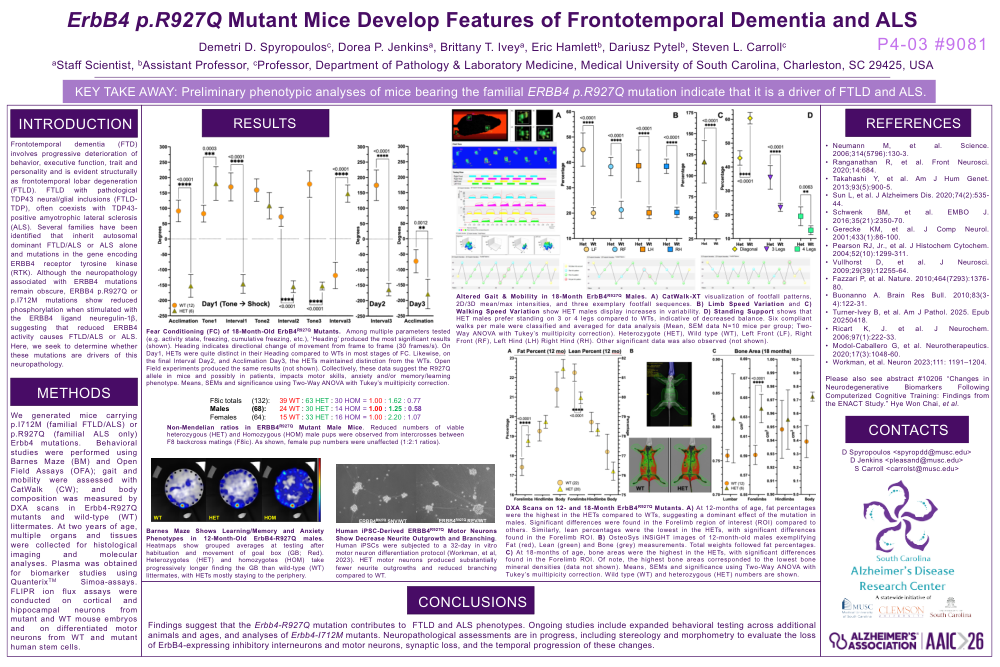
Background: Frontotemporal dementia (FTD) involves deterioration of behavior, executive function, personality/traits and frontotemporal lobar degeneration (FTLD). FTLD with TDP43-positive inclusions (FTLD-TDP), frequently coexists with amyotrophic lateral sclerosis (ALS), which is also marked by TDP-43 pathology. Individuals carrying mutations in the ERBB4 gene develop autosomal dominant FTLD/ALS or ALS alone. ERBB4 variants p.R927Q or p.I712M demonstrate reduced phosphorylation in response to neuregulin-1β stimulation, suggesting that impaired ERBB4 signaling contributes to pathogenesis of FTLD/ALS or ALS. Determining the neuropathological changes associated with ERBB4 mutations is our goal.
Methods: We generated mice carrying p.I712M (familial FTLD/ALS) or p.R927Q (familial ALS only) Erbb4 mutations. Behavioral studies were performed using Barnes Maze (BM) and Open Field Assays (OFA); gait and mobility were assessed with CatWalk (CW); and body composition was measured by DXA scans in Erbb4-R927Q mutants and wild-type (WT) littermates. At two years of age, multiple organs and tissues were collected for histological imaging and molecular analyses. Plasma was obtained for biomarker studies using QuanterixTM Simoa-assays. FLIPR ion flux assays were conducted on cortical and hippocampal neurons from mutant and WT mouse embryos and on differentiated motor neurons from WT and mutant human stem cells.
Results: Mutant mice took longer to find the goal box in the Barnes Maze (BM) and remained closer to the perimeters in BM and Open Field Assay (OFA), indicating impaired spatial learning and increased anxiety. CW analysis (six compliant walks per animal) showed lower hindlimb paw-print intensities and altered gait in mutants. DXA scans showed reduced lean mass in heterozygotes compared to wild-type mice, particularly in the limbs. Human ERBB4-R927Q motor neurons show decreased neuronal length/branching. Histopathological analysis of mouse tissues revealed phenotypes in brain regions and sciatic nerves, with the most pronounced changes in the gastrocnemius muscles of heterozygotes.
Conclusion: Findings suggest that Erbb4-R927Q mutations contribute to FTLD and ALS phenotypes. Further studies are ongoing, including expanded behavioral testing across additional animals and ages, and analyses of Erbb4-I712M mutants. Neuropathological assessments are in progress, including stereology and morphometry to evaluate the loss of ErbB4-expressing inhibitory interneurons and motor neurons, synaptic loss, and the temporal progression of these changes.
Comments
Email is required but is not shown publicly.
Loading comments...