4,068 posters, 219 videos, 101 topics, 69 sessions, 14,365 authors, 6,128 institutions
ePostersLive by SciGen Technologies S.A. All rights reserved.
Alzheimer's Association International Conference 2026
July 12-15, 2026 | London, United Kingdom, and Online

3660
Epigenetic Drift Does Not Dictate Cognitive Fate: Reframing Biological Aging Through Cognitive Reserve
Poster Presenter
Authors
Part of Topic
Epigenetic Drift Does Not Dictate Cognitive Fate: Reframing Biological Aging Through Cognitive Reserve
Author: Rocío Mesa Martínez, Javier Tejada García, Belén Clavera de la Gándara, Julia Francesca Barrutia Yovera.
Neurology, Complejo Asistencial Universitario de León (CAULE), León, Spain.
Abstract:
Background:
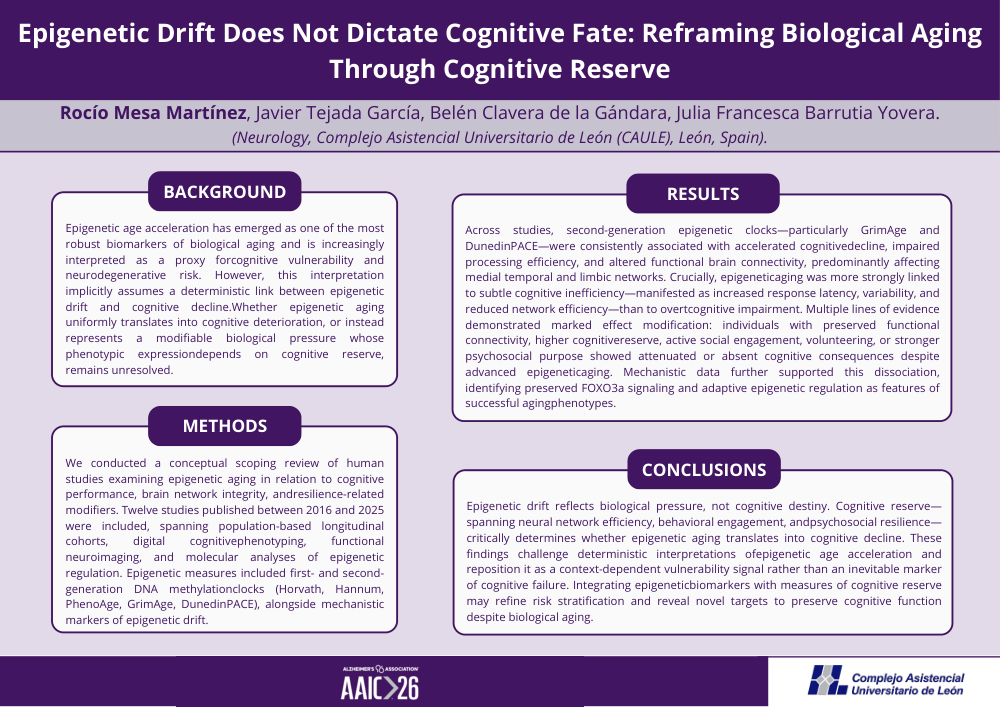
Epigenetic age acceleration has emerged as one of the most robust biomarkers of biological aging and is increasingly interpreted as a proxy forcognitive vulnerability and neurodegenerative risk. However, this interpretation implicitly assumes a deterministic link between epigenetic drift and cognitive decline.Whether epigenetic aging uniformly translates into cognitive deterioration, or instead represents a modifiable biological pressure whose phenotypic expressiondepends on cognitive reserve, remains unresolved.
Methods:
We conducted a conceptual scoping review of human studies examining epigenetic aging in relation to cognitive performance, brain network integrity, andresilience-related modifiers. Twelve studies published between 2016 and 2025 were included, spanning population-based longitudinal cohorts, digital cognitivephenotyping, functional neuroimaging, and molecular analyses of epigenetic regulation. Epigenetic measures included first- and second-generation DNA methylationclocks (Horvath, Hannum, PhenoAge, GrimAge, DunedinPACE), alongside mechanistic markers of epigenetic drift.
Results:
Across studies, second-generation epigenetic clocks—particularly GrimAge and DunedinPACE—were consistently associated with accelerated cognitivedecline, impaired processing efficiency, and altered functional brain connectivity, predominantly affecting medial temporal and limbic networks. Crucially, epigeneticaging was more strongly linked to subtle cognitive inefficiency—manifested as increased response latency, variability, and reduced network efficiency—than to overtcognitive impairment. Multiple lines of evidence demonstrated marked effect modification: individuals with preserved functional connectivity, higher cognitivereserve, active social engagement, volunteering, or stronger psychosocial purpose showed attenuated or absent cognitive consequences despite advanced epigeneticaging. Mechanistic data further supported this dissociation, identifying preserved FOXO3a signaling and adaptive epigenetic regulation as features of successful agingphenotypes.
Conclusion:
Epigenetic drift reflects biological pressure, not cognitive destiny. Cognitive reserve—spanning neural network efficiency, behavioral engagement, andpsychosocial resilience—critically determines whether epigenetic aging translates into cognitive decline. These findings challenge deterministic interpretations ofepigenetic age acceleration and reposition it as a context-dependent vulnerability signal rather than an inevitable marker of cognitive failure. Integrating epigeneticbiomarkers with measures of cognitive reserve may refine risk stratification and reveal novel targets to preserve cognitive function despite biological aging.
Comments
Email is required but is not shown publicly.
Loading comments...