4,068 posters, 219 videos, 101 topics, 69 sessions, 14,365 authors, 6,128 institutions
ePostersLive by SciGen Technologies S.A. All rights reserved.
Alzheimer's Association International Conference 2026
July 12-15, 2026 | London, United Kingdom, and Online

1061
Investigating Sex Differences In Polygenic Risk For Sex-biased Brain Disorders: Impacts On Diagnosis And Brain Age Gap
Poster Presenter
Authors
Arielle Crestol, Dennis van der Meer, Nadine Parker, Ann-Marie G de Lange, Espen Hagen, Hannah Oppenheimer, Stener Nerland, Edith Breton, Christian K. Tamnes, Ole A. Andreassen, Ingrid Agartz, Claudia Barth
Affiliations
Queen Mary University of London, UK, Diakonhjemmet Hospital, Oslo, Norway, Oslo University Hospital, Oslo, Norway, Université du Québec à Chicoutimi Saguenay, Canada, University of Oslo, Norway, Charité - Universitätsmedizin Berlin, Germany
Part of Topic
Investigating Sex Differences In Polygenic Risk For Sex-biased Brain Disorders: Impacts On Diagnosis And Brain Age Gap
WHAT WE KNOW
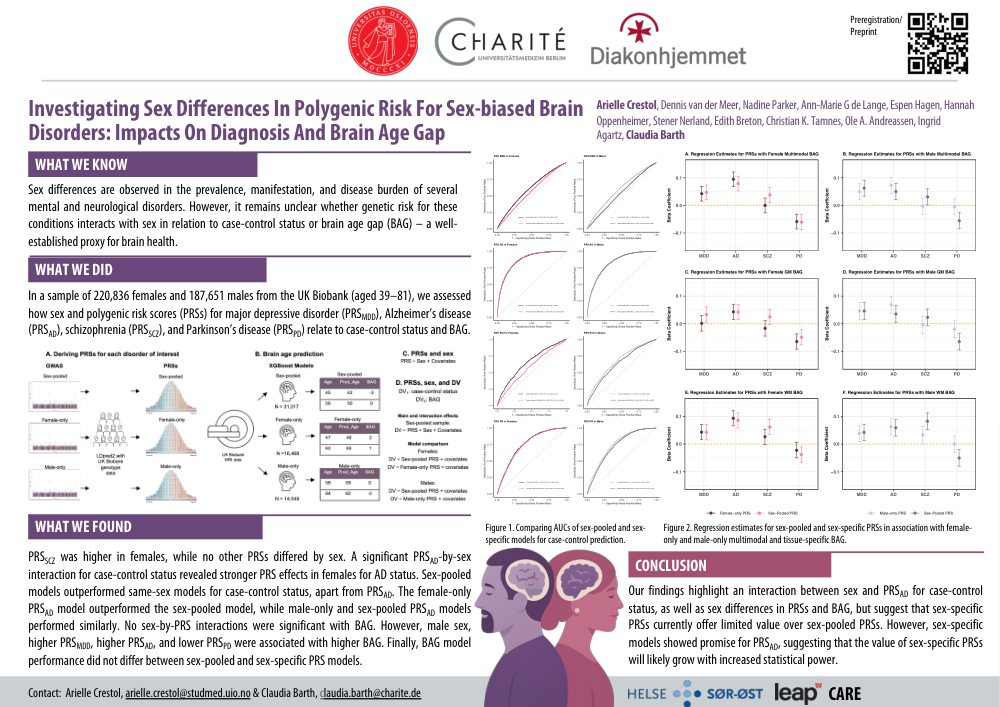
Sex differences are observed in the prevalence, manifestation, and disease burden of several mental and neurological disorders. However, it remains unclear whether genetic risk for these conditions interacts with sex in relation to case-control status or brain age gap (BAG) – a well-established proxy for brain health.
WHAT WE DID
In a sample of 220,836 females and 187,651 males from the UK Biobank (aged 39–81), we assessed how sex and polygenic risk scores (PRSs) for major depressive disorder (PRSMDD), Alzheimer’s disease (PRSAD), schizophrenia (PRSSCZ), and Parkinson’s disease (PRSPD) relate to case-control status and BAG.
WHAT WE FOUND
PRSSCZ was higher in females, while no other PRSs differed by sex. A significant PRSAD-by-sex interaction for case-control status revealed stronger PRS effects in females for AD status. Sex-pooled models outperformed same-sex models for case-control status, apart from PRSAD. The female-only PRSAD model outperformed the sex-pooled model, while male-only and sex-pooled PRSAD models performed similarly. No sex-by-PRS interactions were significant with BAG. However, male sex, higher PRSMDD, higher PRSAD, and lower PRSPD were associated with higher BAG. Finally, BAG model performance did not differ between sex-pooled and sex-specific PRS models.
CONCLUSION
Our findings highlight an interaction between sex and PRSAD for case-control status, as well as sex differences in PRSs and BAG, but suggest that sex-specific PRSs currently offer limited value over sex-pooled PRSs. However, sex-specific models showed promise for PRSAD, suggesting that the value of sex-specific PRSs will likely grow with increased statistical power.
Comments
Email is required but is not shown publicly.
Loading comments...