4,068 posters, 219 videos, 101 topics, 69 sessions, 14,365 authors, 6,128 institutions
ePostersLive by SciGen Technologies S.A. All rights reserved.
Alzheimer's Association International Conference 2026
July 12-15, 2026 | London, United Kingdom, and Online

10363
Blood And Brain Cell Type Specific Dna Methylation Signatures In Alzheimer's Disease
Poster Presenter
Authors
Yiyi Ma, Dolly Reyes-Dumeyer, Clifton Dalgard, Badri Vardarajan, Richard Mayeux
Affiliations
1. Center for Translational and Computational Neuroimmunology, Department of Neurology, Columbia University Irving Medical Center, New York, NY; 3. G.H. Sergievsky Center, Vagelos College of Physicians and Surgeons, Columbia University, New York, New York, USA; 4. Department of Neurology, Vagelos College of Physicians and Surgeons, Columbia University, New York Presbyterian Hospital, New York, New York, USA, 2. Taub Institute for Research on Alzheimer's Disease and the Aging Brain, Vagelos College of Physicians and Surgeons, Columbia University, New York, New York, USA; 3. G.H. Sergievsky Center, Vagelos College of Physicians and Surgeons, Columbia University, New York, New York, USA; 4. Department of Neurology, Vagelos College of Physicians and Surgeons, Columbia University, New York Presbyterian Hospital, New York, New York, USA;, 5. The American Genome Center, Uniformed Services University – “America’s Medical School”, Bethesda, MD, USA, 2. Taub Institute for Research on Alzheimer's Disease and the Aging Brain, Vagelos College of Physicians and Surgeons, Columbia University, New York, New York, USA; 3. G.H. Sergievsky Center, Vagelos College of Physicians and Surgeons, Columbia University, New York, New York, USA; 4. Department of Neurology, Vagelos College of Physicians and Surgeons, Columbia University, New York Presbyterian Hospital, New York, New York, USA
Part of Topic
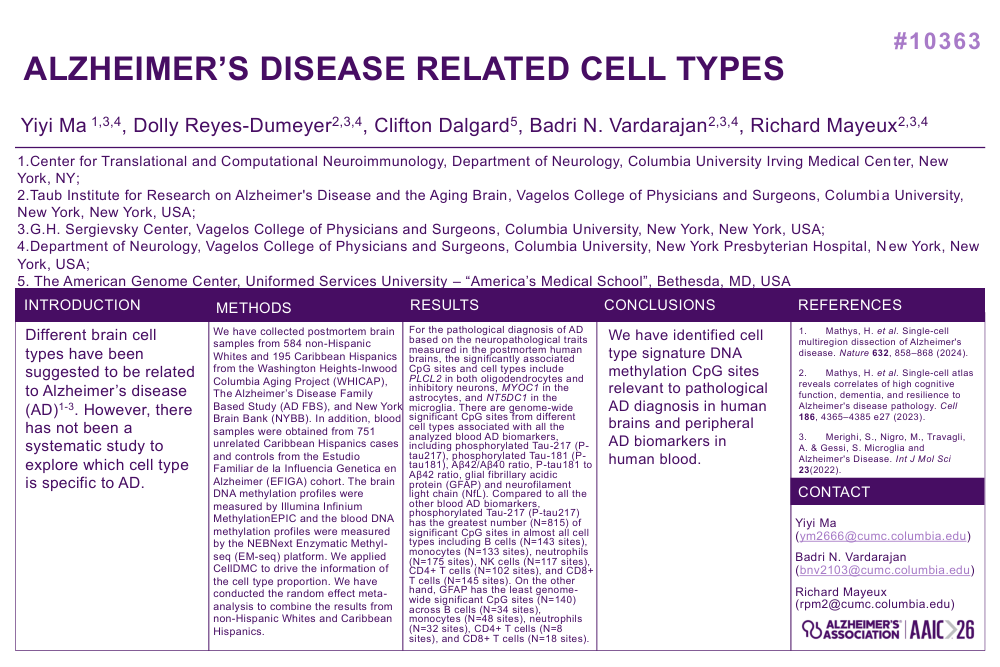
Backgrounds: Different brain cell types have been suggested to be related to Alzheimer’s disease (AD). However, there has not been a systematic study to explore which cell type is specific to AD.
Methods: We have collected postmortem brain samples from 584 non-Hispanic Whites and 195 Caribbean Hispanics from the Washington Heights-Inwood Columbia Aging Project (WHICAP), The Alzheimer’s Disease Family Based Study (AD FBS), and New York Brain Bank (NYBB). In addition, blood samples were obtained from 751 unrelated Caribbean Hispanics cases and controls from the Estudio Familiar de la Influencia Genetica en Alzheimer (EFIGA) cohort. The brain DNA methylation profiles were measured by Illumina Infinium MethylationEPIC and the blood DNA methylation profiles were measured by the NEBNext Enzymatic Methyl-seq (EM-seq) platform. We applied CellDMC to drive the information of the cell type proportion. We have conducted the random effect meta-analysis to combine the results from non-Hispanic Whites and Caribbean Hispanics.
Results: For the pathological diagnosis of AD based on the neuropathological traits measured in the postmortem human brains, the significantly associated CpG sites and cell types include PLCL2 in both oligodendrocytes and inhibitory neurons, MYOC1 in the astrocytes, and NT5DC1 in the microglia. There are genome-wide significant CpG sites from different cell types associated with all the analyzed blood AD biomarkers, including phosphorylated Tau-217 (P-tau217), phosphorylated Tau-181 (P-tau181), Aβ42/Aβ40 ratio, P-tau181 to Aβ42 ratio, glial fibrillary acidic protein (GFAP) and neurofilament light chain (NfL). Compared to all the other blood AD biomarkers, phosphorylated Tau-217 (P-tau217) has the greatest number (N=815) of significant CpG sites in almost all cell types including B cells (N=143 sites), monocytes (N=133 sites), neutrophils (N=175 sites), NK cells (N=117 sites), CD4+ T cells (N=102 sites), and CD8+ T cells (N=145 sites). On the other hand, GFAP has the least genome-wide significant CpG sites (N=140) across B cells (N=34 sites), monocytes (N=48 sites), neutrophils (N=32 sites), CD4+ T cells (N=8 sites), and CD8+ T cells (N=18 sites).
Conclusions: We have identified cell type signature DNA methylation CpG sites relevant to pathological AD diagnosis in human brains and peripheral AD biomarkers in human blood.
Comments
Email is required but is not shown publicly.
Loading comments...