4,068 posters, 219 videos, 101 topics, 69 sessions, 14,365 authors, 6,128 institutions
ePostersLive by SciGen Technologies S.A. All rights reserved.
Alzheimer's Association International Conference 2026
July 12-15, 2026 | London, United Kingdom, and Online

4041
Environmental Epigenetic Effects Of Social Isolation And Their Transgenerational Transmission In Drosophila Melanogaster
Poster Presenter
Authors
Christine Gierke, Martina Morales, Carlos F. Navarro, Walthers Diaz-Gierke, Ignacio Salinas, Aracelly Vergara, Millaray Pizarro, Vicente Iturriaga, Rocio Diaz, Javiera Palma, Francisco Del Pino
Affiliations
1-Neurology & Neurosurgery Service Clinical Hospital University of Chile; 2- Social Isolation Research Center (SIRC), Santiago Chile; 3- School of Psychology Diego Portales University (UDP), Santiago Chile; 4- ISOFLY Lab, NiBG Biomedical Sciences Institute (ICBM), Faculty of Medicine University of Chile., Social Isolation Research Center (SIRC), Santiago Chile; ISOFLY Lab, NiBG Biomedical Sciences Institute (ICBM) Faculty of medicine, University of Chile., School of Psychology Adolfo Ibañez University, Santiago Chile; Social Isolation Research Center (SIRC), Santiago Chile; ISOFLY Lab, NiBG Biomedical Sciences Institute (ICBM) Faculty of medicine, University of Chile., Pontifical Catholic University (PUC), Neurosciences Program, Santiago Chile; Social Isolation Research Center (SIRC), Santiago Chile; ISOFLY Lab, NiBG Biomedical Sciences Institute (ICBM) Faculty of medicine, University of Chile.
Part of Topic
Poster Title: Environmental Epigenetic Effects of Social Isolation and Their Transgenerational Transmission in Drosophila Melanogaster
Poster Number: #4041
Authors: Gierke, C., Morales, M., Navarro, C.F., Diaz-Gierke, W., Valderrama, A., Vergara, A., Salinas, I., Pizarro, M., Iturriaga, V., Diaz, R., Palma, J., & Del Pino, F.
Poster Summary
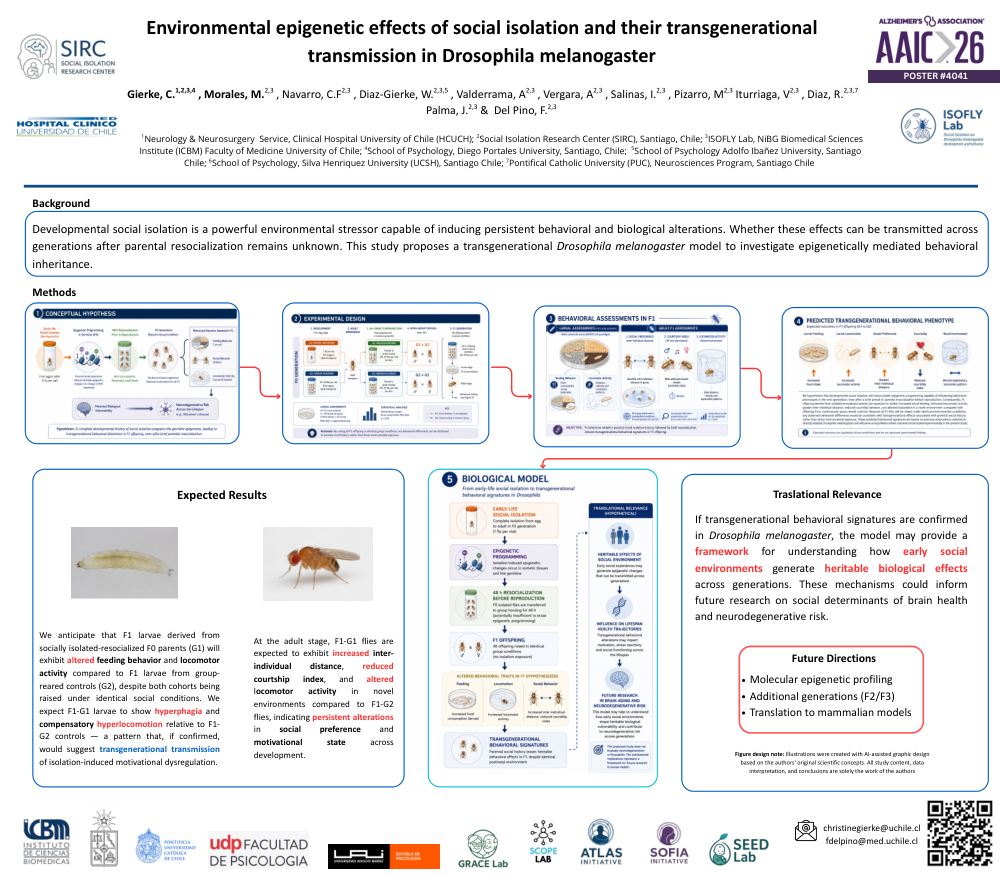
Background: Developmental social isolation is a powerful environmental stressor capable of inducing persistent behavioral and biological alterations. However, whether these detrimental effects can be transmitted across generations after parental resocialization remains unknown. This study proposes a transgenerational Drosophila melanogaster model to investigate epigenetically mediated behavioral inheritance and its long-term implications for neurodegenerative vulnerability.
Methods: The study utilizes a non-mammalian experimental framework where parental generations (F0) are subjected to developmental social isolation and subsequently resocialized before mating. Their unisolated offspring (F1 generation) are evaluated longitudinally. Key behavioral traits, including feeding motivation (hyperphagia) and locomotor activity, are tracked at the larval stage, followed by adult assays assessing inter-individual distance, courtship index, and exploration in novel environments.
Expected Outcomes: It is hypothesized that F1 larvae stemming from isolated-resocialized parents (G1) will exhibit significant alterations, such as hyperphagia and compensatory hyperlocomotion, compared to F1 controls from group-reared parents (G2), despite both cohorts being raised under identical social environments. In adulthood, the F1-G1 flies are expected to display increased inter-individual distance and reduced courtship indices.
Conclusions & Future Directions: Confirming these patterns will demonstrate a clear transgenerational behavioral signature of social isolation, proving that early-life social stress induces an inheritable epigenetic debt. This research establishes a crucial translational foundation for future molecular epigenetic profiling and mammalian translation, offering a novel paradigm to understand how ancestral social deprivation acts as a non-genetic risk factor that accelerates neurodegenerative biology and Alzheimer's disease progression.
Email: christinegierke@uchile.cl | fdelpino@med.uchile.cl
Comments
Email is required but is not shown publicly.
Loading comments...